Capital readiness: connect runway to the next credible evidence package
Recent industry financing data show why an aggregate recovery does not remove the need for company-level capital discipline.
ClarusBIOTECH REVIEWRead, listen & keep
Narrated by Hermione. Save the audio for offline listening.
View figure data and uncertainty
| Measure | Reported value |
|---|---|
| Total biotech financing | 68.5 |
| Venture capital | 20.6 |
| Late-stage venture capital | 10 |
Executive perspective
An industry financing rebound can improve the backdrop for biotechnology without making capital uniformly available. A company still needs a clear account of what the next financing will accomplish, which uncertainty it will reduce, and what happens if the expected result changes. Value Inflection Engineering connects that account to an executable evidence plan.
This white paper uses a recent business-research snapshot to frame the distinction between aggregate capital and individual readiness. Its proposed planning method is an editorial framework, not a forecast of financing availability or a recommendation about securities.
Published evidence and scope
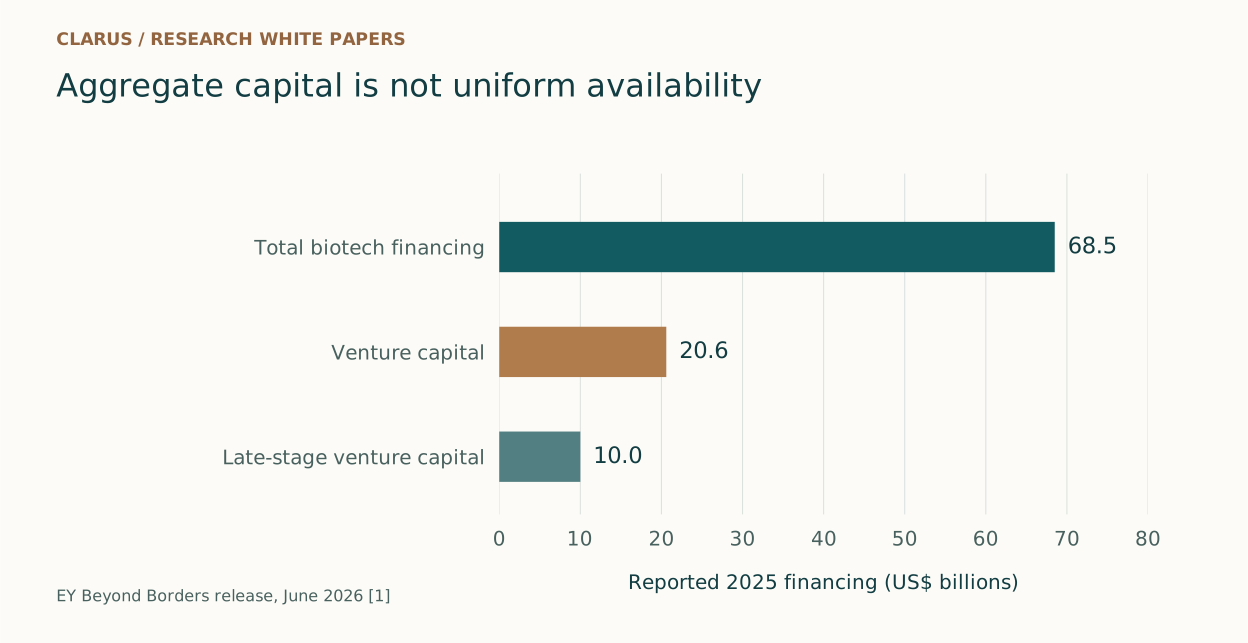
EY’s June 2026 Beyond Borders release reports US$68.5 billion in biotech financing in 2025 and US$20.6 billion in venture capital. Late-stage venture deals accounted for US$10 billion; EY described a tilt toward later-stage assets. These are industry aggregates with different scopes, not funds available to any one company. [1]
S&P Global’s separate analysis of 2024 private-equity and venture-capital transactions reported a weak year on its definitions. The comparison is a reminder that geography, transaction type, timing, and methodology need reconciliation before combining financing statistics. [2]
Clarus analysis: organize the capital story around evidence
Start with the next decision-enabling package, then work backward to the resources required. The package should describe the intended result, how it will be interpreted, and which development choices it can support. A financing narrative that only lists activities leaves reviewers to infer whether those activities will produce a consequential answer.
Separate committed resources from assumptions. Identify work that is contracted, work that depends on a future study start or supply arrangement, and work that depends on a further financing event. This makes the operating plan easier to inspect and prevents a milestone date from appearing more certain than its dependencies allow.
Build outcome scenarios around the program rather than the fundraising headline. Consider a supportive result, a result that requires revision, and a result that undermines the original thesis. Each scenario should show the next evidence need, the action available, and the resource consequence. A credible plan can explain adaptation without pretending every outcome is favorable.
The capital narrative should also match the evidence record. Keep the core claim consistent across the board materials, partner discussions, and operating plan. If the evidence changes the intended population or product profile, update the financing rationale as well. Alignment is a practical form of readiness: it reduces the work a reviewer must do to understand the program.
A practical capital-readiness packet
Prepare a concise packet containing the milestone charter, resource plan, dependency map, scenario response, and the key unresolved issue. Use dates only where there is a reasoned path to them. Explain which assumptions would move the timeline and which commitments are reversible.
The review should end by identifying the next decision and who can make it. Financing is one way to enable progress; partnership, scope adjustment, or a different sequencing choice may be relevant in a particular case. The framework does not presume that a larger capital raise is always the best response.
Limits and next evidence
The figures are reported industry aggregates mainly for 2025, not current funding offers or company valuations. Venture capital is a subset of financing; late-stage VC is a subset of VC. Company-level planning requires verified cash, commitments, burn assumptions, and the specific evidence needed for its next decision.
From reading to a reviewable decision
| Dimension | Evidence to inspect | Next decision check |
|---|---|---|
| Evidence package | Decision-enabling result and interpretation | Link resources to the actual uncertainty |
| Runway | Verified cash and committed work | Expose assumptions and dependencies |
| Scenario | Supportive, mixed, or unfavorable result | Show the next action and its resource consequence |
Clarus editorial synthesis. This framework is not a validated predictive model.
THE NEXT VALUE INFLECTION
What would change the decision
The figures are reported industry aggregates mainly for 2025, not current funding offers or company valuations. Venture capital is a subset of financing; late-stage VC is a subset of VC. Company-level planning requires verified cash, commitments, burn assumptions, and the specific evidence needed for its next decision.
Editorial record
Prepared by Clarus Biotech Review editorial team. Updated 9/30/2026.
Publication relationship: ClarusReview is connected to BioClarus Consulting. No article-specific sponsorship is recorded.
Report a correctionDiscuss this paper
Share evidence, ask a question, or offer a professional perspective. Community guidelines
Loading discussion…