Inclisiran access: the referral queue behind an infrequent injection
A patient-pathway funnel, starter-dose capacity check and financial threshold show why convenient dosing still needs an operating system.
ClarusBIOTECH REVIEWRead, listen & keep
Narrated by Hermione. Save the audio for offline listening.

A medicine administered infrequently can still require a demanding access system. The critical steps happen between the decision to consider treatment and the completed visit: clinical assessment, coverage verification, patient agreement, appointment availability, inventory and follow-up. Inclisiran is a useful case for examining those handoffs. The question here is operational: where would a fictional clinic invest to improve completed access without equating fewer injections with guaranteed adherence or cardiovascular benefit?
The label defines the workflow, not the throughput
The February 2026 US Leqvio label specifies 284 mg initially, again at three months, and then every six months, administered by a healthcare professional. It describes use to reduce LDL-C in the stated adult and familial-hypercholesterolemia populations and includes serious-hypersensitivity precautions. Eligibility requires the complete current label and individual clinical judgment. [1]
For a new patient starting at month zero, planned visits occur at months zero, three and nine during the first twelve months. The maintenance pattern is every six months afterward. Thus, three first-year visits and two maintenance visits are different operational denominators. Calling the regimen twice yearly without the starter schedule can understate a new cohort’s appointment demand. This calendar observation does not specify what any patient should receive.
The 2020 ORION-10 and ORION-11 publication enrolled 1,561 and 1,617 participants and examined LDL-C lowering. FDA’s December 2021 approval notice also identifies LDL-C as the effect evaluated. These records do not make our referral funnel an observed clinical study or establish its effect on cardiovascular events. [2] [3]
| Item | Documented context | What remains to measure locally |
|---|---|---|
| Regimen | Initial, month 3, then every 6 months [1] | Appointment completion and rescheduling |
| Administration | Healthcare professional [1] | Staff time, site capacity and handling workflow |
| Historical trial cohorts | ORION-10: 1,561; ORION-11: 1,617 [2] | Local referral population and access barriers |
| Economic inputs | No practice-specific payer rate in these records | Actual coverage, allowed amounts and collection time |
Use one referral cohort through every handoff
Assume a fictional US network receives 1,000 distinct adult referrals over six months. This is a planning cohort, not estimated market size. In the baseline case, 80% meet the clinic’s completed clinical-assessment criteria, 75% of those clear its coverage-and-financial-verification step, 80% of that group obtain an appointment, and 90% of scheduled patients complete the initial visit. These probabilities are assumptions about a workflow, not Leqvio utilization statistics.
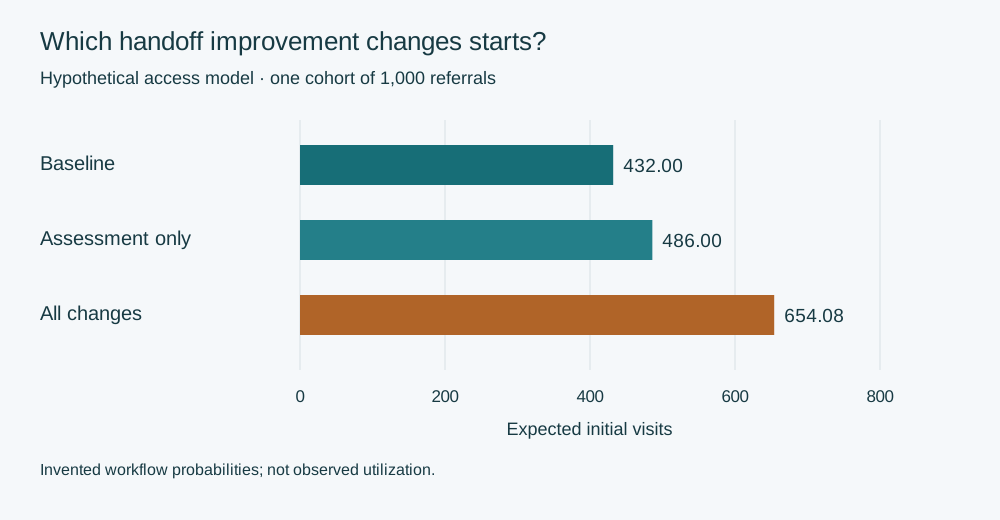
Expected initial visits = referrals × assessment completion × financial clearance × scheduling × attendance. The baseline is 1,000 × 0.80 × 0.75 × 0.80 × 0.90 = 432. We propose a separate improved case using 90%, 85%, 90% and 95%, producing 654.075 expected starts, reported as approximately 654 people. Fractions represent expected values; a real cohort contains whole people.
Clinical appropriateness must remain a clinical decision, not a target manipulated to increase conversion. In this exercise, the assessment step includes unresolved records and incomplete evaluations as well as patients who are not appropriate. A real review must separate those categories. Improving documentation completion is different from broadening treatment eligibility, and it should never be rewarded by an indiscriminate increase in prescribing.
| Step | Baseline expected people | Improved expected people |
|---|---|---|
| Referrals | 1,000 | 1,000 |
| Completed assessment / appropriate to proceed | 800 (80%) | 900 (90%) |
| Financially cleared | 600 (75% of previous step) | 765 (85% of previous step) |
| Scheduled | 480 (80% of previous step) | 688.5 (90% of previous step) |
| Initial visit completed | 432 (90% of scheduled) | 654.075 (95% of scheduled) |
Prioritize the constraint rather than every percentage
Changing the first probability alone from 80% to 90%, while leaving the other three unchanged, yields 486 expected starts: 54 more than baseline. Changing all four yields about 222 more. The larger result is attractive, but it assumes the downstream system can receive every additional patient. If appointment capacity is fixed, better referral documentation may simply move people from one queue to another.
A consultant should therefore observe the queue before proposing staffing. Sample unresolved referrals and classify the reasons: missing clinical information, a financial question, patient choice, an unavailable appointment or a failed handoff. Record time in each state and whether the case eventually resolves. This proposed method creates a more useful intervention than treating every non-start as an insurance denial or assuming that a reminder fixes every missed visit.
Keep distinct patient choice visible. A patient who declines treatment after an informed discussion is not an operational failure. Reporting should distinguish the offer of a feasible appointment, the decision to accept it, and the completed visit. The proposed funnel is a service-analysis instrument; it is not a prescribing quota or a measure of clinician quality.
Capacity must include the starter cohort
If every baseline starter completes the planned first-year schedule, the cohort requires 1,296 administrations during each patient’s first twelve months. The improved cohort requires 1,962.225 expected administrations, approximately 1,962. These are cohort follow-up totals, not administrations falling inside the six-month referral period or one shared calendar year. They assume no missed follow-up, discontinuation or restart.
Suppose the network dedicates 200 appointment slots per month. Its nominal annual allocation is 2,400 slots, but comparing that number with 1,962 does not prove adequate capacity. Starts cluster, the month-three follow-up follows those clusters, existing patients consume slots, and cancellations may be too late to refill. The operational plan needs a monthly schedule linking new starts and returning patients rather than a single annual subtraction.
For an established maintenance cohort, two annual visits per person would permit at most 1,200 patients within 2,400 slots if every slot were usable and no starter visits competed. That is a theoretical ceiling, not a safe capacity target. Staff absence, inventory problems, longer consultations and other clinic work need separate allowances. The ceiling is useful precisely because it shows what assumptions must be relaxed before making a promise.
| Measure | Definition | Why it changes the decision |
|---|---|---|
| Referral resolution | Resolved referrals / all distinct referrals | Separates missing information from clinical ineligibility |
| Time to feasible offer | Days from completed assessment to available appointment | Locates the scheduling constraint |
| Initial-visit completion | Completed first visits / accepted scheduled first visits | Separates attendance from patient choice |
| Follow-up completion | Completed due visits / visits due in the period | Avoids counting enrolled people as adherent |
| Collection delay | Days from administration to collected payment | Connects service delivery to working capital |
| Unused slot fraction | Unfilled allocated slots / allocated slots | Shows whether more capacity is needed |
A financial threshold without invented reimbursement
Assume a $45,000 six-month coordination project and a fictional $60 contribution per completed administration after medicine acquisition, administration and collection costs. Neither figure is a payer tariff, acquisition price, margin estimate for Leqvio or vendor quote. If all 222.075 incremental expected starters complete three visits, the additional contribution is 222.075 × 3 × $60 = $39,973.50. On those assumptions alone, it does not recover the project cost.
The threshold is $45,000 ÷ (222.075 × 3), or $67.54 contribution per incremental completed administration. Alternatively, at $60 per administration, 250 incremental people completing three visits would be needed. The gap between the modeled 222 and required 250 is a question for the investment committee. It should not be hidden by showing more referrals while leaving the contribution calculation out of the report.
This comparison omits continuing maintenance visits, discounting, overhead changes, capacity investment and clinical value. Those exclusions matter. A project might be justified by a wider service goal even when the narrow six-month spending comparison is negative, but that rationale should be stated explicitly. If a clinic buys inventory before collecting payment, finance must also model the time between purchase, administration and collection. A positive contribution cannot fund cash it has not yet received.
What the next access milestone should establish
The proposed milestone is a tested, patient-respecting pathway: clinically appropriate referrals are resolved, affordable options are explained, feasible appointments are offered, and returning visits can be supported without displacing existing care. Before expanding, compare a pilot workflow against its documented baseline using the same referral definitions and follow-up window. Avoid attributing a change to the intervention when staffing, payer mix or referral criteria changed at the same time.
Read the existing ORION delivery analysis for the scientific endpoint discussion. This paper’s contribution is the referral-to-visit model, starter-capacity calculation and financial threshold. The two should remain distinct canonical articles, linked for context rather than copied into each other.
Sources were checked October 2, 2026 Pacific. This is operating analysis, without independent clinical, reimbursement or practice-management review. All probabilities, costs, capacity and margins are hypothetical; no insurer coverage guarantee, treatment recommendation, real patient record or measured adherence result is claimed. The artwork depicts a fictional clinical setting and generic syringe, not a specific product or recommended preparation procedure.
THE NEXT VALUE INFLECTION
What would change the decision
The proposed milestone is a tested, patient-respecting pathway: clinically appropriate referrals are resolved, affordable options are explained, feasible appointments are offered, and returning visits can be supported without displacing existing care. Before expanding, compare a pilot workflow against its documented baseline using the same referral definitions and follow-up window. Avoid attributing a change to the intervention when staffing, payer mix or referral criteria changed at the same time.
Editorial record
Prepared by Clarus Biotech Review editorial team. Updated 10/3/2026.
Publication relationship: ClarusReview is connected to BioClarus Consulting. No article-specific sponsorship is recorded.
Report a correctionDiscuss this paper
Share evidence, ask a question, or offer a professional perspective. Community guidelines
Loading discussion…