The cancer-vaccine option: finance the evidence before counting the payment
Merck–Moderna’s collaboration provides the timeline; a separate cash model tests option exercise, delay, settlement and the no-payment branch.
ClarusBIOTECH REVIEWRead, listen & keep
Narrated by Hermione. Save the audio for offline listening.

A licensing option is a mechanism for deciding when to commit, not merely a smaller version of a large transaction. Its usefulness depends on whether the agreed evidence arrives before the sponsor runs short of capital, whether the partner can interpret it, and what obligations begin if the option is exercised. The Merck–Moderna cancer-vaccine collaboration illustrates a long evidence and partnering sequence. An emerging company needs its own shorter, cash-explicit decision plan rather than a borrowed headline valuation.
A decade-long sequence, with different types of money
The June 2016 announcement described a $200 million upfront payment supporting research through proof of concept and part of a manufacturing build-out, with a later participation election. In May 2018, the expanded collaboration included a separate $125 million preferred-equity investment. These are different economic categories, not interchangeable licensing proceeds. [1] [2]
On October 12, 2022, Merck announced exercise of the personalized cancer-vaccine option for $250 million, with costs and any profits shared equally. The release preceded the expected fourth-quarter Phase II data announcement. That chronology matters: do not describe the option payment as a reward triggered automatically by a later public result. [3]
The August 19, 2026 company release reported positive topline Phase III INTerpath-001 results in 1,137 patients: the recurrence-free-survival and distant-metastasis-free-survival endpoints were met, while the trial continued for other endpoints including overall survival. Detailed presentation and regulatory discussions were planned. This is a sponsor announcement concerning an investigational therapy, not a final approval or a complete numerical efficacy dossier. [4]
| Date | Event / amount | Interpretive limit |
|---|---|---|
| June 2016 | $200 million announced upfront [1] | Research funding and a future election; not approval |
| May 2018 | $125 million preferred-equity investment [2] | Equity capital; separate from licensing fees |
| October 2022 | $250 million option exercise announced [3] | Shared future costs/profits; not all future value |
| August 2026 | Phase III topline report; 1,137 enrolled [4] | Sponsor report; no approval claim or imported Phase II effect size |
Translate the sequence into a decision architecture
For Value Inflection Engineering, the important object is the evidence package that makes the next commitment rational. It should identify the question being retired, the data required, what remains uncertain and who has authority to decide. An option can align that package with a payment and a work-sharing transition, but it cannot make an ambiguous result unambiguous.
The publicly filed 2018 amended agreement includes separate exhibits covering proof-of-concept plans, economic effects of non-participation or cessation, confidential CMC review, technology transfer, patent matters and supply terms. Some content is redacted. Its structure demonstrates the range of operating issues to investigate, without letting a reader infer the undisclosed terms. [5]
A contemporary data room should make those issues navigable. Organize scientific claims alongside the experiments that support them, connect manufacturing claims to comparability and supply evidence, and attach ownership and dependencies to each unresolved item. A prospective partner should not need to reconstruct the project from a polished slide deck and disconnected files. The next financing discussion should use the same evidence map so that the commercial narrative and cash request describe one program.
A hypothetical cash plan for a smaller company
Assume an emerging US biotech has $18 million of unrestricted cash at the start of a ten-month evidence program. Base operating burn is $1 million per month, and a separate $4 million evidence work package is incurred before the decision. There are no existing debt payments or other income in this simplified case. All amounts are nominal 2026 USD and wholly fictional; they are not Moderna’s spending or the partners’ current economics.
Cash before an option payment = opening cash − base burn × elapsed months − evidence cost. At month ten, the balance is $18 million − $10 million − $4 million = $4 million. A three-month delay reduces it to $1 million. A four-month delay leaves zero. That arithmetic explains why a desirable milestone can still be poorly financed: the company must be able to reach the decision without relying on a receipt whose occurrence is conditional.
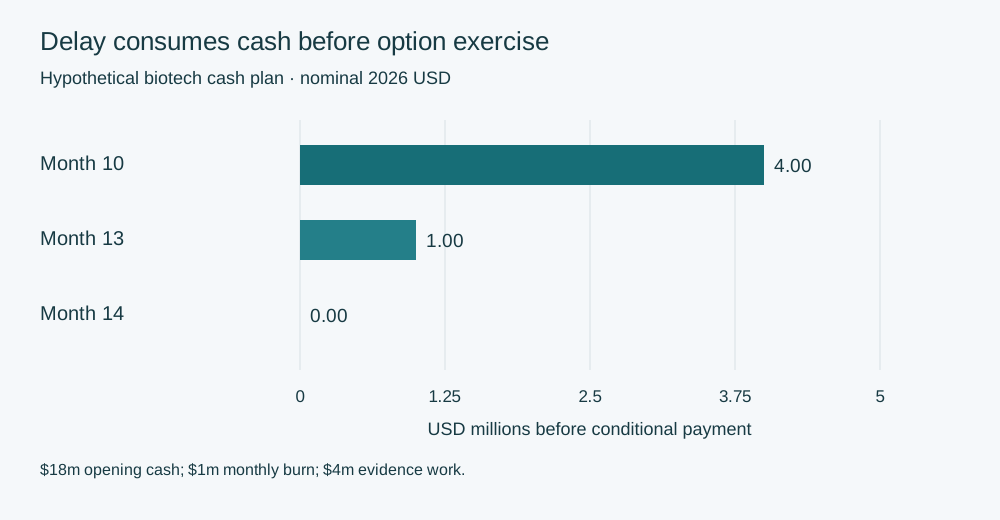
| Decision month | Cash before payment | Cash if $12m option pays immediately |
|---|---|---|
| 10 | $4m | $16m |
| 13 | $1m | $13m |
| 14 | $0m | $12m |
The third column is a conditional scenario, not available liquidity. Assume a fictional $12 million option fee is paid only if the partner elects to proceed, and afterward the company funds $0.6 million per month plus a one-time $3 million transition cost. An on-time payment gives ($16 million − $3 million) ÷ $0.6 million = 21.67 months of modeled post-transition runway. If the decision slips to month thirteen, the comparable figure becomes ($13 million − $3 million) ÷ $0.6 million = 16.67 months.
Even these figures assume receipt at the decision date. If there is a two-month settlement interval after a month-thirteen decision, the company cannot finance that interval from its $1 million balance at the assumed $1 million monthly pre-payment burn. The existence of a positive post-payment case does not bridge a pre-payment cash shortfall. Payment conditions, invoicing, settlement timing and permitted interim spending belong in the capital plan.
Expected cash is not a solvency test
Suppose management assigns a 60% probability to exercise. Multiplying that belief by the $12 million fee gives $7.2 million of expected payment. This is an invented probability-weighted amount, not cash, a market valuation or an empirically estimated likelihood. The downside branch still receives nothing. A financial plan that adds $7.2 million to the bank balance has erased the very failure case the option is designed to preserve.
At month ten, non-exercise leaves $4 million. If the board protects a $1 million wind-down reserve, only $3 million remains for ongoing work: three months at the original burn before reaching the reserve. At month thirteen, the balance already equals that reserve. The decision therefore needs an earlier contingency trigger, not simply a promise to seek another partner after an adverse result. This model does not assume an actual company could close financing within the available time.
Define the contingency while the program is still running: a narrower evidence package, a paused discretionary campaign, an alternative financing process or an orderly stop. Cost reductions can themselves require cash and time. Do not count a future partner, bridge or asset sale until the required transaction is realistically executable and its proceeds are available. Showing this limitation does not diminish the scientific opportunity; it makes the operating choices reviewable.
| Workstream | Question before the election | Measure / accountable owner |
|---|---|---|
| Evidence | What result is sufficient, equivocal or adverse? | Complete interpretable package / clinical lead |
| Manufacturing | Can the next study receive evidence-consistent supply? | Unresolved transfer dependencies / CMC |
| IP and rights | What rights, obligations and third-party permissions are needed? | Unresolved diligence items / counsel |
| Payment | When can money actually be collected? | Decision-to-cash interval / finance |
| Governance | Who can approve continuation or a stop? | Decision deadlines and delegated authority / board |
| Downside | Can the no-payment branch be executed safely? | Cash above reserve / CEO and finance |
Negotiate around evidence, responsibilities and time
For a fictional negotiation, distinguish an automatically payable milestone from a discretionary election. A milestone may have a specified evidence condition; an option preserves a choice. The board should know which one it is discussing and what work remains unfunded if the other party declines. This is a commercial-analysis distinction, not an interpretation of any undisclosed clause or legal advice on a particular agreement.
Translate the next commitment into work packages. If a partner funds clinical work but the biotech retains supply obligations, reduced headline burn may hide material manufacturing expenditure. If the agreement requires transfer to another site, include preparation, qualification, personnel and the timing of acceptance. A scientific success may expand obligations immediately while the payment arrives later. A cash curve should show that transition rather than assuming every exercised option lengthens runway.
The diligence dashboard should also expose disagreement. A partner may view an endpoint, assay or manufacturing package differently from the originating company. An explicit unresolved-question register gives both teams a place to define the additional experiment or analysis needed before election. That is more informative than rating all workstreams green on the strength of one encouraging result.
What the 2026 news changes—and what it does not
The recent Phase III announcement gives readers a timely reason to revisit how a long collaboration can sustain development. It does not establish that the original agreement alone caused the result, that another platform will succeed, or that the historical payments are today’s negotiating benchmarks. The published chronology shows successive commitments over years; our scenario tests the narrower problem of reaching one near-term decision with enough liquidity.
For headline decomposition, see the existing deal-structure analysis. This paper focuses instead on optionality, evidence readiness, the no-payment branch and settlement timing. The practical output is a board memo with two cash paths and an explicit stop decision, not a single expected-value number presented as spendable capital.
Sources were checked October 2, 2026 Pacific. Company releases are attributed sponsor statements; redacted contractual details are not reconstructed. All modeled cash, burn, probabilities and runway are invented teaching inputs, excluding tax, financing costs, discounting and correlated development risk. Historical amounts are not inflation-adjusted comparables. This analysis has no independent financial, legal or clinical review and claims no client engagement or investment recommendation. The lead illustration is a fictional dossier and molecular model.
THE NEXT VALUE INFLECTION
What would change the decision
For headline decomposition, see the existing deal-structure analysis . This paper focuses instead on optionality, evidence readiness, the no-payment branch and settlement timing. The practical output is a board memo with two cash paths and an explicit stop decision, not a single expected-value number presented as spendable capital.
Editorial record
Prepared by Clarus Biotech Review editorial team. Updated 10/3/2026.
Publication relationship: ClarusReview is connected to BioClarus Consulting. No article-specific sponsorship is recorded.
Report a correctionDiscuss this paper
Share evidence, ask a question, or offer a professional perspective. Community guidelines
Loading discussion…