Liposomal delivery: when usable yield changes the investment case
Vyxeos provides the clinical anchor; a separate yield and cash-cost model tests whether a manufacturing improvement deserves investment.
ClarusBIOTECH REVIEWRead, listen & keep
Narrated by Bella. Save the audio for offline listening.

A sophisticated carrier is commercially useful only if the team can reproduce the product that generated its evidence. The investment question is therefore two-sided: does the formulation change an important clinical outcome, and can the manufacturing system preserve that advantage at an acceptable cost and delivery cadence? Vyxeos provides a historical example of clinically meaningful co-delivery. It does not provide public factory economics that an emerging developer can simply copy. This analysis separates the observed clinical result from an original, hypothetical yield-improvement decision.
What the historical experiment actually established
In the randomized Phase III study of CPX-351, 309 adults aged 60–75 with newly diagnosed high-risk or secondary acute myeloid leukemia received the liposomal combination or conventional 7+3 chemotherapy. Median overall survival was 9.56 versus 5.95 months; the hazard ratio was 0.69, with a 95% confidence interval of 0.52–0.90. The reported cytarabine:daunorubicin molar ratio was 5:1. Those findings concern this formulation, comparator and population, not liposomes as a class. [1]
The 3.61-month difference between medians is an arithmetic comparison, not the extra life every patient receives. The same publication reports longer blood-count recovery with CPX-351; among patients achieving CR/CRi after initial induction, median neutrophil recovery was 35 versus 29 days. A delivery advantage needs its clinical-management burden beside it. [1]
FDA initially approved Vyxeos on August 3, 2017. The January 2026 label still contains a boxed warning against interchange with other daunorubicin/cytarabine products and specifies product-specific dosing. Its indication includes adults and children aged one year and older with the named AML categories. These are current label boundaries, not an invitation to substitute formulations. [2] [3]
| Dimension | Verified observation | Decision boundary |
|---|---|---|
| Clinical benefit | 9.56 vs 5.95 months; HR 0.69 (95% CI 0.52–0.90) | 309 randomized adults, ages 60–75 [1] |
| Administration identity | Non-interchange warning remains in January 2026 label | Different formulations require their own evidence [3] |
| Manufacturing economics | Commercial batch cost, yield and utilization not established here | Model inputs below are invented planning assumptions |
The carrier creates a product-identity obligation
FDA’s April 2018 final liposome guidance discusses particle size/distribution, encapsulated versus free drug, drug loading, release, stability and manufacturing controls. It warns that scale and manufacturing conditions can affect quality. This is nonbinding guidance; it is not a universal specification or an automatic clinical-bridging waiver. [4]
For a developer, the practical implication is to connect each proposed process change with the property it might alter and the decision that property supports. A cheaper material can be attractive on a purchasing spreadsheet while creating an unanswered comparability question. A larger batch can lower nominal unit cost while extending a hold time or changing the usable output. Management should require a shared scientific and financial change record rather than separate presentations that never reconcile.
Begin that record with the intended product and candidate population. Identify what was used in the experiments supporting the current claims. Then specify the proposed change, the relevant analytical comparison, the operational benefit sought, and the rule for stopping or escalating the project. This is a Clarus governance proposal. The appropriate regulator and program experts must determine what evidence a real change requires.
A yield model that can be challenged
Consider a fictional US development operation in nominal 2026 dollars. One attempted batch has 10,000 nominal vial positions and costs $900,000, including the assumed production and release-testing spend. Let y be the fraction surviving the production process and let r = 98% be the additional fraction released after subsequent quality disposition. Assume distribution costs $40 per released vial. The model deliberately uses vials, not patients, treatment courses or clinical doses.
Released vials = 10,000 × y × r. Delivered cost per released vial = $900,000 ÷ released vials + $40. Here r is conditional on surviving production; it must not be counted again if a real operation’s yield already includes final release. The model assumes the same batch cost, composition, quality and distribution cost across scenarios. Those assumptions create a comparison; they do not establish that a process improvement is achievable.
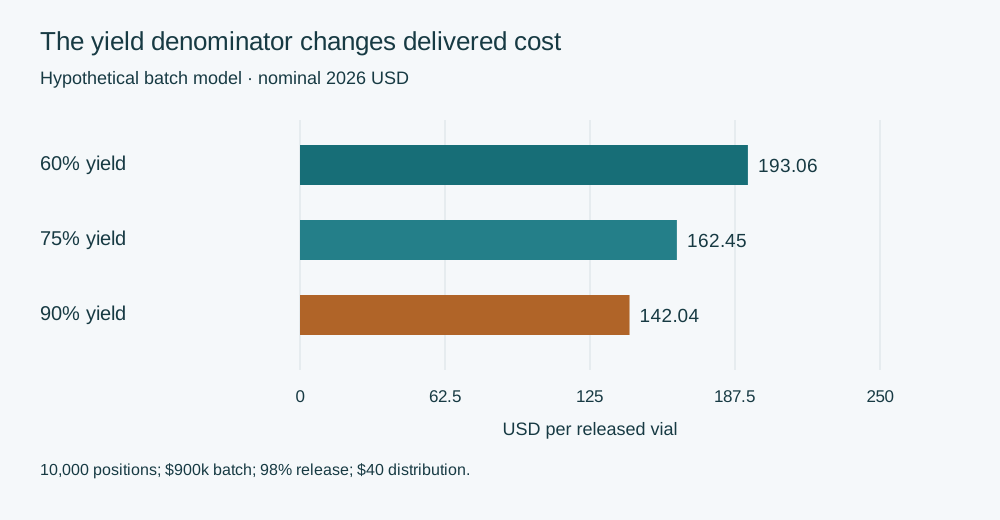
| Process yield | Expected released vials | Delivered cost / released vial |
|---|---|---|
| 60% | 5,880 | $193.06 |
| 75% | 7,350 | $162.45 |
| 90% | 8,820 | $142.04 |
A $240,000 process-improvement project would need approximately 4,704 released vials benefiting from the modeled $51.02 reduction between the 60% and 90% cases to recover its cost. This is an allocation-based threshold: $240,000 ÷ ($193.0612 − $142.0408). It assumes released volume is actually needed and that the cost difference is economically realizable. It is not a forecast of supplier savings, drug price, reimbursement or patient affordability.
That last distinction can reverse the decision. If the operation already has excess inventory and cannot reduce attempted batches, a lower allocated cost may not release cash. Conversely, if lost output forces an additional batch, a yield improvement may eliminate a discrete expenditure. A useful second analysis would schedule the actual number of batches required to meet demand, including whole-batch rounding, shelf life, safety stock and release timing. The smooth chart is an entry point, not a manufacturing plan.
Put time beside the unit-cost calculation
Assume the improvement work occupies 16 calendar weeks: four for method and protocol preparation, eight for engineering work, and four for analysis and disposition. This timetable is fictional and contains no FDA turnaround estimate. The sequence should be replaced with dependency-based dates: the engineering campaign cannot begin until the required methods and materials are available, and a decision cannot be signed before deviations have been resolved.
A management review should ask whether those weeks fit inside the current supply buffer. If validation displaces a committed production slot, include the replacement slot and resulting delivery risk in the business case. Do not value the project only by a theoretical saving on material. A missed clinical supply date may create a different problem from a missed commercial delivery date, and both need a named owner and escalation path.
Track the distribution of release times as well as their median. A process that usually performs quickly but occasionally incurs a long deviation review can be difficult to plan around. Report completed batches and attempted batches separately, and explain whether aborted runs are included. This suggested KPI practice avoids an apparently improving yield that is achieved by silently removing the hardest runs from the denominator.
| Gate | Required decision evidence | KPI / owner |
|---|---|---|
| Analytical identity | Predefined comparison to evidence-generating material | Relevant attribute agreement / CMC |
| Operations | Representative runs and explained loss categories | Released vials per attempted batch / manufacturing |
| Calendar | Supply commitments and change dependencies | Release-time distribution / operations |
| Economics | Demand-linked batches and avoidable costs | Cash saved, not just allocated cost / finance |
| Clinical bridge | Program-specific assessment of meaningful product changes | Unresolved evidence questions / clinical and regulatory |
What would make the investment fail?
The proposal fails its economic purpose if the improvement does not persist outside the engineering campaign, if the chosen yield omits quality losses, or if the resulting extra output cannot be used. It fails a more fundamental test if the change undermines product identity or the evidence bridge. These are scenario failure modes, not allegations about the named historical product or its manufacturer.
Separate technical success from investment success in the final report. The technical objective could be reproducible output meeting predefined criteria. The investment objective could be avoiding a batch, improving supply resilience or reducing cash tied up in inventory. The first does not automatically establish the second. A consultant should show both conclusions, including a technically successful project that remains commercially unattractive at the actual demand level.
Before approving a larger commitment, request the raw batch ledger, cost categories, quality-disposition definitions, demand forecast and change-control rationale. Test at least one pessimistic case: no yield improvement, longer release or lower demand. The decision memo should explain whether the project remains justified, requires a smaller scope or should stop. A bounded negative decision can preserve more capital than an optimistic unit-cost claim.
The value-inflection deliverable
The useful milestone is a reviewable demonstration that a specified process can preserve the evidence-generating product and supply the next program stage. It joins formulation science with an operating calendar and an explicit capital choice. For the broader supply-resilience question, see the second-source investment analysis. This paper instead isolates yield denominators and the economics of usable output.
Sources were checked October 2, 2026 Pacific. Historical observations and label statements are cited; all batch costs, yields, budgets and dates in the consulting exercise are hypothetical. Actual manufacturing yields and costs for Vyxeos are not asserted. This analysis has not received independent clinical or CMC review and does not recommend treatment or a manufacturing specification. The conceptual lead art is fictional and deliberately enlarges a vesicle to show two payloads. No experimental microscopy is represented.
THE NEXT VALUE INFLECTION
What would change the decision
The useful milestone is a reviewable demonstration that a specified process can preserve the evidence-generating product and supply the next program stage. It joins formulation science with an operating calendar and an explicit capital choice. For the broader supply-resilience question, see the second-source investment analysis . This paper instead isolates yield denominators and the economics of usable output.
Editorial record
Prepared by Clarus Biotech Review editorial team. Updated 10/3/2026.
Publication relationship: ClarusReview is connected to BioClarus Consulting. No article-specific sponsorship is recorded.
Report a correctionDiscuss this paper
Share evidence, ask a question, or offer a professional perspective. Community guidelines
Loading discussion…