Liver-chip validation: the evidence and investment gate for a NAM
FDA’s 2026 terminology change, a historical liver-chip benchmark and a transparent error-cost model show what a validation investment must establish.
ClarusBIOTECH REVIEWRead, listen & keep
Narrated by Bella. Save the audio for offline listening.

A liver-chip result becomes investable when the team can explain which decision it changes, how often it could mislead that decision and what it costs to resolve the uncertainty. A persuasive photograph or an attractive sensitivity estimate cannot answer those questions alone. This white paper connects a current FDA terminology change with historical testing evidence and a transparent, hypothetical portfolio model. Its central question is narrow: when is an additional liver-toxicity screen worth validating before a candidate advances?
The policy clock and the scientific clock are different
FDA published its direct final rule on nonclinical testing terminology on September 22, 2026. It specifies February 4, 2027 as the effective date and December 7, 2026 as the comment deadline. Significant adverse comments can trigger withdrawal; as of this October 2 review, the specified effective date is still in the future. The rule broadens terminology without adding new requirements. It does not certify a particular chip or abolish animal evidence across all programs. [1]
The March 2026 FDA document on NAMs is draft guidance, not a final requirement. It organizes validation around intended use, human biological relevance, technical characterization and fitness for the proposed purpose. It also distinguishes validation from formal tool qualification and discusses fit-for-purpose data within a wider evidence package. A sponsor should describe the specific uncertainty the method resolves rather than equating a research publication with regulatory acceptance. [2]
A useful historical benchmark, with an important boundary
Ewart and colleagues reported testing 870 Liver-Chips against 27 benchmark small molecules in 2022. Their protein-binding-adjusted analysis reported 87% sensitivity and 100% specificity when combining two donors; the Results section identifies an 18-drug subset tested in both donors. These are retrospective compound-classification findings, not patient diagnostic accuracy or prospective performance on an unfamiliar pipeline. The chosen decision threshold and donor conditions matter. [3]
The paper also describes a missed toxicity signal for zileuton. Many authors disclosed employment or equity relationships with Emulate. Neither a missed signal nor those relationships erase the evidence, but they strengthen the case for independent transfer and challenge testing. Confidence intervals are not supplied for the headline rates in the cited abstract; this paper does not manufacture them or interpret 100% observed specificity as zero future errors. [3]
Two 2023 corrections deserve attention: January corrected the spheroid specificity entry in Table 5 from 100% to 67%; February replaced erroneous duplicated Table 3 data. We use the updated article and link both notices. This paper does not turn the study’s modeled industry benefit into realized savings for a client. [4] [5]
| Measure | Reported value / cohort | Interpretive boundary |
|---|---|---|
| Total experimental scope | 870 chips; 27 benchmark compounds | Not 870 patients or 870 independent compounds |
| Two-donor analysis | 18 compounds; headline sensitivity 87%, specificity 100% | Protein-binding adjusted; selected benchmark set |
| Publication chronology | December 2022; corrections January/February 2023 | Historical evidence, not a new 2026 trial |
Define the decision before contracting the experiment
For a hypothetical small-molecule developer, the proposed use is an additional screen for a specified liver-injury hazard before a preclinical investment gate. The output may prioritize further investigation, defer a candidate or support a bounded monitoring discussion. It is not an automatic pass/fail judgment on all human safety. The operational owner should document what changes after a positive, negative or inconclusive result; otherwise the assay can generate information that nobody uses.
A consultant could begin with a one-page protocol charter: candidate chemistry and exposure range; reference compounds; donor coverage; blinded classification; repeatability; uncertainty; exclusions; and the escalation owner. Acceptance criteria should be agreed before opening results. Predefine how an indeterminate assay is handled and budget the repeat rather than quietly dropping it from the denominator. These are Clarus operating proposals, not a checklist issued by FDA.
| Gate | Evidence required for the next decision | Owner / measure |
|---|---|---|
| Question | Named hazard and action following each result | Program lead / actionability |
| Exposure | Relevant unbound exposure and assay-interaction review | Toxicology lead / exposure coverage |
| Transfer | Blinded challenge set and repeat runs across relevant conditions | Assay lead / concordance and inconclusive fraction |
| Governance | Escalation rules, deviations, data provenance and uncertainty | Quality lead / complete traceable records |
| Regulatory discussion | Program-specific justification in the total evidence package | Regulatory lead / unresolved questions |
A twelve-week planning exercise, not a vendor quote
Assume a US-based team allocates a nominal 2026 USD $400,000 validation budget over 12 calendar weeks. None of these amounts is a reported vendor price, FDA timetable or actual client expenditure. The allocation is $80,000 for setup and protocol work, $120,000 for materials and testing, $160,000 for staff/analysis and $40,000 for quality review. Weeks 1–2 define the question; weeks 3–6 establish the assay; weeks 7–10 perform blinded repeats; weeks 11–12 finalize analysis and the decision record. Parallel tasks do not guarantee that the investment gate moves earlier.
Track cost per evaluable compound, elapsed weeks to a signed decision, invalid-run fraction, repeat-run concordance, donor coverage and unresolved deviations. Define each denominator. For example, an invalid-run fraction counts invalid runs divided by all attempted runs; a repeatability measure must state whether the unit is a measurement, a chip or a compound classification. Report patient and regulatory outcomes only after actual follow-up, not from the laboratory gate.
Value depends on error costs, not accuracy alone
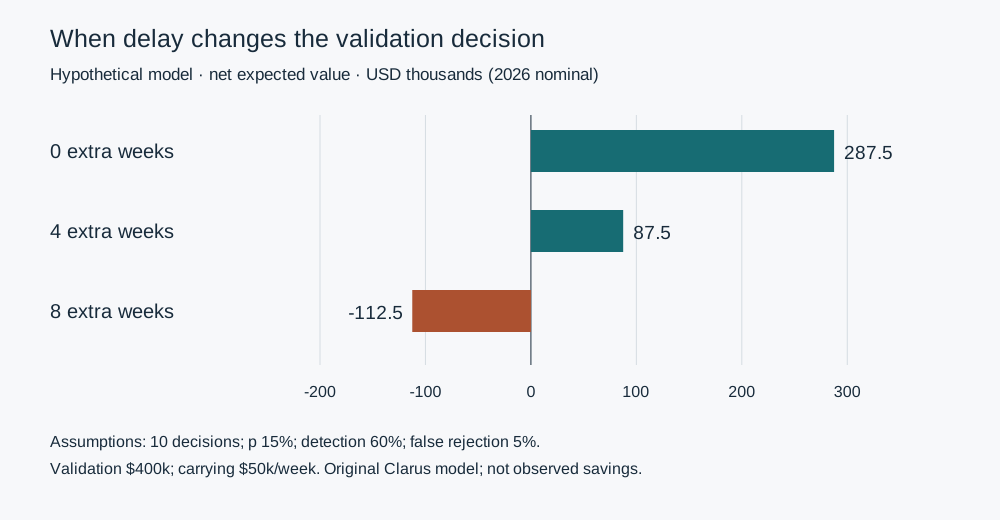
The scenario below evaluates 10 candidate decisions. Let p = 15% be the assumed probability of an actionable hazard remaining after the existing workflow; d = 60% the incremental probability of detecting it in time to act; L = $1,000,000 the downstream cost avoided per detected hazard; f = 5% the probability of wrongly rejecting an otherwise viable candidate; V = $500,000 the assumed opportunity cost of each mistaken rejection; C = $400,000 validation cost; and B = $50,000 incremental weekly carrying cost if the gate is delayed. All inputs are hypothetical. In particular, d is not the published 87% sensitivity.
Expected avoided spend = N × p × d × L = $900,000. Expected false-rejection cost = N × (1 − p) × f × V = $212,500. Net modeled value = avoided spend − false-rejection cost − C − B × additional delay weeks. This is a simple expected-cost comparison, not a clinical forecast, company valuation or discounted cash-flow estimate. Correlated compound risks, inconclusive results and repeated testing would require a richer model.
| Extra gate delay | Net modeled value | Break-even p |
|---|---|---|
| 0 weeks | $287,500 | 10.4% |
| 4 weeks | $87,500 | 13.6% |
| 8 weeks | $-112,500 | 16.8% |
The break-even hazard probability is (C + B × delay + N × f × V) ÷ [N × (d × L + f × V)]. At zero extra delay, it is 10.4%; after eight extra weeks, 16.8%. This threshold asks what belief would justify the proposed spend under the stated error costs. It does not estimate the prevalence of liver injury. At the assumed p of 15%, an eight-week delay turns the calculation negative. Management could reduce the scope, change the timing or seek better evidence before committing; that is more actionable than assuming every new assay must accelerate development.
The next milestone is a bounded, reproducible decision
Value Inflection Engineering treats the deliverable as a decision record: what uncertainty was reduced, which action changed, what remains unresolved and how much capital is now exposed. A positive model output is not permission to bypass a safety package. A negative one is not proof that the technology has no scientific value. The conclusion depends on the specific use, transfer performance and consequences of errors.
For readers who want the platform introduction, see A Human Organ Small Enough for a Chip. For the milestone framework, see Value Inflection Engineering. This paper’s new contribution is the decision/error-cost model and validation budget; it does not repeat those broader treatments.
Method and limitations
Sources were checked October 2, 2026 Pacific. This is editorial analysis with automated source, arithmetic and publication checks; it has not received independent human toxicology or regulatory review. The retrospective study does not establish prospective performance or regulatory qualification. Site analytics and search-demand data were not used. The fictional budget, probabilities and values need replacement with documented program-specific inputs before business use. No real consulting engagement, sponsor-specific acceptance, patient benefit or realized savings is claimed.
THE NEXT VALUE INFLECTION
What would change the decision
Value Inflection Engineering treats the deliverable as a decision record: what uncertainty was reduced, which action changed, what remains unresolved and how much capital is now exposed. A positive model output is not permission to bypass a safety package. A negative one is not proof that the technology has no scientific value. The conclusion depends on the specific use, transfer performance and consequences of errors.
Editorial record
Prepared by Clarus Biotech Review editorial team. Updated 10/3/2026.
Publication relationship: ClarusReview is connected to BioClarus Consulting. No article-specific sponsorship is recorded.
Report a correctionDiscuss this paper
Share evidence, ask a question, or offer a professional perspective. Community guidelines
Loading discussion…