A royalty can finance the next mission—or be sold to fund it sooner
Cystic Fibrosis Foundation venture philanthropy frames a hypothetical royalty-retention and monetization decision.
ClarusBIOTECH REVIEWRead, listen & keep
Narrated by Hermione. Save the audio for offline listening.
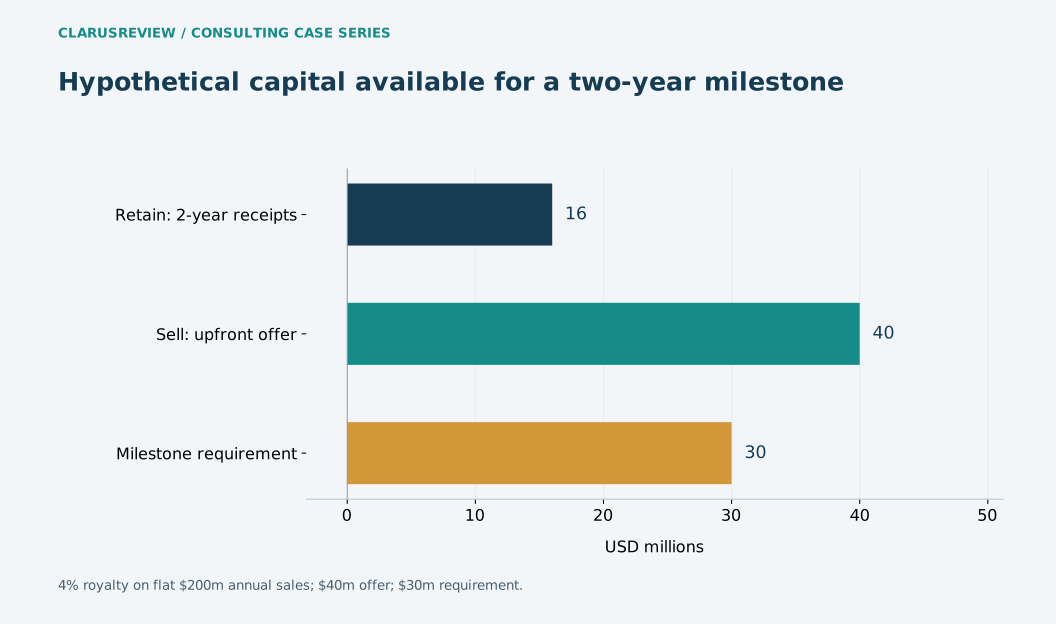
View figure data and context
| Measure | Value |
|---|---|
| Retain: 2-year receipts | 16 |
| Sell: upfront offer | 40 |
| Milestone requirement | 30 |
The consulting assignment
A royalty is both an economic asset and a financing choice. Keeping it preserves future participation; selling it can accelerate work that cannot wait for revenue to accumulate. Value Inflection Engineering asks which capital structure funds the next consequential evidence milestone while keeping the organization’s mission and retained rights coherent.
The documented comparator
In 2014 the Cystic Fibrosis Foundation sold rights to Vertex cystic-fibrosis royalties for $3.3 billion. The foundation describes the transaction within its venture-philanthropy model. The amount is a historical monetization outcome, not a standard multiple for another royalty or proof that any research investment can achieve comparable returns. [1]
The current-news bridge
Vertex’s August 2026 report described continuing portfolio development and commercial investment. It is a current reminder that product revenue, reinvestment and future evidence needs coexist; none fixes the value of an unrelated royalty. [2]
Hypothetical client and numerical assumptions
Assume a fictional patient-focused organization receives a 4% royalty on $200 million annual licensed-product net sales. That produces $8 million annually under a simplified flat-sales model. A buyer offers $40 million cash for the rights. The organization needs $30 million over two years for an unrelated development milestone. These terms and costs are entirely invented.
What the numbers change
Retaining the royalty produces $16 million over the assumed two-year period, leaving a $14 million funding gap before other resources. Selling provides $40 million now and leaves $10 million after the milestone budget, but sacrifices future payments. The timing difference is a genuine financing distinction even when the ultimate value comparison remains uncertain.
At flat sales of $100 million, $200 million and $300 million, annual royalty receipts are $4 million, $8 million and $12 million. Five years of undiscounted receipts equal $20 million, $40 million and $60 million. Discounting, sales ramp, patent life, contract scope and payment risk could change the comparison materially. The $40 million offer is not declared fair merely because it equals five years of the middle scenario.
Partial monetization, borrowing against a royalty or co-funding a milestone could provide other structures. Each carries legal and operating constraints; the consultant should model available options rather than pretend all structures are accessible. Mission alignment includes what evidence is funded, who retains influence and whether the funded program can actually reach its milestone.
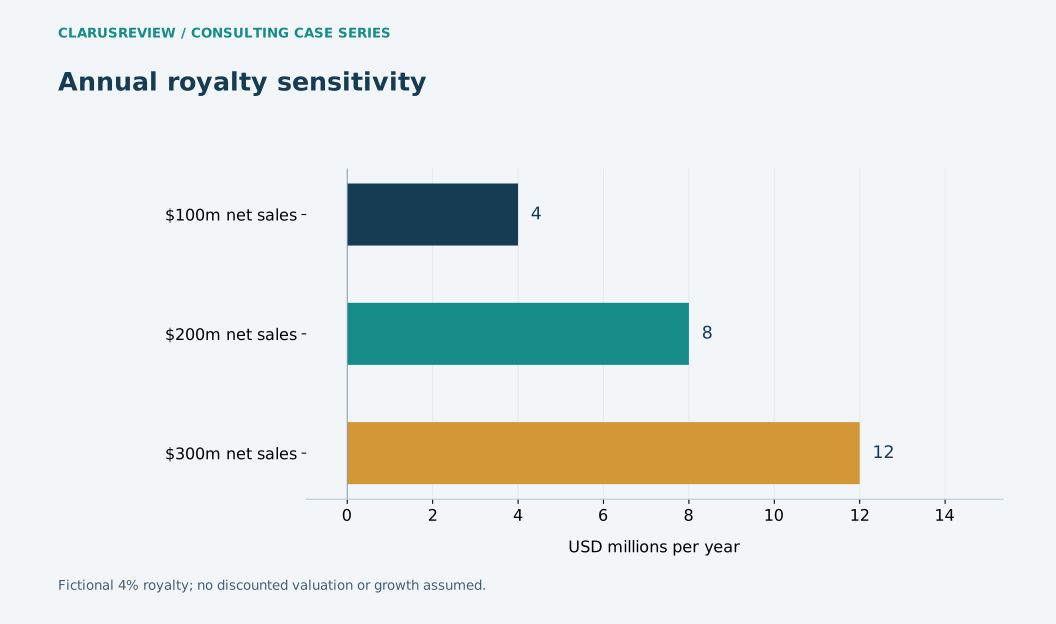
| Scenario | USD millions per year |
|---|---|
| $100m net sales | 4 |
| $200m net sales | 8 |
| $300m net sales | 12 |
The next decision gate
Prepare a rights schedule, sales scenarios, discounted cash-flow review and a timed milestone spending plan. Compare structures on cash available when needed, rights surrendered and downstream flexibility. Release program funding in evidence-linked tranches so immediate liquidity does not substitute for disciplined development.
What to watch next
Watch future product sales, contract adjustments and the cost to reach the next evidence decision. A later commercial success may increase royalty value, but it remains a scenario until realized.
| Workstream | Measure to collect | Decision use |
|---|---|---|
| Rights | Territory, indications, term and royalty base | Identify the exact asset being monetized |
| Timing | Cash receipts versus milestone spending by quarter | Expose the funding gap |
| Mission | Evidence generated per funded tranche | Keep liquidity tied to a consequential result |
Reporting cutoff: October 1, 2026 Pacific. Later outcomes are not assumed. These tools illustrate decisions; they are not validated clinical, legal or investment prediction models.
Royalty-to-milestone bridge
Assumes flat annual net sales and no discounting; not a fair-value appraisal.
Receipts = annual net sales × royalty / 100 × years; funding balance = receipts − $30m.
Changing an input explores a scenario; it does not establish an observed result. Inputs stay in this page and are not submitted.
THE NEXT VALUE INFLECTION
What would change the decision
Prepare a rights schedule, sales scenarios, discounted cash-flow review and a timed milestone spending plan. Compare structures on cash available when needed, rights surrendered and downstream flexibility. Release program funding in evidence-linked tranches so immediate liquidity does not substitute for disciplined development.
Editorial record
Prepared by Clarus Biotech Review editorial team. Updated 10/2/2026.
Publication relationship: ClarusReview is connected to BioClarus Consulting. No article-specific sponsorship is recorded.
Report a correctionDiscuss this paper
Share evidence, ask a question, or offer a professional perspective. Community guidelines
Loading discussion…