A device investment committee needs the sham-control question
SYMPLICITY HTN-3 frames a hypothetical device trial budget, site plan and milestone gate.
ClarusBIOTECH REVIEWRead, listen & keep
Narrated by Hermione. Save the audio for offline listening.
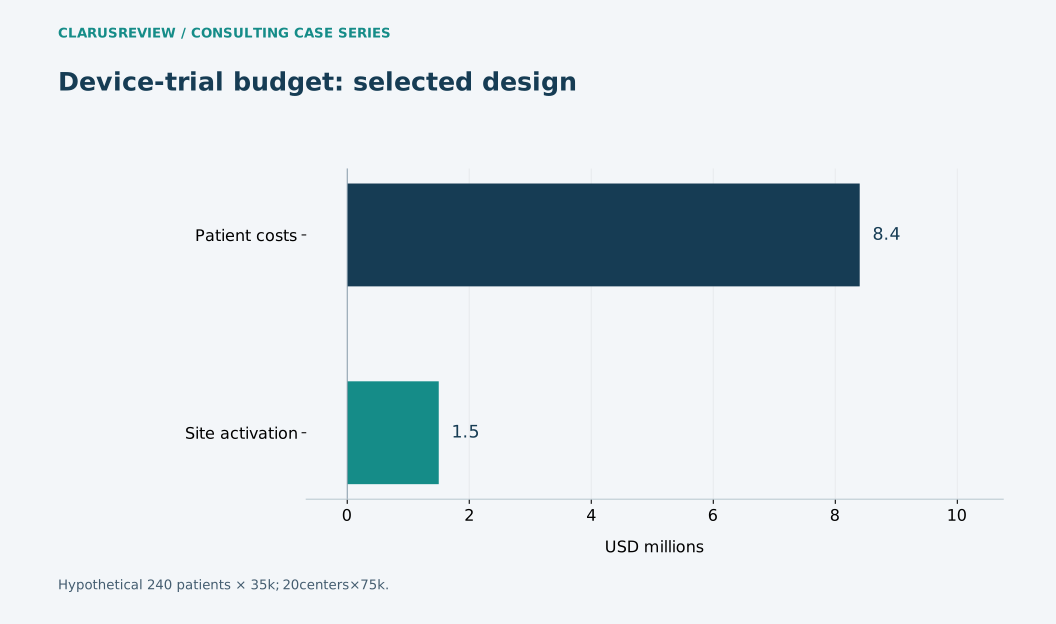
View figure data and context
| Measure | Value |
|---|---|
| Patient costs | 8.4 |
| Site activation | 1.5 |
The consulting assignment
A procedure can produce striking before-and-after measurements without establishing how much change is attributable to the intervention. Medication changes, observation effects, operator technique and patient selection can all influence the result. The consulting assignment is to design a comparison that a skeptical purchaser or regulator can interpret, then cost that design honestly.
The documented comparator
SYMPLICITY HTN-3 randomized 535 patients and did not demonstrate a significant systolic blood-pressure benefit over sham at six months in its primary report. That result belongs to the device, protocol and population studied. It does not establish permanent failure of the entire renal-denervation category. [1]
The current-news bridge
September 2026 AMT-130 external-control reporting offers a different contemporary comparison-design question. The bridge is methodological: both stories make the counterfactual important, while their diseases, interventions and feasible controls remain different. [2]
Hypothetical client and numerical assumptions
Consider a fictional implantable-device sponsor planning 240 randomized patients across 20 centers. Assume $35,000 per randomized patient plus $75,000 activation cost per center. The modeled variable-plus-activation budget is $9.9 million: $8.4 million for patients and $1.5 million for centers. Device supply, headquarters overhead and specialized follow-up are excluded.
What the numbers change
Adding ten centers raises fixed activation cost by $750,000 before any recruitment benefit. Reducing the patient requirement cannot be justified merely to fit cash; statistical design must reflect the intended endpoint, variability, effect and error rates. The calculator costs a selected design, not the sample size that science requires.
At 20 fully active centers recruiting one patient monthly, recruitment takes twelve months for 240 patients. At 1.5 monthly it takes eight months; at two it takes six. Activation ramp-up and unequal productivity make those idealized values. A trial needing six-month outcomes cannot deliver its full endpoint dataset on the final enrollment date.
Operator standardization should include training, procedural fidelity and site-specific monitoring. The analysis plan should consider how operator and site variability are handled. A sham design may reduce some biases while introducing ethical and execution questions; clinical and regulatory specialists must assess suitability rather than treating sham as a universal requirement.
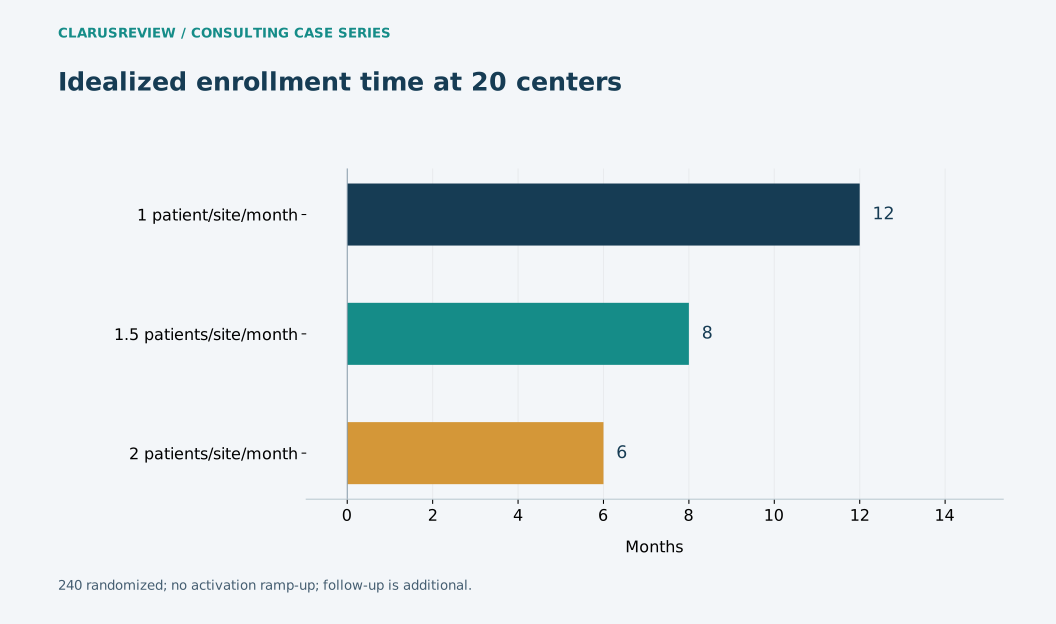
| Scenario | Months |
|---|---|
| 1 patient/site/month | 12 |
| 1.5 patients/site/month | 8 |
| 2 patients/site/month | 6 |
The next decision gate
Before advancing, ask an independent design team to reconcile the claimed mechanism, control, endpoint and recruitment assumptions. Use an initial site run-in to audit fidelity and measurement quality. The next value milestone is an interpretable comparison, not merely installation of more devices or faster enrollment.
What to watch next
Expected decision pressure: a favorable later study should be assessed on its own protocol and data. Neither a historical negative result nor a current mechanistic narrative predicts a future device outcome.
| Workstream | Measure to collect | Decision use |
|---|---|---|
| Design | Control appropriateness and blinded measurement | Reduce uncertainty about the counterfactual |
| Procedure | Protocol-compliant procedures / performed | Assess technique consistency |
| Execution | Randomized per active site-month; activation lag | Reconcile budget with an achievable timeline |
Reporting cutoff: October 1, 2026 Pacific. Later outcomes are not assumed. These tools illustrate decisions; they are not validated clinical, legal or investment prediction models.
Device-trial cost planner
Use a sample size justified separately; fixed activation is $75,000 per center.
Cost = patients × per-patient cost + centers × $75,000.
Changing an input explores a scenario; it does not establish an observed result. Inputs stay in this page and are not submitted.
THE NEXT VALUE INFLECTION
What would change the decision
Before advancing, ask an independent design team to reconcile the claimed mechanism, control, endpoint and recruitment assumptions. Use an initial site run-in to audit fidelity and measurement quality. The next value milestone is an interpretable comparison, not merely installation of more devices or faster enrollment.
Editorial record
Prepared by Clarus Biotech Review editorial team. Updated 10/2/2026.
Publication relationship: ClarusReview is connected to BioClarus Consulting. No article-specific sponsorship is recorded.
Report a correctionDiscuss this paper
Share evidence, ask a question, or offer a professional perspective. Community guidelines
Loading discussion…