Selection biomarkers: an evidence design decision, not a success guarantee
Historical industry data support careful study of biomarker-led programs while leaving important causal and operational questions open.
ClarusBIOTECH REVIEWRead, listen & keep
Narrated by Hermione. Save the audio for offline listening.
View figure data and uncertainty
| Measure | Reported value |
|---|---|
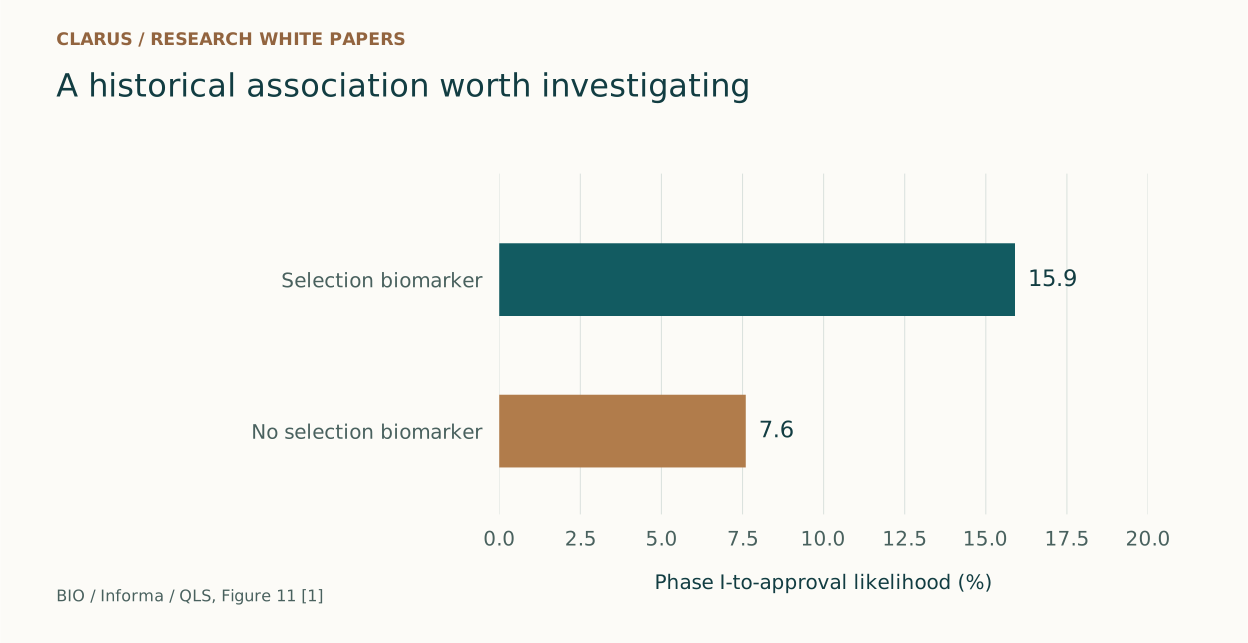
| Selection biomarker | 15.9 |
| No selection biomarker | 7.6 |
Executive perspective
A selection biomarker can change who enters a study and what biological hypothesis the study tests. That makes it a development design decision with consequences for assays, recruitment, interpretation, and eventual use. A persuasive biomarker strategy must explain those consequences before it relies on an attractive industry benchmark.
This white paper separates a historical association from a candidate-level decision. The Clarus framework asks whether the marker identifies a biologically relevant group, whether the test can be executed reliably, and whether the resulting trial can answer a clinically useful question. Each requirement deserves its own evidence rather than being folded into a single platform claim.
Published evidence and scope
The BIO, Informa Pharma Intelligence and QLS Advisors 2011–2020 report estimated Phase I-to-approval likelihood at 15.9% for programs using patient-preselection biomarkers versus 7.6% without them. It is an observational industry dataset, not a randomized test of adding a biomarker to an otherwise identical program. [1]
FDA’s surrogate-endpoint resources describe a separate issue: using a measured endpoint to predict clinical benefit. A selection test and a surrogate outcome serve different purposes; evidence supporting one role does not automatically validate the other. [2]
Clarus analysis: separate three questions
The first question is biological. Specify why the selected population should respond differently and what evidence would falsify that explanation. Avoid making an exploratory association do the work of a prospectively defined treatment hypothesis. The intended use of the marker should be written before the team selects the most convenient available assay.
The second question is analytical. A classification boundary is only useful if it can be reproduced under the conditions of the study. Consider specimen handling, timing, assay failures, repeat testing, and results close to the cutoff. These issues can influence which participants enter the study even when the underlying biological concept is sound.
The third question is clinical and operational. A narrower group may offer a clearer hypothesis while making enrollment more demanding. Map the screening pathway and the burden on sites. Record the population excluded by the test and whether the proposed eventual product profile depends on excluding the same group. The resulting tradeoff should be explicit rather than described simply as precision.
The benchmark should prompt investigation, not supply a numerical uplift to a valuation model. Disease mix, modality, sponsor decisions, and other differences may contribute to the association. A program-specific probability needs its own rationale and a stated uncertainty range.
A practical biomarker decision packet
Bring biology, assay, and clinical operations into one review. Ask each function to identify its minimum decision-enabling evidence and its highest-risk dependency. The output should describe a testable hypothesis, a feasible screening workflow, a prespecified analysis approach, and a plan for ambiguous or missing test results.
Keep changes to the biomarker definition visible in the program’s evidence register. If a threshold changes, record whether the change preceded examination of outcomes and what it does to the intended population. Clear version history helps a partner distinguish disciplined learning from retrospective selection.
Limits and next evidence
The benchmark reflects an older cohort and database methodology, not the current success probability for any asset. This paper does not establish that enrichment causes higher approval rates. The next evidence is prospective demonstration that the chosen assay and population support the candidate’s clinical question.
From reading to a reviewable decision
| Dimension | Evidence to inspect | Next decision check |
|---|---|---|
| Biology | Prospective response hypothesis | Identify a falsifying result |
| Assay | Reliable classification in real specimens | Test borderline and failed samples |
| Trial | Feasible population and recruitment | Confirm screening and analysis rules |
Clarus editorial synthesis. This framework is not a validated predictive model.
THE NEXT VALUE INFLECTION
What would change the decision
The benchmark reflects an older cohort and database methodology, not the current success probability for any asset. This paper does not establish that enrichment causes higher approval rates. The next evidence is prospective demonstration that the chosen assay and population support the candidate’s clinical question.
Editorial record
Prepared by Clarus Biotech Review editorial team. Updated 9/30/2026.
Publication relationship: ClarusReview is connected to BioClarus Consulting. No article-specific sponsorship is recorded.
Report a correctionDiscuss this paper
Share evidence, ask a question, or offer a professional perspective. Community guidelines
Loading discussion…