The $22 billion headline is not the cash available to develop an ADC
A major ADC collaboration and a recent filing setback frame staged licensing, dilution and evidence-linked funding.
ClarusBIOTECH REVIEWRead, listen & keep
Narrated by Hermione. Save the audio for offline listening.
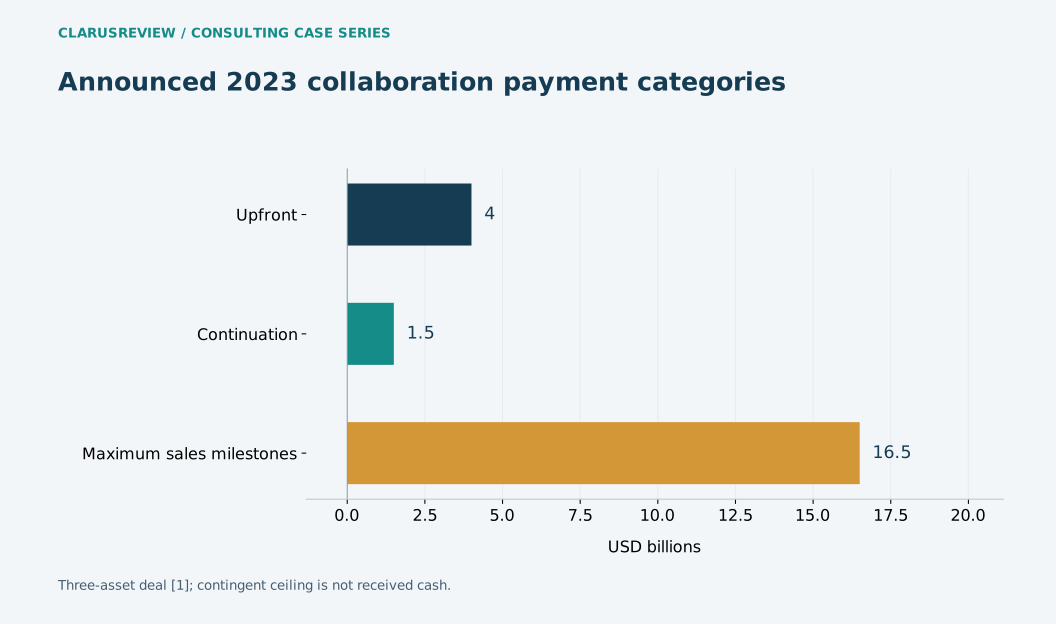
View figure data and context
| Measure | Value |
|---|---|
| Upfront | 4 |
| Continuation | 1.5 |
| Maximum sales milestones | 16.5 |
The consulting assignment
A licensing headline can look like a valuation while describing several assets, territories, obligations and contingent payments. A founder needs a different number: cash available to complete the next evidence milestone. The consulting assignment is to reconstruct the deal perimeter, assign each payment to its trigger and compare financing alternatives on the same funded work.
The documented comparator
The 2023 Merck–Daiichi collaboration covered three ADC candidates. Announced economics included $4 billion upfront, $1.5 billion continuation payments over 24 months and up to $16.5 billion sales milestones, for a potential $22 billion total. The upfront represented about 18.2% of the headline ceiling. Japan rights and manufacturing responsibilities also shaped the agreement. [1]
The current-news bridge
The September 2026 ifinatamab deruxtecan filing withdrawal illustrates why clinical and regulatory milestones remain uncertain after a major partnership. It does not establish that the entire $22 billion ceiling was paid, lost or attributable to one candidate. [2]
Hypothetical client and numerical assumptions
A fictional Phase II sponsor must fund a $60 million evidence/CMC milestone. It has $15 million cash. A proposed regional license supplies $35 million upfront and a $20 million payment only after a later evidence trigger. The upfront plus existing cash totals $50 million, leaving a $10 million gap before the contingent payment. Assuming the milestone payment arrives first would reverse the dependency.
What the numbers change
An alternative equity raise of $45 million exactly fills the current gap. At an invented $180 million pre-money equity valuation, post-money value is $225 million and new investors own 20%, ignoring fees, options and other securities. The regional license may preserve equity but surrender territory economics and still require bridge financing. Comparing the upfront with the whole raise misses those differences.
A term sheet should specify who pays for the confirmatory study, who owns manufacturing changes, how data are shared and what happens if a filing is delayed. Rights and obligations can create more value or exposure than the headline milestone total. Sales milestones should not be treated as present cash, and probability-weighting them requires an explicit method and time structure.
The analysis should show a quarterly cash bridge for each option and a rights map after closing. If one option funds only a biomarker readout and another funds a pivotal result, their cash amounts are not economically comparable. The next inflection thesis defines the unit of comparison: a specified dataset that a named stakeholder can act on.
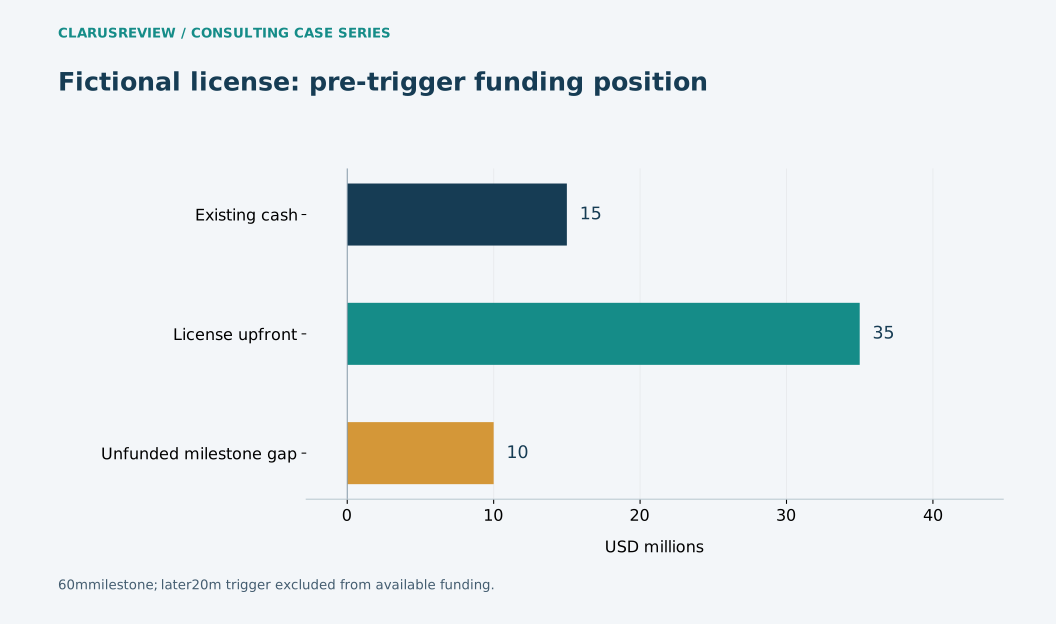
| Scenario | USD millions |
|---|---|
| Existing cash | 15 |
| License upfront | 35 |
| Unfunded milestone gap | 10 |
The next decision gate
Recommend a structure only after matching cash timing to the milestone budget and verifying retained rights. In this fictional case, either increase upfront funding, obtain a bridge or reduce the funded scope through an evidence-supported redesign. Do not count a payment that depends on finishing the work as financing that work.
What to watch next
Future readouts may change bargaining power, but delaying a deal also consumes cash and preserves risk. Model both the improved-term scenario and the no-deal scenario before advising the sponsor to wait.
| Workstream | Measure to collect | Decision use |
|---|---|---|
| Funding | Unrestricted cash available before each trigger | Prevent circular milestone financing |
| Rights | Retained territory and development obligations | Compare more than upfront payment |
| Dilution | New capital / post-money equity on a stated basis | Distinguish equity issuance from licensing economics |
Reporting cutoff: October 1, 2026 Pacific. Later outcomes are not assumed. These tools illustrate decisions; they are not validated clinical, legal or investment prediction models.
License upfront funding gap
The fictional next milestone costs $60m; future milestone receipts are excluded.
Gap = milestone budget − existing cash − upfront payment.
Changing an input explores a scenario; it does not establish an observed result. Inputs stay in this page and are not submitted.
THE NEXT VALUE INFLECTION
What would change the decision
Recommend a structure only after matching cash timing to the milestone budget and verifying retained rights. In this fictional case, either increase upfront funding, obtain a bridge or reduce the funded scope through an evidence-supported redesign. Do not count a payment that depends on finishing the work as financing that work.
Editorial record
Prepared by Clarus Biotech Review editorial team. Updated 10/2/2026.
Publication relationship: ClarusReview is connected to BioClarus Consulting. No article-specific sponsorship is recorded.
Report a correctionDiscuss this paper
Share evidence, ask a question, or offer a professional perspective. Community guidelines
Loading discussion…