AI value inflection: from technical promise to measurable enterprise value
A decision framework for separating clinical evidence, regulatory credibility and usable economic returns.
ClarusBIOTECH REVIEWRead, listen & keep
Narrated by Hermione. Save the audio for offline listening.

The uploaded AI whitepaper makes an important strategic argument: a model becomes commercially meaningful when it changes a decision that matters. Value-Inflection Engineering applies that principle by connecting a defined use case to evidence, an operating owner, an economic baseline and the next investment decision. Model novelty alone cannot tell a leadership team whether to fund a larger trial, change a regulated workflow or expand an enterprise contract.
Clinical progress is evidence about a program
A 2025 randomized phase 2a study of rentosertib, an AI-discovered TNIK inhibitor for idiopathic pulmonary fibrosis, enrolled 71 participants for 12 weeks. Safety and tolerability were primary; forced vital capacity (FVC) was secondary. Mean FVC change was +98.4 mL at 60 mg once daily versus −20.3 mL with placebo: a calculated difference of 118.7 mL. Only 55 participants completed the trial. The short duration and small groups limit inference, and the study does not establish that AI discovery outperforms conventional discovery. [A1]
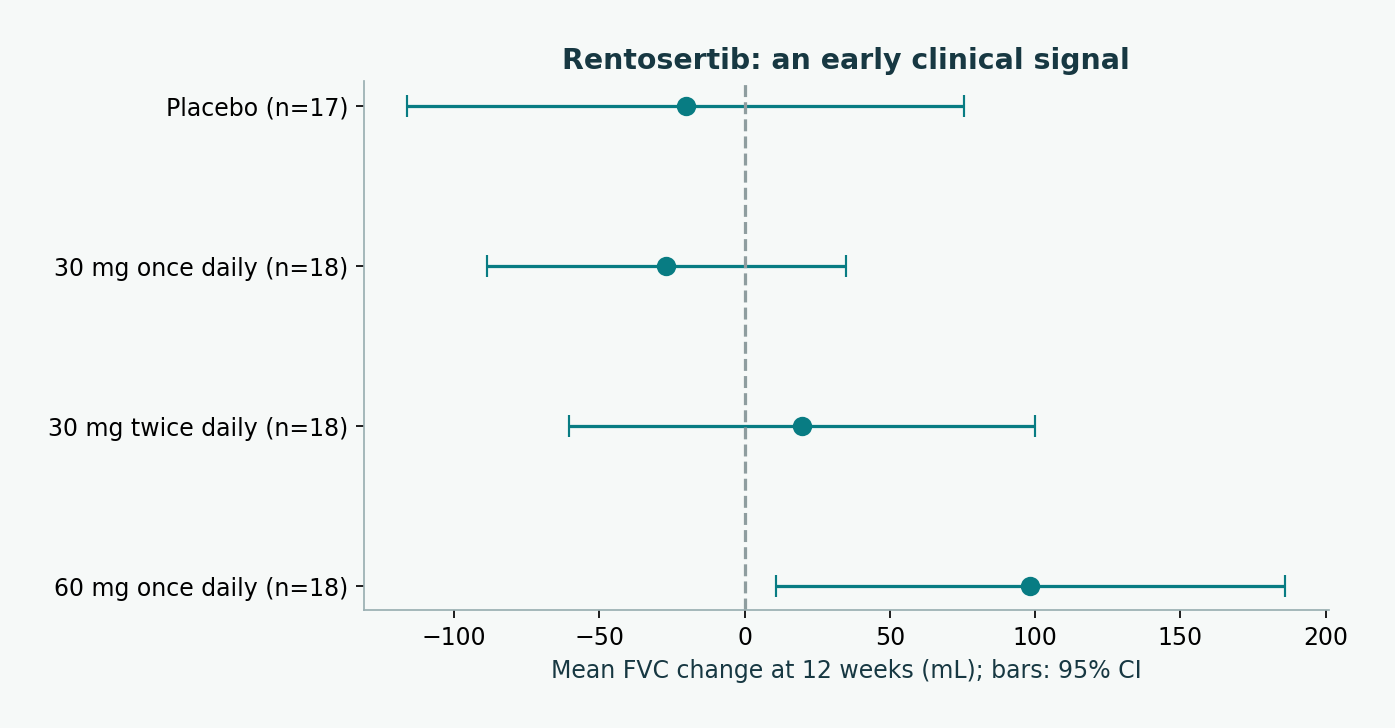
For a development team, the actionable question is what additional evidence would change the next decision. A larger program should address durability, safety, reproducibility and the consequences of missing follow-up. A technology investor must separately ask whether the discovery process works across multiple targets and whether any time advantage survives experimental validation. An attractive clinical signal and a repeatable discovery advantage require different evidence packages.
Regulatory credibility has a defined scope
In December 2025, FDA qualified AIM-NASH for a specified drug-development use in assessing MASH histology. Pathologists remain responsible for reviewing and accepting or rejecting the output. This is a qualified context of use, not unrestricted approval of AI pathology. FDA’s January 2025 draft guidance likewise describes a risk-based credibility framework for AI supporting drug and biological-product regulatory decisions. The cited document is draft guidance. [A2] [A3]
Leadership should therefore specify the decision, input population, acceptable failure modes and human accountability before selecting a model. A workflow that drafts a first-pass internal summary has different consequences from one contributing to a pivotal endpoint. External validation should test the intended population and workflow, while change control should explain what happens after a model, data source or clinical practice changes.
Capital commitments are not the same as realized returns
Sanofi’s November 2021 Owkin announcement distinguished a $180 million equity investment from a $90 million, three-year collaboration, with additional research milestones. These are different financial instruments and historical announced terms; neither demonstrates realized productivity savings or clinical success. [A4]
A more useful internal investment case starts with work actually performed. In the illustrative model below, 1,000 documents annually require six reviewer hours each before implementation and four afterward. At an assumed $150 per hour, 2,000 released hours have a nominal value of $300,000. Annual software, validation and governance cost $220,000, with $80,000 of initial setup. These are editorial assumptions, not vendor prices or observed industry averages.
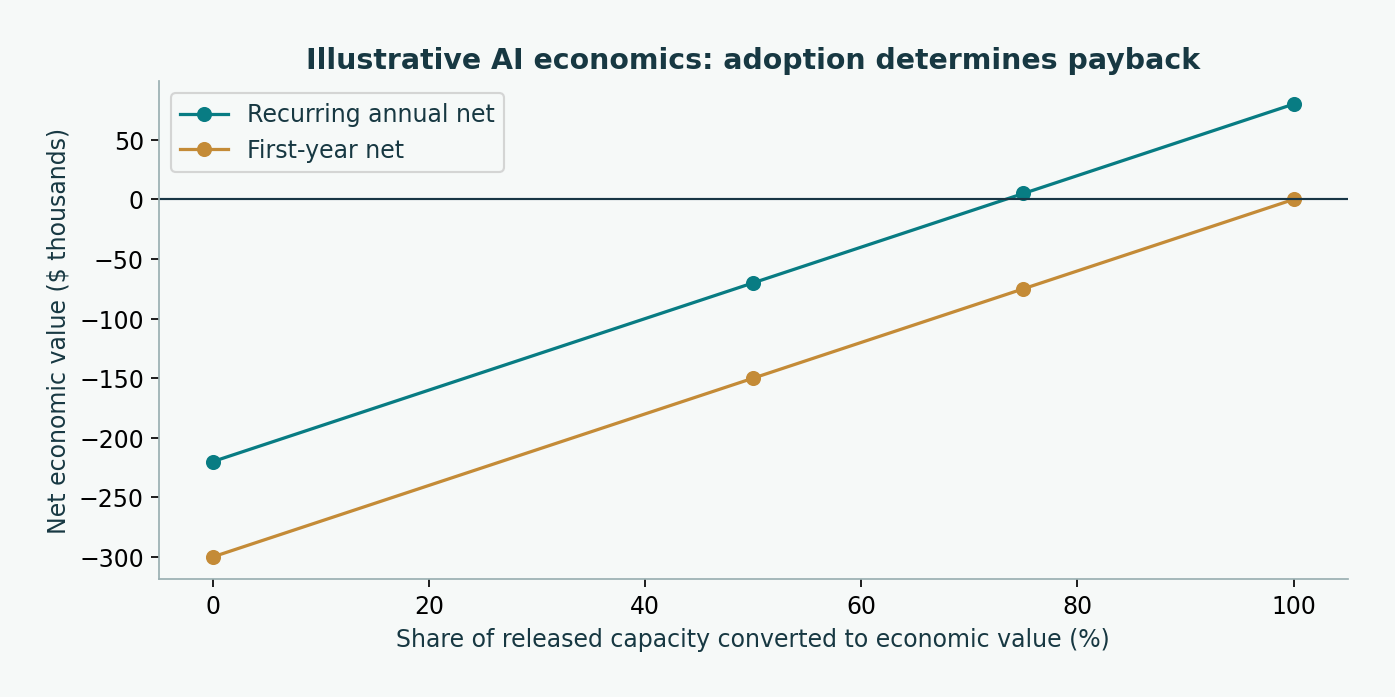
If every released hour becomes usable economic value, recurring net benefit is $80,000 and first-year net benefit is zero. At 50% realization, recurring net benefit is negative $70,000 and first-year net benefit is negative $150,000. Recurring break-even requires 73.3% realization. Released salaried hours become cash savings only through a concrete mechanism such as avoided hiring, reduced external spend or productive redeployment; otherwise they represent capacity.
A management dashboard across five applications
| Application | Measure with a denominator | Decision supported |
|---|---|---|
| Discovery | Validated hits / experimentally tested predictions; cost per validated hit | Expand only after prospective reproducibility |
| Trial operations | Randomized patients / screened patients; median and 90th-percentile recruitment time | Separate better selection from faster enrollment |
| Pathology and imaging | Discordant reads / evaluated cases; subgroup performance; review minutes per case | Define human review and escalation |
| Medical and regulatory writing | Unsupported claims / audited claims; accepted drafts / reviewed drafts | Measure revision burden alongside speed |
| RWE and federated analytics | Eligible records / queried records; missingness by site; reproducible analyses / attempted analyses | Determine whether evidence supports the intended decision |
Each measure needs a baseline period, accountable owner, audit trail and pre-agreed escalation threshold. Targets should be chosen for the specific use case rather than borrowed from an unrelated model demonstration. The source whitepaper’s staged roadmap can be used as a planning hypothesis: define the baseline first, establish data access second, run a bounded pilot, validate prospectively, and expand only after operational and economic evidence converge. Dates in such a roadmap are management commitments, not empirical estimates of how long AI adoption must take.
The next value inflection is therefore a decision backed by evidence: continue, narrow, redesign or stop. That is a more useful board discussion than counting models deployed.
THE NEXT VALUE INFLECTION
What would change the decision
The next value inflection is therefore a decision backed by evidence: continue, narrow, redesign or stop. That is a more useful board discussion than counting models deployed.
Editorial record
Prepared by Clarus Biotech Review editorial team. Updated 10/1/2026.
Publication relationship: ClarusReview is connected to BioClarus Consulting. No article-specific sponsorship is recorded.
Report a correctionDiscuss this paper
Share evidence, ask a question, or offer a professional perspective. Community guidelines
Loading discussion…