From Alpine to the next readout: define what the acquisition price did not resolve
A development-stage acquisition and a company-reported upcoming review date frame a fictional option-value model.
ClarusBIOTECH REVIEWRead, listen & keep
Narrated by Hermione. Save the audio for offline listening.
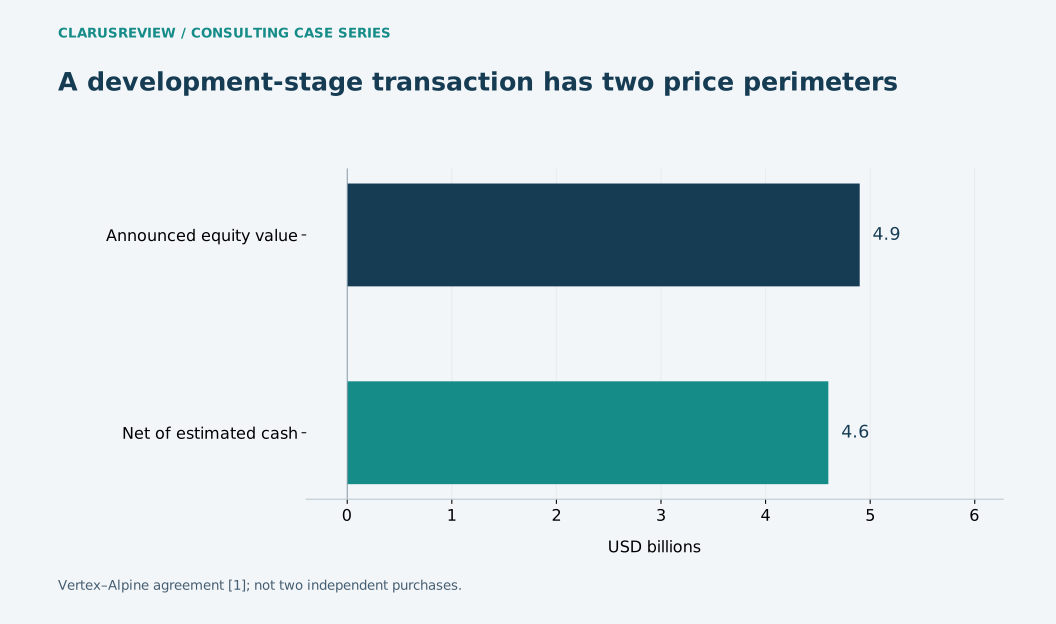
View figure data and context
| Measure | Value |
|---|---|
| Announced equity value | 4.9 |
| Net of estimated cash | 4.6 |
The consulting assignment
A buyer can pay for scientific differentiation and future indications while substantial execution and clinical uncertainty remain. The next milestone should be defined as a decision-changing evidence package, not simply the passage of time after acquisition. The consultant’s job is to identify which assumptions the purchase secures and which must still be earned.
The documented comparator
Vertex’s April 2024 Alpine acquisition agreement announced $65 per share, approximately $4.9 billion equity value and $4.6 billion net of estimated cash. The transaction involved povetacicept’s development opportunity. The two dollar values have different accounting perimeters and should not be treated as conflicting prices. [1]
The current-news bridge
Vertex’s August 2026 update reported a November 30, 2026 PDUFA date for povetacicept. At this article’s October 1 Pacific reporting cutoff, that is a company-reported future review date, not an approval or guaranteed commercial start. [2]
Hypothetical client and numerical assumptions
The fictional client is a buyer evaluating a different renal asset. Assume a success-state discounted value of $1.2 billion, failure-state value of $100 million and $150 million additional development spending. For illustration only, a 50% success probability gives 0.50 × $1.2bn + 0.50 × $0.1bn − $0.15bn = $500 million before acquisition price. The probability and values are invented.
What the numbers change
At assumed probabilities of 30%, 50% and 70%, the corresponding screen values are $280 million, $500 million and $720 million. If the proposed acquisition costs $600 million, modeled balances are −$320 million, −$100 million and +$120 million. This is a scenario screen, not a valuation of Alpine or a calibrated probability model.
The simplified model assumes the state values already incorporate consistent discounting and commercial costs, while the $150 million spend is a separately stated present-value estimate. Mixing discounted success value with an undiscounted development bill would distort the comparison. More detailed work should account for spend timing, taxes, competing products, indication expansion and correlated program risks.
An interim endpoint can improve confidence in one dimension while leaving durability, safety, comparative benefit or commercial adoption unresolved. The evidence team should map which uncertainty the next readout retires and which remains. A review calendar is useful for liquidity and launch preparation, but it is not a scientific result.
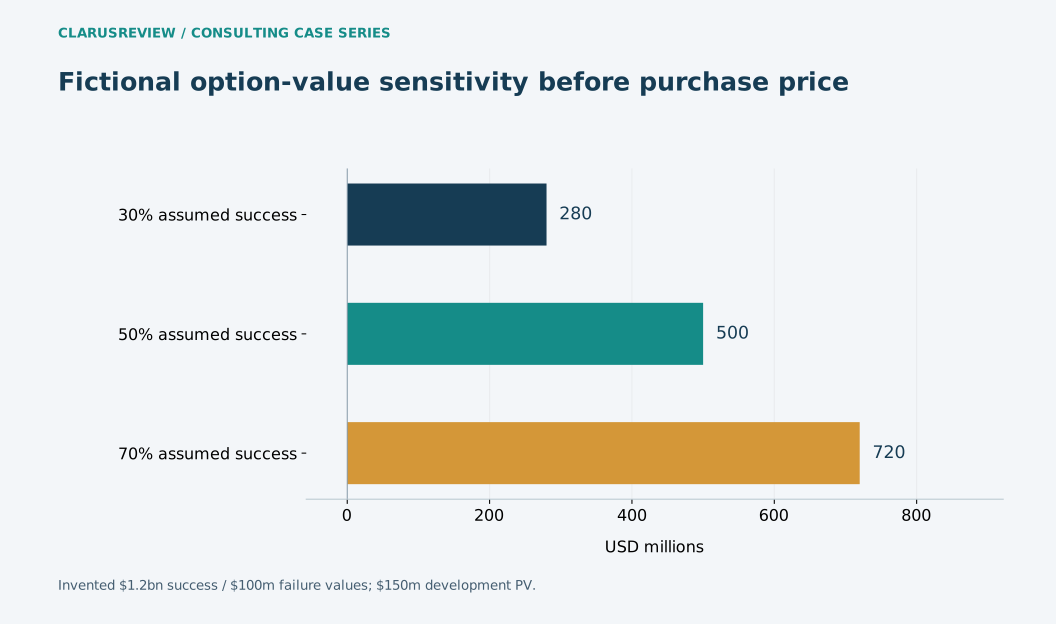
| Scenario | USD millions |
|---|---|
| 30% assumed success | 280 |
| 50% assumed success | 500 |
| 70% assumed success | 720 |
The next decision gate
Create an acquisition thesis with three conditions: the defined evidence needed, the fully funded route to that evidence and the commercial proposition if it arrives. Use contingent consideration when it genuinely allocates unresolved risk, and retain a downside operating plan. Do not select the success probability merely to make the proposed price appear attractive.
What to watch next
Watch actual regulatory decisions and new data when released. A future deadline can move or end in a different outcome; update the model after the event rather than publishing the expected result as news.
| Workstream | Measure to collect | Decision use |
|---|---|---|
| Evidence | Uncertainty retired by each planned readout | Name the information actually purchased later |
| Valuation | Probability and value assumptions with timing basis | Make optimism auditable |
| Capital | Spend to decision plus downside reserve | Maintain an executable plan in both states |
Reporting cutoff: October 1, 2026 Pacific. Later outcomes are not assumed. These tools illustrate decisions; they are not validated clinical, legal or investment prediction models.
Two-state acquisition screen
Illustrative probabilities are not calibrated clinical forecasts. State values are assumed already discounted; development PV is fixed at $150m.
Screen value = p × success value + (1 − p) × failure value − $150m development PV.
Changing an input explores a scenario; it does not establish an observed result. Inputs stay in this page and are not submitted.
THE NEXT VALUE INFLECTION
What would change the decision
Create an acquisition thesis with three conditions: the defined evidence needed, the fully funded route to that evidence and the commercial proposition if it arrives. Use contingent consideration when it genuinely allocates unresolved risk, and retain a downside operating plan. Do not select the success probability merely to make the proposed price appear attractive.
Editorial record
Prepared by Clarus Biotech Review editorial team. Updated 10/2/2026.
Publication relationship: ClarusReview is connected to BioClarus Consulting. No article-specific sponsorship is recorded.
Report a correctionDiscuss this paper
Share evidence, ask a question, or offer a professional perspective. Community guidelines
Loading discussion…