External controls in neurology: price the uncertainty before the next raise
Leqembi’s randomized evidence and AMT-130’s September update frame a client’s sensitivity analysis and evidence reserve.
ClarusBIOTECH REVIEWRead, listen & keep
Narrated by Hermione. Save the audio for offline listening.
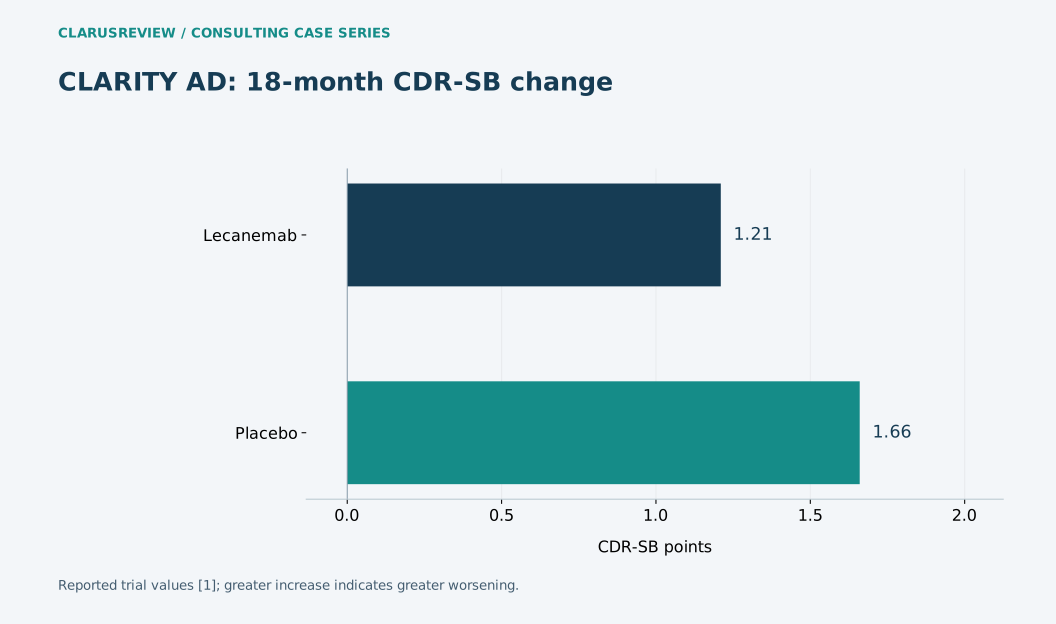
View figure data and context
| Measure | Value |
|---|---|
| Lecanemab | 1.21 |
| Placebo | 1.66 |
The consulting assignment
Long disease timelines can make external controls attractive, especially when recruitment is difficult and a treatment involves a procedure. The central question is whether the comparison can distinguish treatment effect from differences in measurement, selection and follow-up. A consultant should make those uncertainties visible in both the evidence narrative and the capital plan.
The documented comparator
CLARITY AD enrolled 1,795 participants. At 18 months, mean CDR-SB change was 1.21 with lecanemab and 1.66 with placebo, a difference of −0.45 points. The randomized comparison supports a defined result in that study population; it is not a benchmark effect size for Huntington’s disease or gene therapy. [1]
The current-news bridge
uniQure’s September 29, 2026 AMT-130 update reported a high-dose 48-month cUHDRS comparison with p=0.144, alongside substantial missingness in external-control follow-up. Company interpretations should remain attributed; a nonsignificant comparison does not prove either benefit or no benefit. [2]
Hypothetical client and numerical assumptions
An invented CNS gene-therapy client has 40 treated patients and plans a four-year functional analysis. Assume measurement/retention costs $25,000 per treated patient-year. Forty patients followed for four years imply $4 million for that line alone. If 25% lack the target observation, only 30 have an observed endpoint; that is a completeness calculation, not a valid analysis population or a power estimate.
What the numbers change
The consultant should request the external cohort’s inclusion rules, index dates, baseline severity, concomitant care and assessment methods before seeing favorable effect estimates. Matching measured variables cannot prove unmeasured comparability. Differential dropout may change the comparison in either direction; stating that direction requires supporting analysis.
Budget sensitivity can remain useful without inventing clinical outcomes. Follow-up costs of $15,000, $25,000 and $35,000 per patient-year produce $2.4 million, $4 million and $5.6 million for the assumed treated cohort. Comparator acquisition, data harmonization, site overhead and any randomized study are additional lines. The evidence reserve should fund credible sensitivity work and continued observation, not merely a presentation upgrade.
A good evidence brief gives each endpoint its prespecified role, time point, missing-data treatment and uncertainty interval. It reconciles sensitivity results with the main analysis rather than selecting whichever measure is statistically favorable. Later readouts may change confidence, but the financing narrative should reflect the uncertainty present at the decision date.
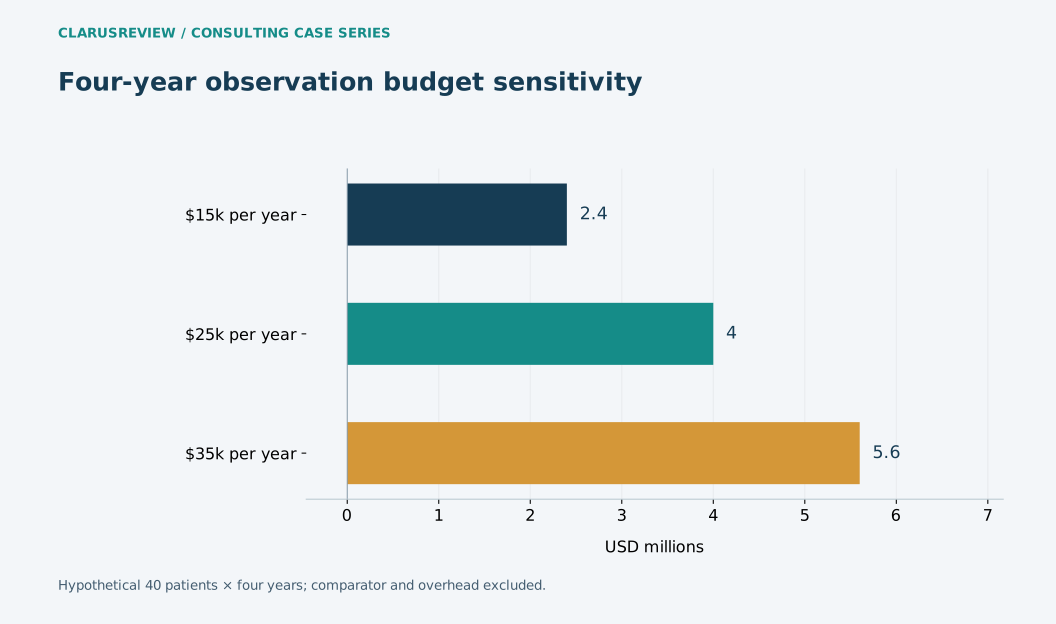
| Scenario | USD millions |
|---|---|
| $15k per year | 2.4 |
| $25k per year | 4 |
| $35k per year | 5.6 |
The next decision gate
Before the next raise, commission a blinded statistical review of cohort construction and missingness. Lock alternative specifications before rerunning the model and disclose them together. Escalate to a different evidence strategy if conclusions depend on assumptions that cannot be justified. A proposed 90% follow-up completeness target is an operating aspiration for the fictional client, not a universal regulatory threshold.
What to watch next
Watch the maturity and completeness of future follow-up, not only the headline percentage change. Any expected regulatory discussion or later readout remains an uncertain event until documented.
| Workstream | Measure to collect | Decision use |
|---|---|---|
| Comparability | Baseline balance and index-date alignment | Expose selection differences before effect interpretation |
| Completeness | Observed / due assessments by cohort | Keep attrition visible |
| Analysis | Effect and interval under prespecified sensitivities | Assess robustness without endpoint shopping |
Reporting cutoff: October 1, 2026 Pacific. Later outcomes are not assumed. These tools illustrate decisions; they are not validated clinical, legal or investment prediction models.
Longitudinal evidence budget
Costs follow-up only; it does not estimate statistical significance, approval probability or treatment benefit.
Budget = patients × follow-up years × annual observation cost.
Changing an input explores a scenario; it does not establish an observed result. Inputs stay in this page and are not submitted.
THE NEXT VALUE INFLECTION
What would change the decision
Before the next raise, commission a blinded statistical review of cohort construction and missingness. Lock alternative specifications before rerunning the model and disclose them together. Escalate to a different evidence strategy if conclusions depend on assumptions that cannot be justified. A proposed 90% follow-up completeness target is an operating aspiration for the fictional client, not a universal regulatory threshold.
Editorial record
Prepared by Clarus Biotech Review editorial team. Updated 10/2/2026.
Publication relationship: ClarusReview is connected to BioClarus Consulting. No article-specific sponsorship is recorded.
Report a correctionDiscuss this paper
Share evidence, ask a question, or offer a professional perspective. Community guidelines
Loading discussion…