A safety action can reset the addressable population overnight
The Elevidys safety revision informs a hypothetical surveillance budget and an eligibility-sensitive operating plan.
ClarusBIOTECH REVIEWRead, listen & keep
Narrated by Hermione. Save the audio for offline listening.
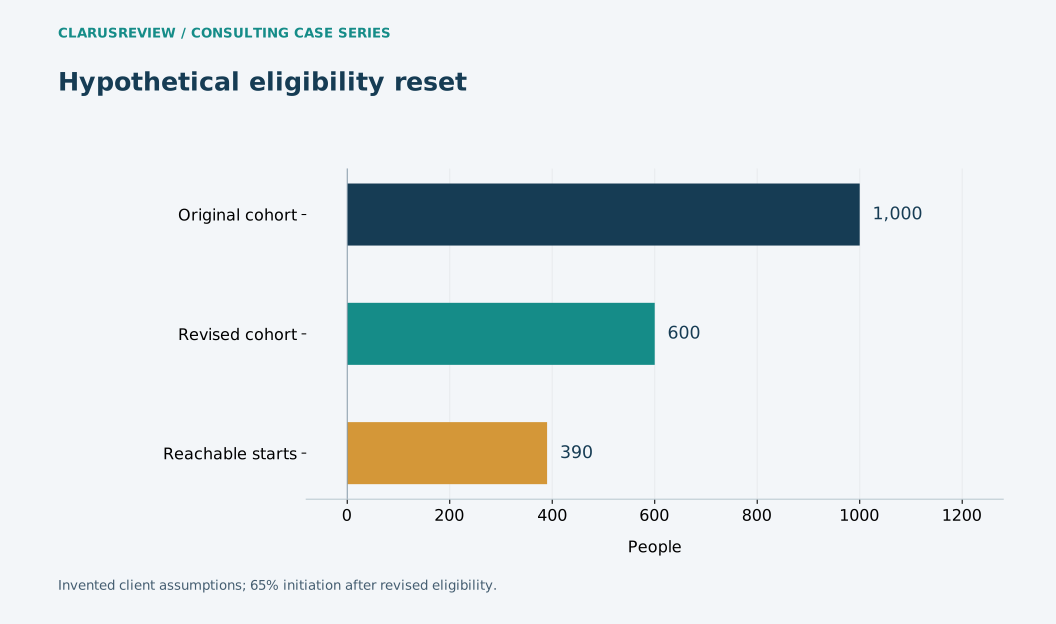
View figure data and context
| Measure | Value |
|---|---|
| Original cohort | 1,000 |
| Revised cohort | 600 |
| Reachable starts | 390 |
The consulting assignment
Addressable-market estimates often assume that the intended label, the treated population and the surveillance burden remain stable. A safety action can change all three. The practical assignment is to revise eligibility, referral messaging, evidence collection and cash allocation at the same time. Otherwise a company can retain an outdated revenue plan while its clinical responsibilities have already changed.
The documented comparator
In November 2025 FDA added a boxed warning to Elevidys and restricted use to ambulatory patients aged four and older after reports of fatal acute liver failure. The action included an observational study of 200 patients with at least 12 months of follow-up. Those are dated regulatory requirements, not a current prescribing summary. [1]
The current-news bridge
FDA’s January 2026 cell/gene therapy framework described CMC development flexibility. Flexibility does not remove the need to plan for safety-driven changes in eligibility and follow-up. Manufacturing strategy and patient-risk management answer different questions. [2]
Hypothetical client and numerical assumptions
Suppose an unrelated rare-disease sponsor initially models 1,000 addressable patients. A fictional eligibility revision leaves 600, while practical screening and access constraints allow 65% to start treatment. The revised modeled opportunity is 390 starts rather than the 650 implied by the same conversion applied to the original cohort. The 260-start difference is not an Elevidys sales estimate.
What the numbers change
Assume an observational program costs $18,000 per participant-year. Two hundred participants followed for one year create a $3.6 million measurement line; two years create $7.2 million and three years $10.8 million. These amounts exclude acute clinical care, insurance, site start-up and analysis infrastructure. Enrollment time must be added to follow-up time before calling the program complete.
The market model should show which patients leave the modeled eligibility set and why. A population restriction and an access barrier should occupy separate rows; otherwise the same patient can be removed twice. Safety communications also affect center readiness and patient preference, but the size of those effects requires observation rather than an assumed multiplier.
The medical team should own adverse-event definitions and escalation procedures. Operations should own follow-up completion and center training. Finance should show the incremental surveillance reserve alongside the revised demand case. That linked plan protects the next evidence milestone from being displaced by a launch forecast that no longer matches the allowed population.
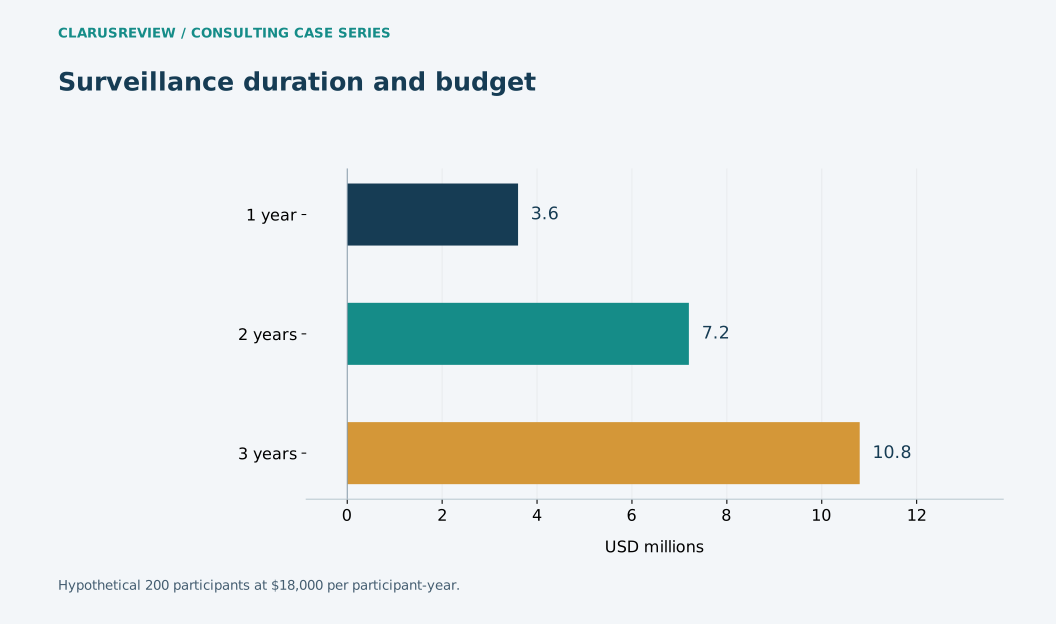
| Scenario | USD millions |
|---|---|
| 1 year | 3.6 |
| 2 years | 7.2 |
| 3 years | 10.8 |
The next decision gate
Use an immediate label-and-protocol reconciliation followed by weekly center readiness checks. Release commercial expansion funding only after the revised patient funnel, safety operating procedures and surveillance budget have accountable owners. The recommendation concerns the fictional sponsor’s governance; the historical case is evidence that post-approval assumptions can change.
What to watch next
Forward sensitivity: additional follow-up could increase, reduce or leave uncertainty unchanged. Track severity, timing, denominator and completeness; spontaneous report counts alone cannot supply a reliable incidence rate.
| Workstream | Measure to collect | Decision use |
|---|---|---|
| Safety | Events by severity / exposed patients with time at risk | Avoid incidence claims from unqualified report counts |
| Follow-up | Completed / due visits | Find surveillance gaps |
| Commercial plan | Eligible and reachable patients separately | Prevent stale or double-counted demand assumptions |
Reporting cutoff: October 1, 2026 Pacific. Later outcomes are not assumed. These tools illustrate decisions; they are not validated clinical, legal or investment prediction models.
Postmarketing observation reserve
Budget sensitivity only; the input cost is fictional and excludes clinical treatment.
Reserve = participants × years × cost per participant-year.
Changing an input explores a scenario; it does not establish an observed result. Inputs stay in this page and are not submitted.
THE NEXT VALUE INFLECTION
What would change the decision
Use an immediate label-and-protocol reconciliation followed by weekly center readiness checks. Release commercial expansion funding only after the revised patient funnel, safety operating procedures and surveillance budget have accountable owners. The recommendation concerns the fictional sponsor’s governance; the historical case is evidence that post-approval assumptions can change.
Editorial record
Prepared by Clarus Biotech Review editorial team. Updated 10/2/2026.
Publication relationship: ClarusReview is connected to BioClarus Consulting. No article-specific sponsorship is recorded.
Report a correctionDiscuss this paper
Share evidence, ask a question, or offer a professional perspective. Community guidelines
Loading discussion…