After Humira: build a price–volume bridge, not a patent-cliff slogan
Historical U.S. erosion and 2026 global reporting inform a hypothetical biosimilar-response model.
ClarusBIOTECH REVIEWRead, listen & keep
Narrated by Hermione. Save the audio for offline listening.
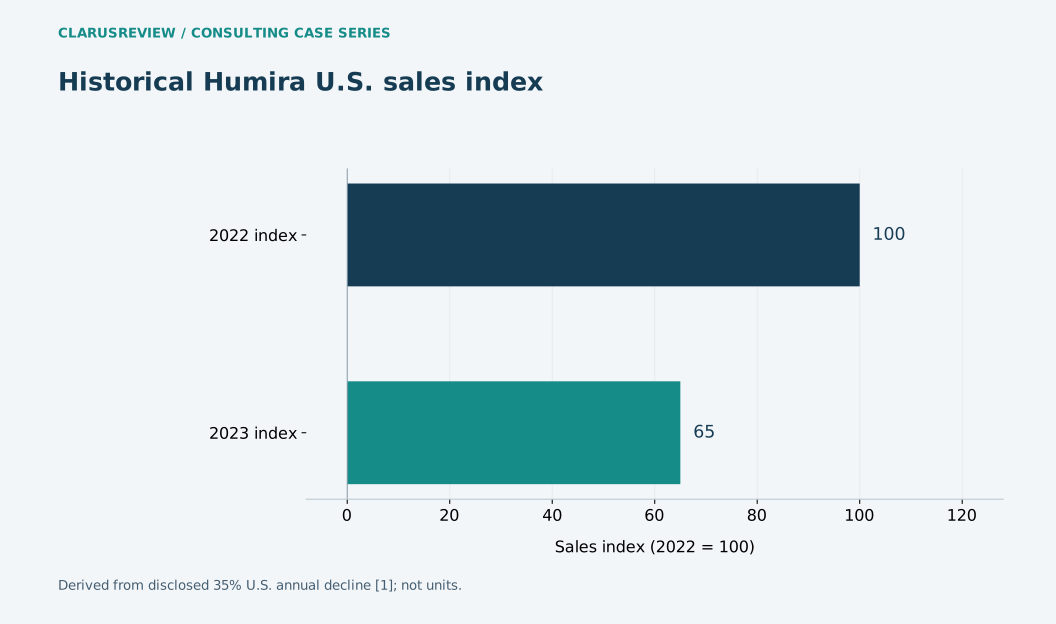
View figure data and context
| Measure | Value |
|---|---|
| 2022 index | 100 |
| 2023 index | 65 |
The consulting assignment
Loss of exclusivity can change price, volume, channel mix and the cost of retaining patients at different speeds. A single percentage decline cannot tell leadership which lever to use. The consultant needs a decomposed revenue bridge and a portfolio plan that distinguishes the declining brand’s economics from the growth required elsewhere.
The documented comparator
AbbVie’s 2023 Form 10-K reported U.S. Humira sales declining 35% following U.S. loss of exclusivity on January 31, 2023. Indexing the prior year to 100 gives 65 for the following year. That index preserves the disclosed change without inventing a patient count or treating sales as volume. [1]
The current-news bridge
AbbVie reported Q2 2026 global Humira net revenue of $756 million, down 35.9% on a reported basis. This is a different geography and period from the historical U.S. annual measure; the two rates cannot be stitched into one comparable time series. [2]
Hypothetical client and numerical assumptions
For a fictional brand, begin with $500 million annual net revenue. Assume net price falls 25% and unit volume falls 20%. Revenue becomes $500m × 0.75 × 0.80 = $300 million, a 40% decline. Adding 25% and 20% would incorrectly call the decline 45%; the effects compound.
What the numbers change
A retention program costing $15 million is assumed to reduce volume loss from 20% to 10% while the price reduction remains unchanged. Modeled revenue becomes $337.5 million, an incremental $37.5 million. At an assumed 60% contribution margin, the extra contribution is $22.5 million; subtracting program cost leaves $7.5 million before fixed overhead. These are sensitivities, not evidence that the intervention will work.
The commercial team should segment contracts by net realization, retention and service burden. A headline volume win can destroy value if additional rebates consume its contribution. Conversely, controlled contraction may release resources for a successor product. Portfolio decisions should compare incremental contribution, not just prescription counts.
The historical erosion should also inform the pre-expiry plan: clarify which innovations genuinely change the clinical proposition, which rights protect them and what evidence payers need. A lifecycle strategy built solely on promotional intensity can fail to address interchangeability, formulary changes and lower-cost alternatives.
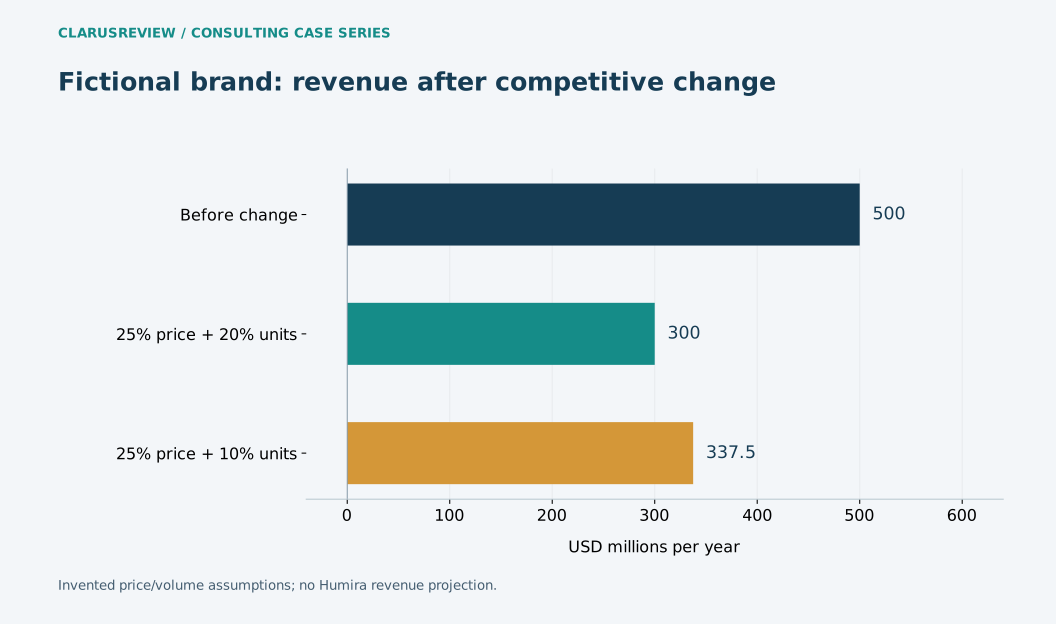
| Scenario | USD millions per year |
|---|---|
| Before change | 500 |
| 25% price + 20% units | 300 |
| 25% price + 10% units | 337.5 |
The next decision gate
Run a channel-level bridge before funding broad retention. Require contract-specific net-price assumptions and a test of incremental patient retention. Apply the same contribution rule to each segment, and reserve resources for the next portfolio milestone rather than preserving all legacy volume at any cost.
What to watch next
Expected competitive shifts should be modeled as price, volume and mix scenarios. Do not infer the fictional brand’s future from Humira’s percentage decline; product, contract and jurisdiction differences are material.
| Workstream | Measure to collect | Decision use |
|---|---|---|
| Revenue | Price, units and channel mix on a common basis | Avoid additive percentage errors |
| Retention | Incremental retained patients versus comparison group | Test whether spending changes behavior |
| Contribution | Net realization less incremental costs | Protect value rather than gross volume |
Reporting cutoff: October 1, 2026 Pacific. Later outcomes are not assumed. These tools illustrate decisions; they are not validated clinical, legal or investment prediction models.
Price–volume erosion calculator
Uses a fixed fictional $500m baseline; price and volume reductions compound.
New revenue = baseline × (1 − price reduction / 100) × (1 − volume reduction / 100).
Changing an input explores a scenario; it does not establish an observed result. Inputs stay in this page and are not submitted.
THE NEXT VALUE INFLECTION
What would change the decision
Run a channel-level bridge before funding broad retention. Require contract-specific net-price assumptions and a test of incremental patient retention. Apply the same contribution rule to each segment, and reserve resources for the next portfolio milestone rather than preserving all legacy volume at any cost.
Editorial record
Prepared by Clarus Biotech Review editorial team. Updated 10/2/2026.
Publication relationship: ClarusReview is connected to BioClarus Consulting. No article-specific sponsorship is recorded.
Report a correctionDiscuss this paper
Share evidence, ask a question, or offer a professional perspective. Community guidelines
Loading discussion…