Engineer the Phase II decision: milestones should retire a defined uncertainty
Historical transition rates help frame the challenge; the program’s evidence must determine the actual go, revise, or stop decision.
ClarusBIOTECH REVIEWRead, listen & keep
Narrated by Hermione. Save the audio for offline listening.
View figure data and uncertainty
| Measure | Reported value |
|---|---|
| Phase I → II | 52 |
| Phase II → III | 28.9 |
| Phase III → filing | 57.8 |
| Filing → approval | 90.6 |
Executive perspective
A milestone has value when it changes what a team, partner, or investor can decide. Completing an activity is often necessary, but completion alone does not guarantee a useful answer. Value Inflection Engineering begins by naming the uncertainty that matters and designing the evidence needed to reduce it.
Phase II planning is a useful setting for this discipline because several threads meet there: biological plausibility, dose and exposure, population definition, outcome selection, and execution. The objective is to make those threads support a consequential decision instead of producing a collection of individually interesting observations.
Published benchmark and scope
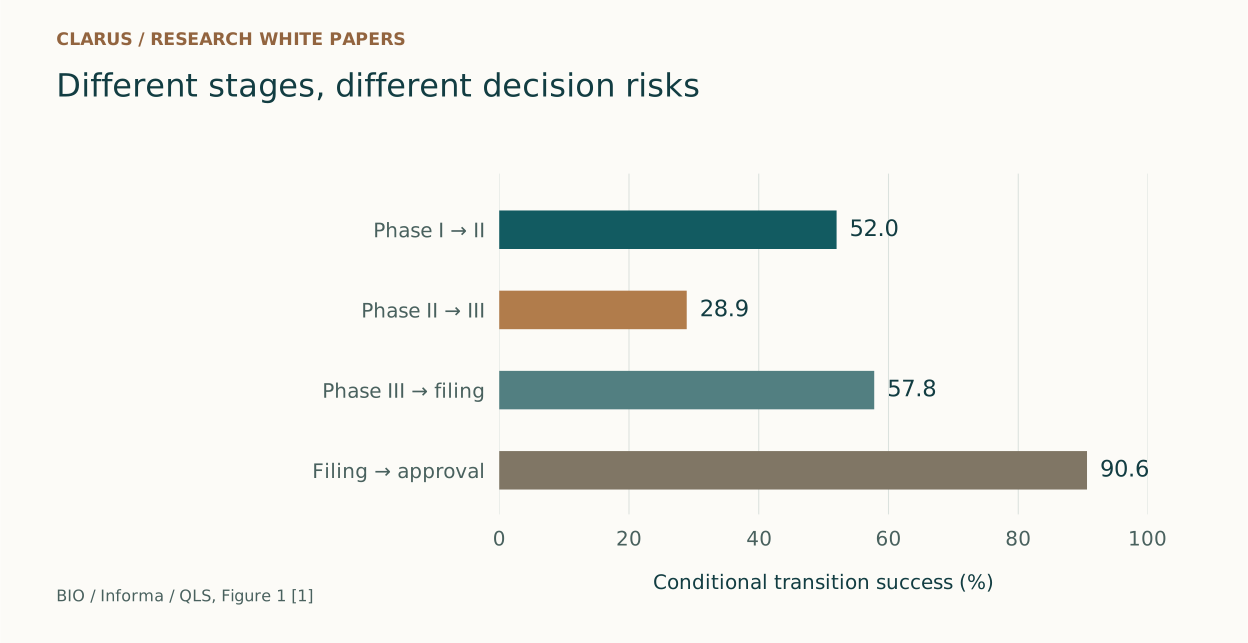
The BIO, Informa and QLS 2011–2020 report estimated all-indication transition success at 52.0% for Phase I to II, 28.9% for II to III, 57.8% for III to regulatory filing, and 90.6% for filing to approval. These are conditional historical transition rates with distinct denominators, not one cohort’s observed survival curve. [1]
Wong and colleagues’ separate peer-reviewed analysis of clinical development illustrates that success estimates depend on datasets, periods, and methods. An industry benchmark can frame uncertainty, but it does not give a personalized forecast for an asset. [2]
Clarus analysis: define the decision before the milestone
Begin with a concrete decision: proceed to the next stage, revise the product profile, repeat or extend an experiment, seek a partner, or stop the program. Then identify the evidence that would distinguish those actions. If every plausible result would lead to the same action, the proposed milestone may not be decision-enabling.
Write the pivotal uncertainty in plain language. Does the product produce a useful effect in the intended population? Is the exposure adequate? Is the endpoint interpretable? Can the development path be executed? A single study may inform several questions, but the team should know which answer carries the decision.
Set the response logic before results are known. Define what would support proceeding, what would require revision, and what would undermine the hypothesis. This is not a promise that development decisions can be reduced to a simple threshold. It is a way to keep evidence, judgment, and enthusiasm from becoming indistinguishable after a result arrives.
Pair the scientific milestone with its dependencies. A good result may be difficult to use if the product cannot be made consistently, the analysis cannot be interpreted, or the next study cannot recruit the intended population. The decision packet should show those conditions rather than presenting the data event as an isolated value catalyst.
A practical milestone charter
A milestone charter should name the decision maker, uncertainty, evidence standard, dependencies, and the actions available after each broad outcome. Give each dependency an owner and define when it must be resolved. Review the charter as the program learns, preserving why any change was made.
At the milestone review, separate the observed result from the team’s interpretation and the proposed action. Include disconfirming evidence and the most important unresolved issue. This makes the review useful to a new partner and allows the next capital request to be tied to a clearly stated development choice.
Limits and next evidence
The historical rates are benchmarks, not causal effects of a milestone strategy or an estimate of a company’s value. Multiplying the plotted rates does not recreate an observed longitudinal cohort. Program-specific decisions need the complete scientific, clinical, manufacturing, and operational record.
From reading to a reviewable decision
| Dimension | Evidence to inspect | Next decision check |
|---|---|---|
| Decision | Proceed, revise, partner, or stop | Name the accountable decision maker |
| Evidence | Result that distinguishes those actions | Prespecify the response logic |
| Dependency | Conditions needed to use the result | Resolve the critical blocker before review |
Clarus editorial synthesis. This framework is not a validated predictive model.
THE NEXT VALUE INFLECTION
What would change the decision
The historical rates are benchmarks, not causal effects of a milestone strategy or an estimate of a company’s value. Multiplying the plotted rates does not recreate an observed longitudinal cohort. Program-specific decisions need the complete scientific, clinical, manufacturing, and operational record.
Editorial record
Prepared by Clarus Biotech Review editorial team. Updated 9/30/2026.
Publication relationship: ClarusReview is connected to BioClarus Consulting. No article-specific sponsorship is recorded.
Report a correctionDiscuss this paper
Share evidence, ask a question, or offer a professional perspective. Community guidelines
Loading discussion…