When a Phase II response is not a filing strategy
A September 2026 ADC filing withdrawal becomes a hypothetical evidence-gap, delay and cash-runway assignment.
ClarusBIOTECH REVIEWRead, listen & keep
Narrated by Hermione. Save the audio for offline listening.
View figure data and context
| Measure | Value |
|---|---|
| Objective response | 39.6 |
The consulting assignment
A promising response rate can create a financing narrative before it creates a defensible filing strategy. The consulting problem is to separate biological activity, durability, patient benefit and regulatory sufficiency, then fund the work that closes the actual gap. Accelerated approval is a pathway with product-specific evidence requirements, not a generic reward for an attractive waterfall plot.
The documented comparator
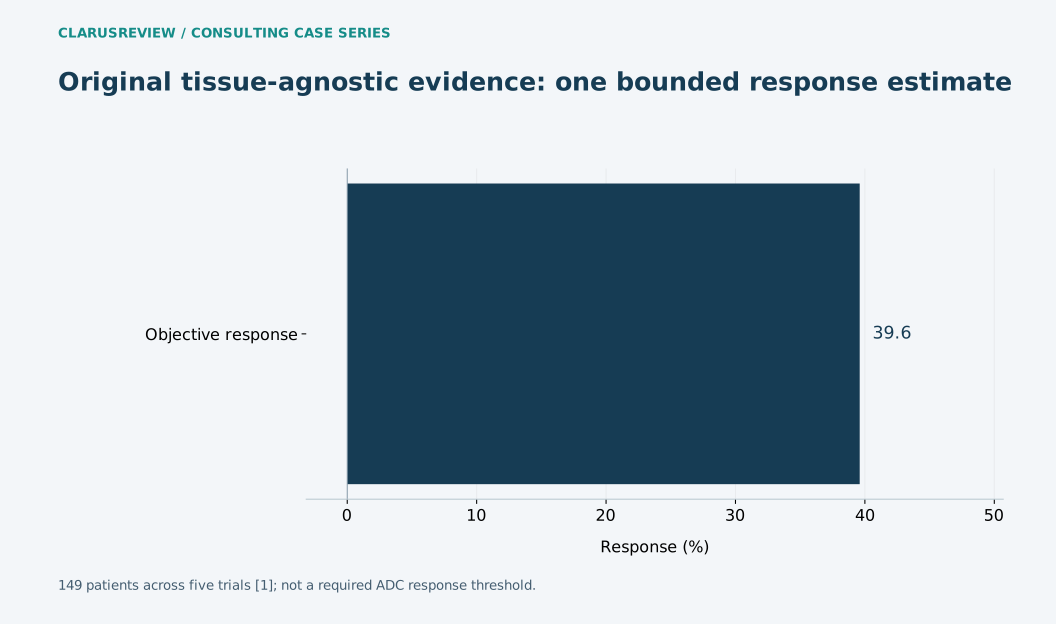
Keytruda’s original tissue-agnostic MSI-H/dMMR authorization drew on 149 patients across five trials and an objective response rate of 39.6%. That historical package involved a defined biomarker and clinical context. It supplies a comparator for evidence architecture, not a transferable response-rate threshold for ADCs. [1]
The current-news bridge
On September 25, 2026, Daiichi Sankyo announced withdrawal of the accelerated-approval BLA for ifinatamab deruxtecan after FDA discussions. The company said Phase II evidence did not meet requirements for the proposed indication and reported Phase III enrollment nearing completion. [2]
Hypothetical client and numerical assumptions
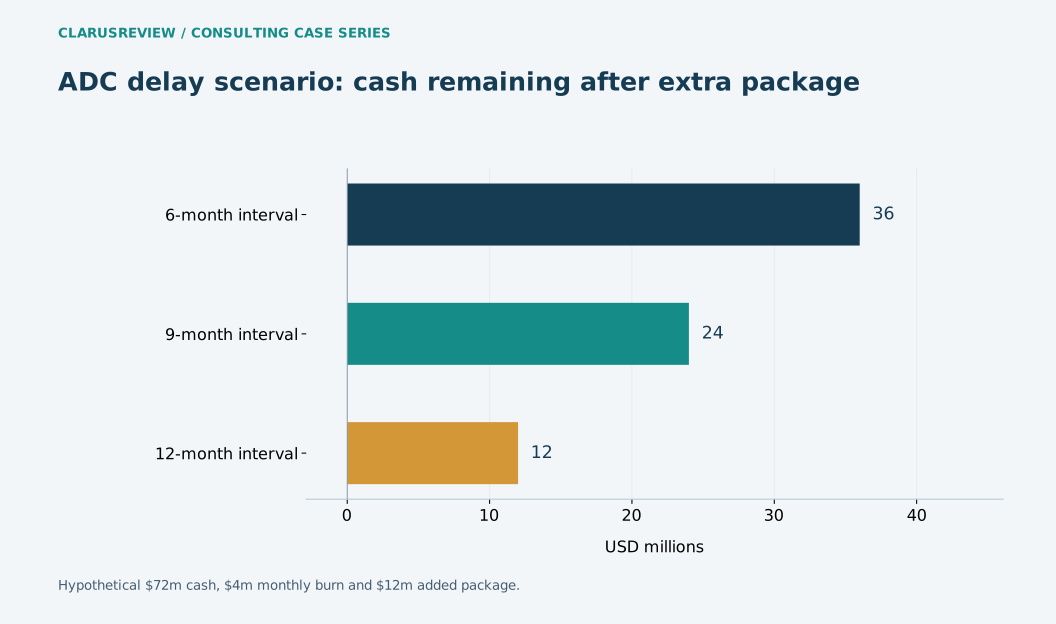
The fictional client is a separate Phase II ADC sponsor holding $72 million in unrestricted cash and burning $4 million monthly. Baseline runway is 18 months. Its board considers a nine-month additional evidence interval plus an assumed $12 million incremental study/CMC package. Waiting consumes $36 million at baseline burn; total modeled cash use is $48 million, leaving $24 million.
What the numbers change
The remaining $24 million funds six months at unchanged burn. It does not fund an unspecified launch, future trial expansion or debt obligation. If the extra interval is twelve months, the same package leaves $12 million and three months of runway. A six-month interval leaves $36 million and nine months. The scenario chart keeps the added package separate from time-driven operating spend to avoid double counting.
The regulatory gap should be written as questions, not guessed from another sponsor’s outcome. Is the proposed population coherent? Is durability sufficiently mature? Is the comparator relevant? What confirmatory evidence is available or underway? Safety, manufacturing comparability and endpoint interpretation can constrain the plan independently of the response estimate.
A staged license may fund the next study while surrendering geography or future economics. A financing may preserve rights but create dilution and leave execution risk entirely with the sponsor. Those options should be compared at the same funded milestone and with the same cost baseline. Neither a headline deal ceiling nor an optimistic filing date substitutes for cash available to complete the work.
| Scenario | USD millions |
|---|---|
| 6-month interval | 36 |
| 9-month interval | 24 |
| 12-month interval | 12 |
The next decision gate
Set a board decision before cash falls below the modeled cost to reach the next interpretable dataset plus a contingency reserve. Require written evidence-gap reconciliation, a vendor-supported study estimate and a cash bridge that includes manufacturing. The clinical team owns interpretation; regulatory owns the agency engagement plan; finance owns runway. A cross-functional milestone review joins those responsibilities without replacing their expertise.
What to watch next
Forward scenario: Phase III results may support a later filing, or may not. Treat future data and review dates as contingencies; the withdrawal alone does not establish the outcome of the entire ADC collaboration.
| Workstream | Measure to collect | Decision use |
|---|---|---|
| Evidence | Mature response duration and comparator relevance | Determine what the next dataset can support |
| Timing | Months to an interpretable confirmatory result | Align financing with evidence availability |
| Liquidity | Cash remaining after milestone and reserve | Avoid a financing decision made after the runway gate |
Reporting cutoff: October 1, 2026 Pacific. Later outcomes are not assumed. These tools illustrate decisions; they are not validated clinical, legal or investment prediction models.
Evidence-delay cash bridge
Assumes constant baseline burn and an additional $12 million package, excluding financing and revenue.
Remaining cash = cash − burn × months − $12m. Remaining runway = remaining cash / burn.
Changing an input explores a scenario; it does not establish an observed result. Inputs stay in this page and are not submitted.
THE NEXT VALUE INFLECTION
What would change the decision
Set a board decision before cash falls below the modeled cost to reach the next interpretable dataset plus a contingency reserve. Require written evidence-gap reconciliation, a vendor-supported study estimate and a cash bridge that includes manufacturing. The clinical team owns interpretation; regulatory owns the agency engagement plan; finance owns runway. A cross-functional milestone review joins those responsibilities without replacing their expertise.
Editorial record
Prepared by Clarus Biotech Review editorial team. Updated 10/2/2026.
Publication relationship: ClarusReview is connected to BioClarus Consulting. No article-specific sponsorship is recorded.
Report a correctionDiscuss this paper
Share evidence, ask a question, or offer a professional perspective. Community guidelines
Loading discussion…