Biosimilar access: approval creates an option, implementation creates reach
A record approval year offers an opportunity to examine the operational steps between regulatory entry and patient access.
ClarusBIOTECH REVIEWRead, listen & keep
Narrated by Hermione. Save the audio for offline listening.

View figure data and uncertainty
| Measure | Reported value |
|---|---|
| All new biosimilars | 18 |
| First biosimilars for 3 reference products | 8 |
Executive perspective
A regulatory approval creates an important option in a treatment market. Whether that option becomes available, affordable, and used depends on a further sequence of decisions. A biosimilar access plan should therefore connect regulatory readiness with supply, contracting, clinical workflow, and communication rather than treating approval as the final access milestone.
This paper uses a completed annual approval cohort to frame that sequence. It is intended for readers designing commercialization and access evidence, not for choosing between individual products. The most useful outcome of the review is a set of measurable implementation questions with named owners.
Published evidence and scope
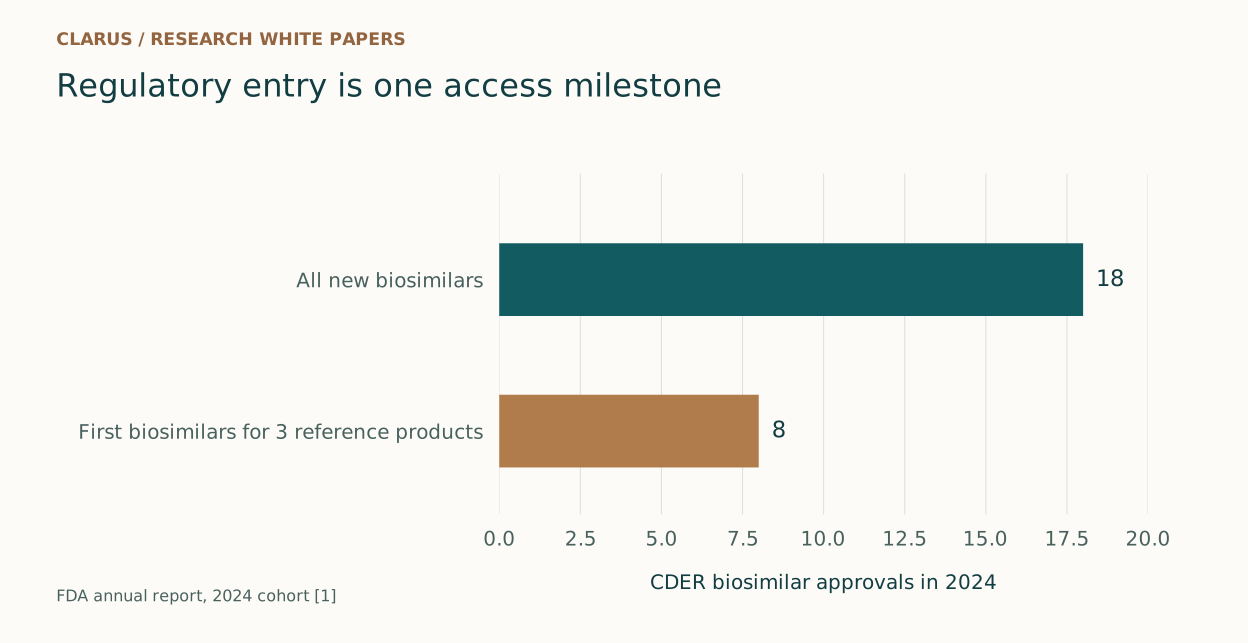
FDA’s 2024 annual report records 18 new CDER biosimilar approvals. Eight were for three reference products that previously had no approved biosimilars. These are product approvals, not a count of commercially launched products or patients who switched therapies. [1]
FDA’s biosimilar product information provides the authoritative product-level entry point. Reuters’ May 2024 report on the first Soliris biosimilar illustrates how an individual approval enters the news cycle. Neither an approval list nor a news announcement establishes local availability or a payer’s current coverage terms. [2, 3]
Clarus analysis: map the implementation sequence
The first step is product availability. Identify the intended geography, launch timing, supply conditions, and the organizations responsible for distribution. The access discussion should distinguish a product that is authorized from one that can actually be ordered in the intended setting.
The second step is the decision pathway. Determine who evaluates the option: a payer, a health system, a procurement team, a clinician, or more than one of these groups. A favorable decision at one level does not remove the need for implementation at the next. Map the evidence and operational information each group requires.
The third step is workflow. Product selection may interact with ordering, inventory, administration, documentation, and patient communication. A commercial plan should describe these tasks in the actual care setting and identify where avoidable friction could prevent a regulatory option from becoming a practical one.
The fourth step is measurement. Evaluate reach through observable access milestones, such as availability at relevant sites and completion of implementation decisions. Do not substitute market-entry counts for actual uptake or affordability. A sound access dashboard keeps those measures separate so a bottleneck can be located.
A practical access evidence brief
For each intended setting, record the population served, decision makers, distribution route, and implementation requirements. Pair the proposed access advantage with the evidence needed to substantiate it. If the claim concerns costs, state whose costs are being measured and over what period. If it concerns convenience, define the task and comparator.
Build a review cadence around bottlenecks rather than only around sales activity. A supply issue, a procurement delay, or an incomplete implementation process can each call for a different action. The team should be able to tell which condition limits access before it chooses a response.
Limits and next evidence
The graphic is a 2024 approval snapshot; the highlighted subset is included within the total. It makes no estimate of savings, switching, availability, or market share. Current product and setting-specific decisions require up-to-date regulatory, supply, coverage, and operational information.
From reading to a reviewable decision
| Dimension | Evidence to inspect | Next decision check |
|---|---|---|
| Availability | Supply and distribution readiness | Verify ordering in the intended setting |
| Decision pathway | Coverage and procurement process | Identify the next decision maker |
| Implementation | Clinical and administrative workflow | Measure the actual access bottleneck |
Clarus editorial synthesis. This framework is not a validated predictive model.
THE NEXT VALUE INFLECTION
What would change the decision
The graphic is a 2024 approval snapshot; the highlighted subset is included within the total. It makes no estimate of savings, switching, availability, or market share. Current product and setting-specific decisions require up-to-date regulatory, supply, coverage, and operational information.
Editorial record
Prepared by Clarus Biotech Review editorial team. Updated 9/30/2026.
Publication relationship: ClarusReview is connected to BioClarus Consulting. No article-specific sponsorship is recorded.
Report a correctionDiscuss this paper
Share evidence, ask a question, or offer a professional perspective. Community guidelines
Loading discussion…