What cardiovascular evidence adds to an access dossier
Wegovy’s outcomes result and Medicare’s next negotiation cycle frame evidence, budget and eligible-population planning.
ClarusBIOTECH REVIEWRead, listen & keep
Narrated by Hermione. Save the audio for offline listening.
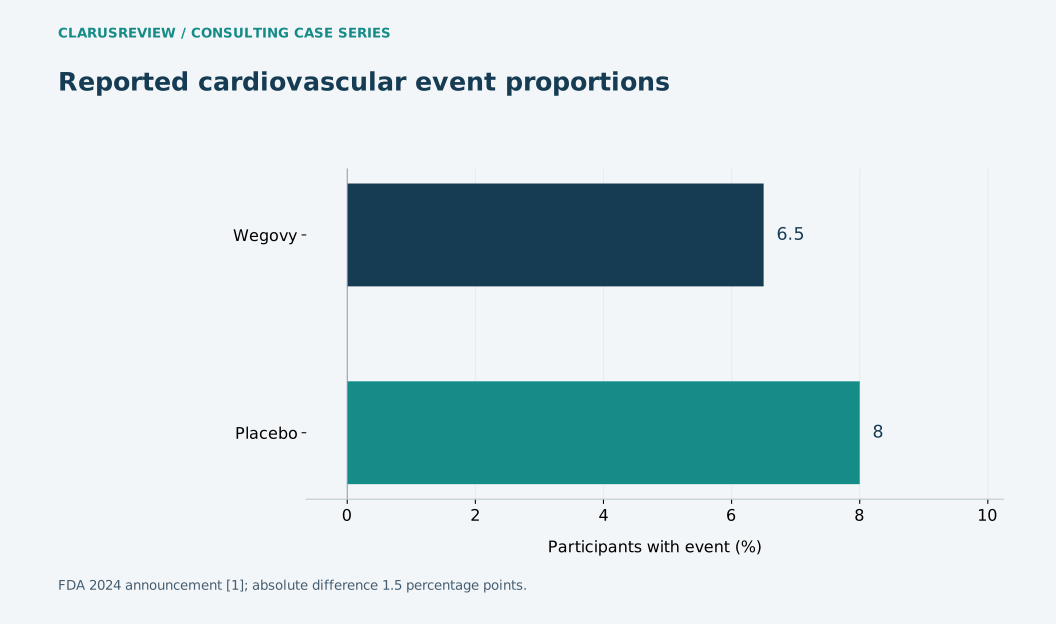
View figure data and context
| Measure | Value |
|---|---|
| Wegovy | 6.5 |
| Placebo | 8 |
The consulting assignment
A broader evidence package can make a product relevant to additional stakeholders without automatically making it affordable or covered for every patient. The consultant should identify which decision each endpoint supports, which population was studied and what costs accompany real-world use. That approach connects clinical value to an access plan without converting efficacy into guaranteed demand.
The documented comparator
FDA’s March 2024 Wegovy cardiovascular announcement reported major cardiovascular events in 6.5% versus 8.0% of participants. The calculated absolute difference is 1.5 percentage points. The raw proportion-based relative reduction is 18.75%, which should not be confused with a time-to-event hazard-ratio estimate. [1]
The current-news bridge
CMS announced 15 drugs for its third negotiation cycle in January 2026, with negotiations during 2026 and prices effective January 1, 2028. That calendar illustrates a known policy timing issue; it does not establish selection or a future price for the fictional product below. [2]
Hypothetical client and numerical assumptions
An invented chronic-disease sponsor considers a 10,000-person payer cohort and assumes 25% initiation at $3,000 annual net drug cost. The drug budget is $7.5 million for 2,500 patient-years. Adding an assumed $500 annual monitoring/service cost per treated patient raises the modeled total to $8.75 million, before offsets or discontinuation.
What the numbers change
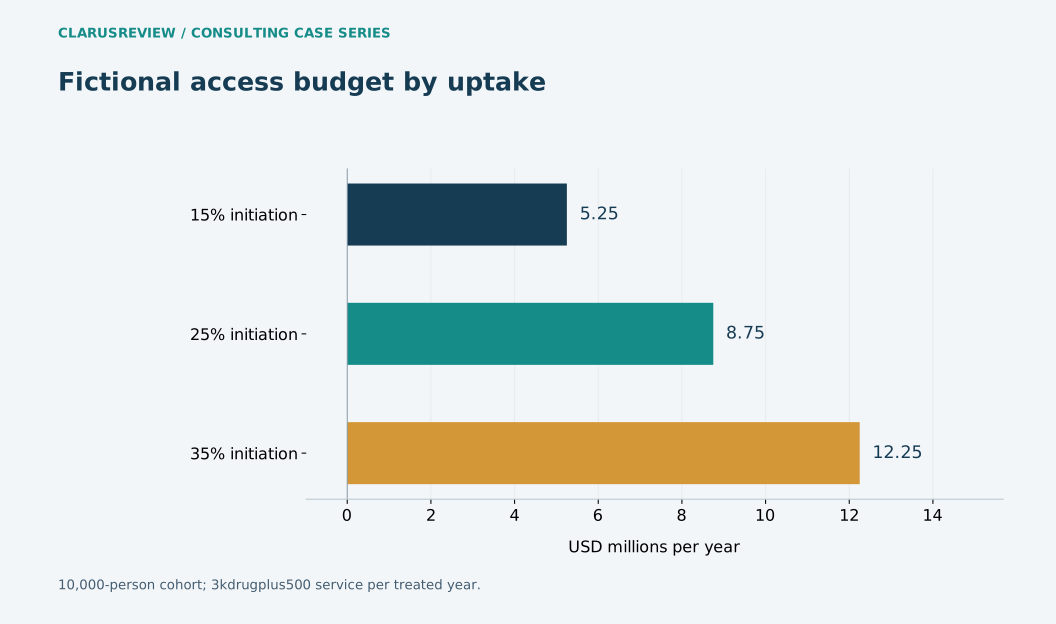
At 15%, 25% and 35% initiation, the combined drug-and-service spending becomes $5.25 million, $8.75 million and $12.25 million. These fictional costs and uptake rates are unrelated to Wegovy’s current pricing. They demonstrate how an access dossier can show budget consequences without manufacturing a cost-effectiveness conclusion.
For arithmetic illustration only, a 1.5-percentage-point event-proportion difference corresponds to 150 fewer events per 10,000 trial-like participants over the reported study horizon. It does not establish 150 annual events prevented in a payer’s different population, and real-world adherence or baseline risk can alter the result. Do not place that quantity next to annual spending and imply a matched time horizon.
The evidence plan should collect the outcomes relevant to the intended payer decision and retain the appropriate comparator. A clinical effect, label expansion and reimbursement determination are separate milestones. Each can change the next financing or launch decision, but none should be presumed to complete the other two.
| Scenario | USD millions per year |
|---|---|
| 15% initiation | 5.25 |
| 25% initiation | 8.75 |
| 35% initiation | 12.25 |
The next decision gate
Prepare a three-part dossier: trial evidence with uncertainty and horizon, the intended eligible-population definition, and year-specific budget scenarios. Reconcile inclusion criteria with the payer cohort and define which real-world observations would change uptake or cost assumptions. A consultant can recommend evidence priorities without predicting an undisclosed future coverage decision.
What to watch next
Track published policy dates, final versus proposed rules and actual contracts. Future negotiation cycles should enter the model as timed scenarios until product-specific outcomes are documented.
| Workstream | Measure to collect | Decision use |
|---|---|---|
| Evidence | Absolute and relative effect with study horizon | Avoid importing trial benefit into unmatched annual budgets |
| Population | Eligible patients under intended indication | Keep label and payer criteria distinct |
| Budget | Drug, service and offset cash flows by year | Present affordability separately from value |
Reporting cutoff: October 1, 2026 Pacific. Later outcomes are not assumed. These tools illustrate decisions; they are not validated clinical, legal or investment prediction models.
Indication-specific access budget
Assumed service cost is $500 per treated patient-year; no downstream savings are imputed.
Budget = cohort × initiation / 100 × (net drug cost + $500 service).
Changing an input explores a scenario; it does not establish an observed result. Inputs stay in this page and are not submitted.
THE NEXT VALUE INFLECTION
What would change the decision
Prepare a three-part dossier: trial evidence with uncertainty and horizon, the intended eligible-population definition, and year-specific budget scenarios. Reconcile inclusion criteria with the payer cohort and define which real-world observations would change uptake or cost assumptions. A consultant can recommend evidence priorities without predicting an undisclosed future coverage decision.
Editorial record
Prepared by Clarus Biotech Review editorial team. Updated 10/2/2026.
Publication relationship: ClarusReview is connected to BioClarus Consulting. No article-specific sponsorship is recorded.
Report a correctionDiscuss this paper
Share evidence, ask a question, or offer a professional perspective. Community guidelines
Loading discussion…