Clinical authorization and freedom to operate are separate milestones
The CRISPR patent appeal frames a hypothetical rights map, licensing sensitivity and IP diligence gate.
ClarusBIOTECH REVIEWRead, listen & keep
Narrated by Hermione. Save the audio for offline listening.
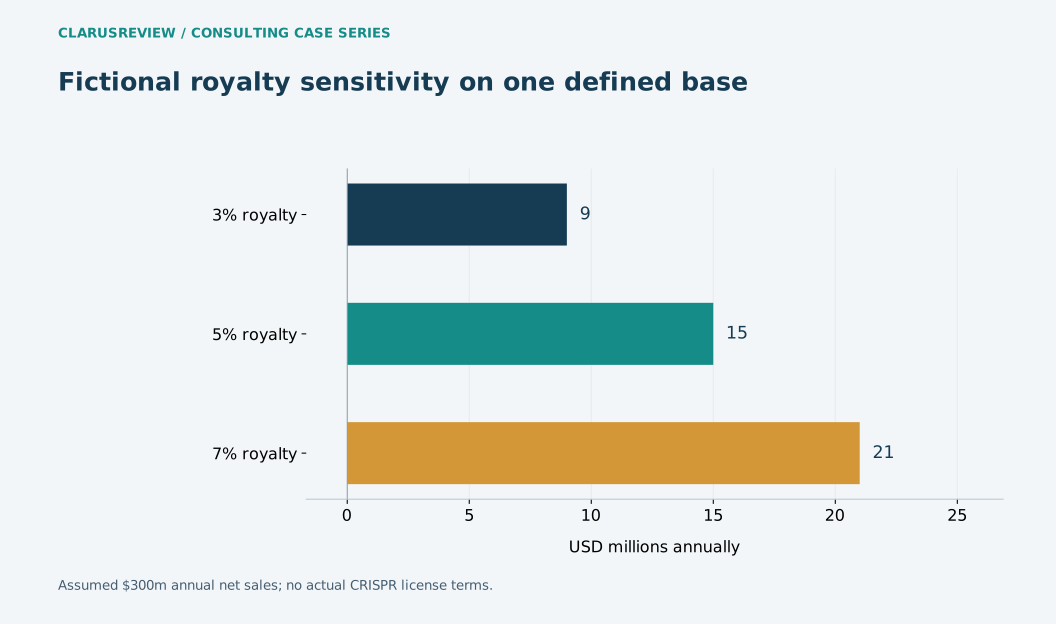
View figure data and context
| Measure | Value |
|---|---|
| 3% royalty | 9 |
| 5% royalty | 15 |
| 7% royalty | 21 |
The consulting assignment
A biotechnology asset can have credible biology, a regulatory pathway and an incomplete rights position at the same time. Value Inflection Engineering should keep these uncertainties distinct. Scientific validation does not determine ownership, and a patent license does not establish clinical benefit. The consultant coordinates the diligence map while qualified counsel evaluates the legal conclusions.
The documented comparator
In May 2025 the Federal Circuit affirmed in part, vacated in part and remanded the main Broad–UC CRISPR appeal, while dismissing the cross-appeal. That opinion should not be reported as a final resolution awarding every relevant commercial right to one party. Jurisdiction, claims and subsequent proceedings matter. [1]
The current-news bridge
FDA’s September 2026 camizestrant/diagnostic authorization provides a current example of a clinical-regulatory milestone. It is not a determination of freedom to operate; this methodological comparison makes no claim of an IP dispute involving those products. [2]
Hypothetical client and numerical assumptions
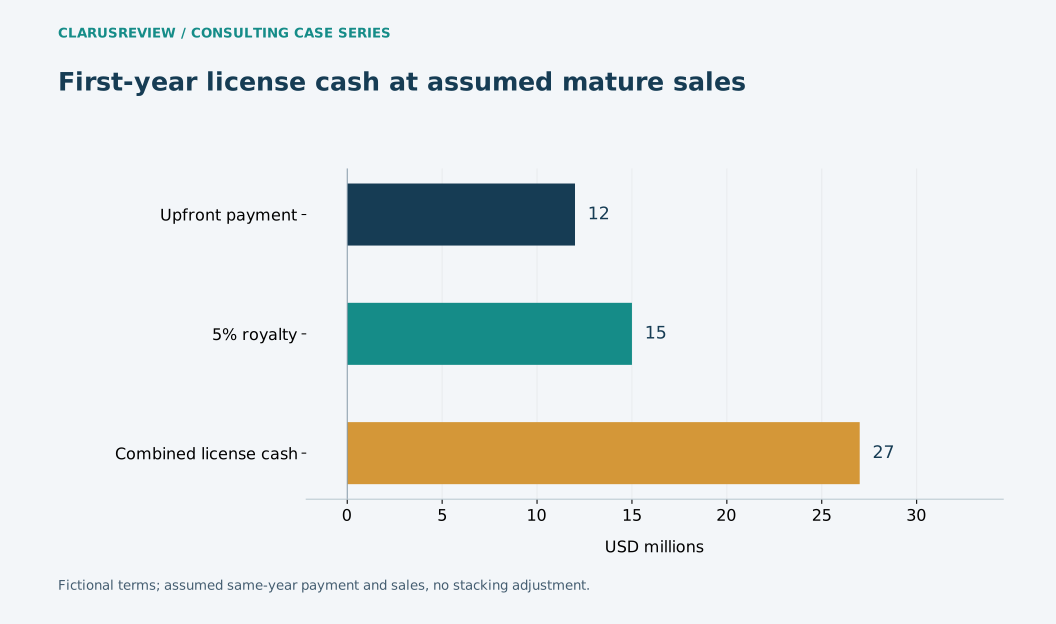
Assume an unrelated gene-editing client forecasts $300 million annual product net sales in a modeled mature year. A proposed license asks for $12 million upfront plus a 5% sales royalty. Annual royalty would be $15 million; first-year license cash would be $27 million if that mature sales level and the upfront payment occurred in the same year. The economics are fictional.
What the numbers change
Royalty sensitivities of 3%, 5% and 7% imply $9 million, $15 million and $21 million annual payments at the same sales level. If a second license adds 2% on the same royalty base, combined royalties at the middle case total $21 million annually. Agreements may define different bases, caps or stacking adjustments, so simple addition is only an explicitly stated assumption.
The rights map should distinguish platform technology, editing components, delivery, manufacturing, disease-specific use and improvements. Owning one layer may leave another dependent on a third party. Territory and patent term also matter: a global product forecast cannot be supported by an unexplained single-jurisdiction rights conclusion.
A transaction data room should contain the relevant assignments, license schedules, prosecution and dispute status, sublicense permissions and obligations. The finance model should link each royalty to its contractual base and include payments due before revenue. Commercial exclusivity, patent exclusivity and regulatory exclusivity are related planning inputs, but they are not interchangeable rights.
| Scenario | USD millions |
|---|---|
| Upfront payment | 12 |
| 5% royalty | 15 |
| Combined license cash | 27 |
The next decision gate
Set an IP gate before signing a major collaboration or committing to a launch assumption: counsel-reviewed claims and territory map, verified chain of title and a funded plan for unresolved dependencies. If a right is uncertain, show the affected development or commercial option explicitly instead of assigning a generic legal contingency percentage.
What to watch next
Future proceedings or agreements may change the rights position. Recheck their actual status before any transaction decision; the dated appeal opinion supplies historical context rather than a current clearance opinion.
| Workstream | Measure to collect | Decision use |
|---|---|---|
| Rights | Claim, owner, jurisdiction and sublicense permission | Locate missing dependencies |
| Economics | Royalty base, stacking, caps and upfront timing | Avoid an unsupported blended royalty |
| Milestone | Counsel-reviewed unresolved-rights register | Keep legal clearance separate from clinical evidence |
Reporting cutoff: October 1, 2026 Pacific. Later outcomes are not assumed. These tools illustrate decisions; they are not validated clinical, legal or investment prediction models.
License cash sensitivity
Assumes one royalty base and same-year upfront payment; excludes caps, stacking relief and taxes.
Annual royalty = sales × rate / 100. First-year cash = upfront + royalty.
Changing an input explores a scenario; it does not establish an observed result. Inputs stay in this page and are not submitted.
THE NEXT VALUE INFLECTION
What would change the decision
Set an IP gate before signing a major collaboration or committing to a launch assumption: counsel-reviewed claims and territory map, verified chain of title and a funded plan for unresolved dependencies. If a right is uncertain, show the affected development or commercial option explicitly instead of assigning a generic legal contingency percentage.
Editorial record
Prepared by Clarus Biotech Review editorial team. Updated 10/2/2026.
Publication relationship: ClarusReview is connected to BioClarus Consulting. No article-specific sponsorship is recorded.
Report a correctionDiscuss this paper
Share evidence, ask a question, or offer a professional perspective. Community guidelines
Loading discussion…