Supply resilience is part of access: reading drug-shortage statistics carefully
Recent FDA prevention counts provide a signal about supply interventions, while leaving product-level access questions unresolved.
ClarusBIOTECH REVIEWRead, listen & keep
Narrated by Hermione. Save the audio for offline listening.

View figure data and uncertainty
| Measure | Reported value |
|---|---|
| 2023 | 236 |
| 2024 | 283 |
| 2025 | 330 |
Executive perspective
A medicine’s value is difficult to realize when it cannot be supplied consistently. Access planning should include supply resilience as an operating requirement, alongside clinical evidence and commercial decisions. National shortage statistics offer context, but a useful product plan needs to locate its own vulnerabilities.
This white paper uses a recent public FDA report to distinguish a system-level intervention count from the exposure faced by a particular manufacturer or care setting. The Clarus framework converts that distinction into a product-level dependency map and a small set of actionable readiness questions.
Published evidence and scope
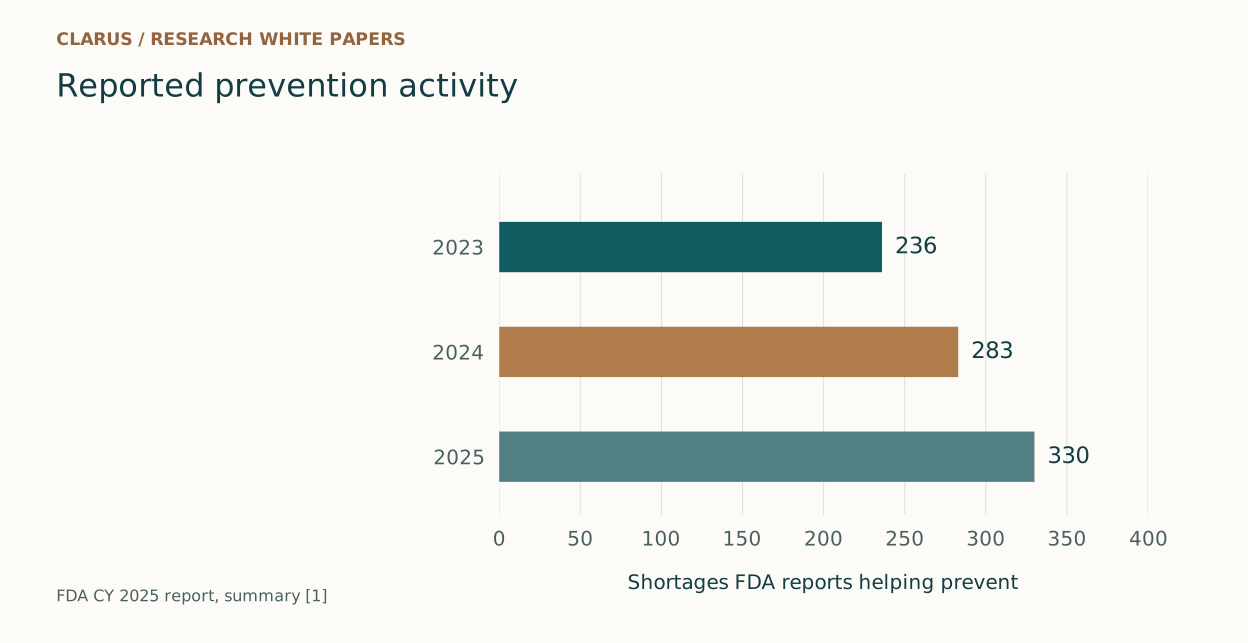
FDA’s calendar-year 2025 report states that the agency helped prevent 236 drug shortages in 2023, 283 in 2024, and 330 in 2025. These are reported prevented-shortage counts, not the number of active shortages, a measure of patients affected, or a controlled estimate of intervention effectiveness. [1]
FDA’s public drug-shortage resources provide product-level status information and describe routes for reporting supply interruptions. They are a source to consult when a current product question arises; an annual aggregate cannot resolve that question. [2]
Clarus analysis: follow the product dependencies
Start with the product’s critical inputs and work outward. Identify suppliers, specialized equipment, analytical release requirements, packaging, and distribution conditions that could interrupt usable supply. A single-source dependency deserves a different response from a capacity limitation or a long release cycle. The map should explain the mechanism of interruption, not just list suppliers.
Next, distinguish detection from response. Early visibility into a problem is valuable only if the organization knows what it can do with that information. Assign responsibility for identifying the issue, assessing its consequences, and coordinating the response. The plan should include the evidence needed before any proposed alternative supply path can be used.
Then connect supply conditions to the intended access setting. A national statistic may conceal very different local experiences. Product allocation, inventory rules, distribution intervals, and demand variability can each change whether a site can maintain service. A commercial launch assumption should therefore specify the level at which availability is measured.
Finally, preserve the denominator in every dashboard. A rise in prevented-shortage counts can reflect changes in underlying risks, reporting, interventions, or other conditions. It should not automatically be presented as deterioration or improvement in the whole supply system. The figure can motivate planning while leaving causal questions open.
A practical resilience review
Hold a cross-functional review that links manufacturing, quality, supply, and commercial teams. For each major dependency, record the interruption scenario, warning signal, mitigation option, evidence requirement, and decision owner. Test the plan against a plausible scenario and identify where it relies on an unverified assumption.
Integrate the resulting actions into the next development or launch milestone. Supply readiness should be demonstrated through conditions that can be checked: validated capacity, qualified inputs, interpretable release data, and an executable distribution plan. A signed supply contract is a useful artifact, but it does not answer every readiness question.
Limits and next evidence
Reported prevention counts are not comparable to an institution’s active-shortage inventory without reconciling definitions and timing. This paper does not quantify a product’s shortage risk or recommend changes to manufacturing controls. The next useful evidence is a current, product-specific supply assessment and a verified response plan.
From reading to a reviewable decision
| Dimension | Evidence to inspect | Next decision check |
|---|---|---|
| Dependency | Critical input or supply step | Describe how interruption occurs |
| Response | Warning signal and qualified alternative | Assign the decision and evidence owner |
| Access | Availability in the intended care setting | Test distribution and inventory assumptions |
Clarus editorial synthesis. This framework is not a validated predictive model.
THE NEXT VALUE INFLECTION
What would change the decision
Reported prevention counts are not comparable to an institution’s active-shortage inventory without reconciling definitions and timing. This paper does not quantify a product’s shortage risk or recommend changes to manufacturing controls. The next useful evidence is a current, product-specific supply assessment and a verified response plan.
Editorial record
Prepared by Clarus Biotech Review editorial team. Updated 9/30/2026.
Publication relationship: ClarusReview is connected to BioClarus Consulting. No article-specific sponsorship is recorded.
Report a correctionDiscuss this paper
Share evidence, ask a question, or offer a professional perspective. Community guidelines
Loading discussion…