Metabolic disease: sequence indications around evidence, capacity and access
A MASH case shows why a biomarker result, an approval and a commercial forecast answer different questions.
ClarusBIOTECH REVIEWRead, listen & keep
Narrated by Hermione. Save the audio for offline listening.

The metabolic-disease source paper links obesity, type 2 diabetes, MASH, lipid-related cardiovascular risk and kidney disease. Its useful insight is that one program may create several development opportunities. The corresponding discipline is to avoid counting overlapping patients, outcomes or revenue twice. A molecule’s activity in one organ system does not automatically establish a clinically meaningful benefit in another.
Value-Inflection Engineering starts with the evidence needed for a particular indication and then asks whether the company can fund, manufacture and deliver that program. The first attractive biological signal need not be the most executable commercial entry point. Screening infrastructure, endpoint duration and background therapy can change the capital required to reach a decision.
MASH illustrates the distinction between histology and clinical outcomes
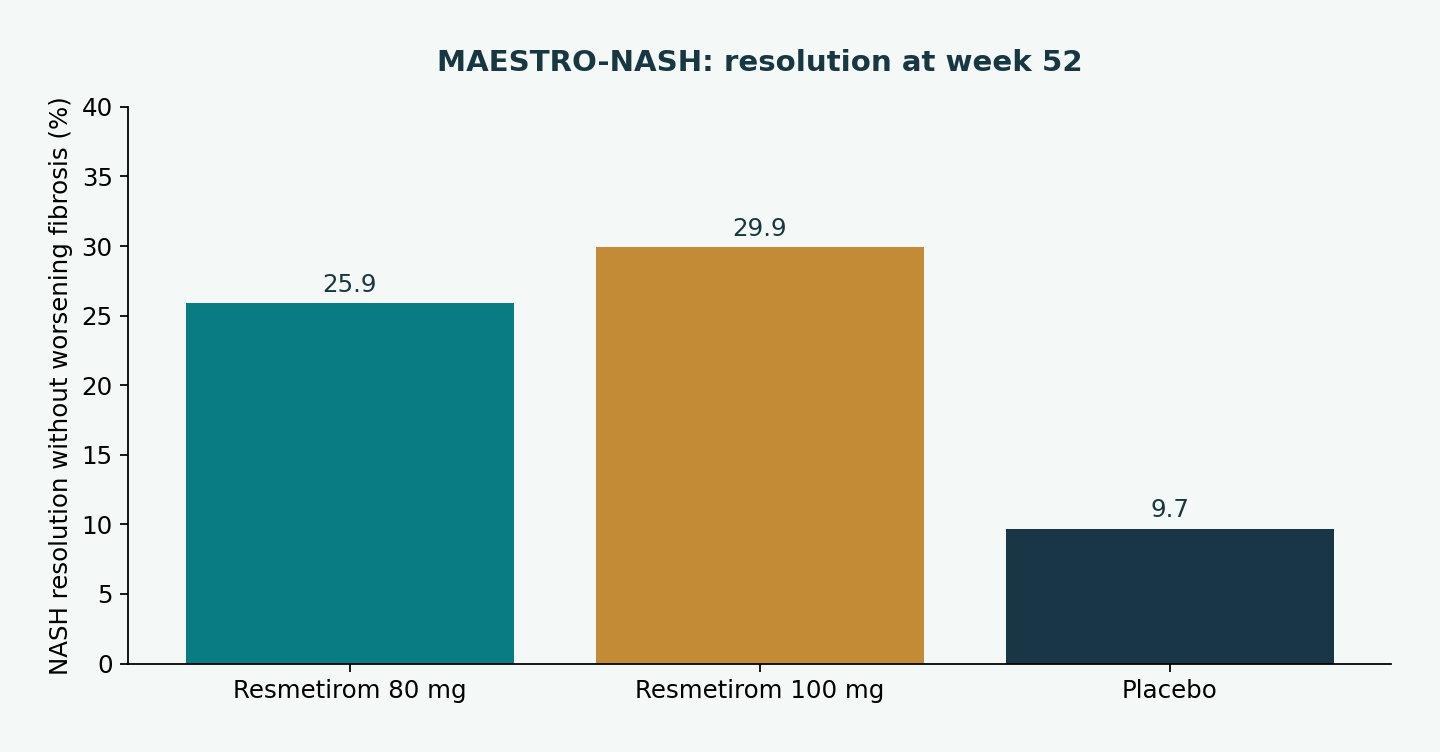
The 2024 MAESTRO-NASH report evaluated 966 patients in its primary analysis. At week 52, NASH resolution without worsening fibrosis occurred in 25.9% with resmetirom 80 mg, 29.9% with 100 mg and 9.7% with placebo. The calculated differences were 16.2 and 20.2 percentage points. The enrolled population included fibrosis stages F1B, F2 and F3; the trial population should not be silently equated with a label-defined population. [1]
FDA’s March 14, 2024 accelerated approval of Rezdiffra concerned adults with noncirrhotic NASH and moderate-to-advanced fibrosis, alongside diet and exercise. The agency described a month-12 surrogate-endpoint analysis within a 54-month trial and a requirement to verify clinical benefit. That historical approval decision should not be paraphrased as proof of reduced mortality or liver transplantation. [2]
For a new entrant, this creates two connected planning tasks: produce a credible near-term endpoint and fund the evidence that remains. A commercial model should carry both tasks. The first revenue date cannot be treated as the end of development expenditure when substantial follow-up remains part of the evidence plan.
Build one population model, then apply indication rules
A patient may have obesity, diabetes, hepatic disease and kidney disease simultaneously. Adding headline prevalence totals would overstate the number of distinct people. A defensible model instead starts with a defined geographic population and applies diagnosis, severity, eligibility and access rules. If several labels are contemplated, explicitly record overlap and whether the forecast counts patients, prescriptions or treatment-years.
The same care is needed with revenue. Sales of a multi-indication product are not automatically the market size for any one disease. The original paper identifies public revenue pools as proxies; this adaptation retains that limitation and does not convert them into precise market shares. Competitive positioning should instead begin with the relevant comparator and the attribute the new evidence can change.
The cost of an incomplete diagnostic pathway
An illustrative launch-readiness model begins with 10,000 referrals. Assume 40% complete staging, half of those satisfy treatment eligibility, 70% obtain access and 80% initiate. The result is 1,120 starts. Improving staging completion from 40% to 50%, with all later conditional rates unchanged, produces 1,400 starts: 280 additional starts. This is arithmetic under stated assumptions, not a forecast of resmetirom utilization.
If the additional 1,000 completed staging assessments cost an assumed $300 each, the incremental assessment cost is $300,000, or roughly $1,071 per additional modeled start. This excludes drug cost, coordination, monitoring and downstream care. It also does not establish that the intervention is cost-effective: the perspective, outcomes, durability and actual local costs would need to be specified.
The point is to make a bottleneck visible. A company may need better diagnostic completion before it needs a larger promotional footprint. Health systems may care more about appropriate referral and capacity than raw treatment-start volume. An adoption strategy should therefore report both eligible access and inappropriate referrals, rather than treating every increase in demand as success.
Sequence the next decision
For obesity, identify durability and tolerability alongside weight change. For diabetes, distinguish glycemic control from other outcomes. For lipid programs, keep biomarker lowering separate from event reduction. For kidney programs, specify baseline risk, background therapy and the endpoint definition. These are strategic questions, not claims that every class has equivalent evidence.
Before expanding indications, the executive team should compare calendar time, cash requirement, evidence uncertainty, manufacturing demand and access burden. Choose a base case and downside case for each path. A meaningful inflection is an evidence package that changes a decision with a feasible next step, rather than a larger list of potential indications.
Proposed operating dashboard
| Decision area | Measure or question | Why it matters |
|---|---|---|
| Clinical | Endpoint, follow-up and comparator for each indication | Prevents surrogate and clinical outcomes being mixed |
| Diagnosis | Staging completed / referrals; eligible / staged | Locates the real patient-pathway constraint |
| Supply | Released doses / forecast demand; stock-outs by period | Tests whether demand can be served |
| Finance | Cost to next readout plus ongoing commitments | Includes evidence obligations after an initial milestone |
| Access | Time to initiation; persistence at a defined interval | Separates first fill from durable use |
THE NEXT VALUE INFLECTION
What would change the decision
Before expanding indications, the executive team should compare calendar time, cash requirement, evidence uncertainty, manufacturing demand and access burden. Choose a base case and downside case for each path. A meaningful inflection is an evidence package that changes a decision with a feasible next step, rather than a larger list of potential indications.
Editorial record
Prepared by Clarus Biotech Review editorial team. Updated 10/1/2026.
Publication relationship: ClarusReview is connected to BioClarus Consulting. No article-specific sponsorship is recorded.
Report a correctionDiscuss this paper
Share evidence, ask a question, or offer a professional perspective. Community guidelines
Loading discussion…