From evidence to execution: an operating model for lean biotech teams
Coordinate clinical, regulatory and manufacturing decisions with clear ownership, acceptance criteria and measurable handoffs.
ClarusBIOTECH REVIEWRead, listen & keep
Narrated by Hermione. Save the audio for offline listening.

The consulting executive summary proposes integrating clinical clarity, commercial architecture, market intelligence, finance and deal execution. Its most useful general lesson is operational: an emerging company needs senior judgment at the points where one function’s decision creates obligations for another. A protocol change can affect supply. A formulation change can affect comparability. A launch assumption can affect manufacturing capacity and cash requirements.
This article translates that proposition into a working model for lean teams. It does not reproduce the source’s unverified firm track-record totals or categorical comparisons with other consulting models. Performance should be demonstrated through documented outcomes in a defined engagement, not inferred from the seniority label alone.
Handoffs create cost when requirements change late
A 2024 Tufts CSDD study reported data from 16 organizations covering 950 protocols and 2,188 amendments. Protocols with at least one amendment increased from 57% in the 2015 comparison to 76% in the follow-up, while mean amendments per protocol rose from 2.1 to 3.3. The study reported a mean 260 days from recognizing the need for an amendment to last oversight approval and 215 days during which sites used different versions. These are cohort observations, not guaranteed delays for every amendment. [1]
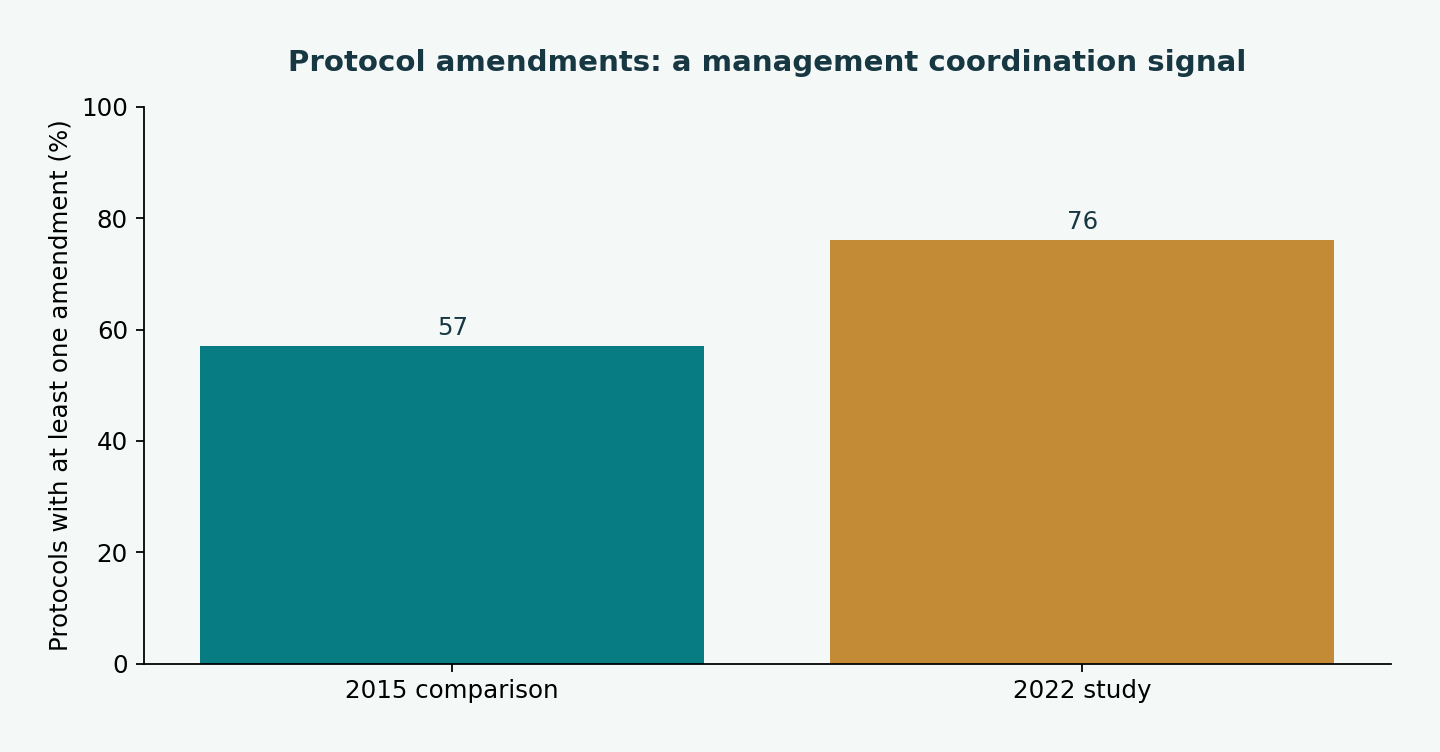
The findings do not prove that an integrated advisory team eliminates amendments. Many changes are necessary. They do show why change decisions require coordinated assessment of evidence, patient burden, site implementation, supply and budget. A team that measures only document completion can miss the operating consequences of a change.
Put manufacturing in the same decision room
FDA’s 2011 process-validation guidance describes a lifecycle approach encompassing process design, process qualification and continued process verification. A release-ready manufacturing process is therefore more than a batch that once met specifications. The development and commercial plan should account for process understanding, qualification and ongoing evidence of control. [2]
For a lean sponsor, the practical question is who owns each handoff among development, quality and external manufacturers. A clinical team needs confidence that the regimen and presentation can be supplied. A manufacturing team needs an appropriate forecast, specifications and change schedule. Finance needs commitments and contingencies. Regulatory needs the evidence relevant to the proposed change. No single team’s milestone is sufficient if the adjacent dependencies remain unresolved.
A bounded operating sprint
The source summary proposes a six-week sprint. Treat that as a management format rather than an observed industry cycle-time advantage. In weeks one and two, define the decision and reconcile current evidence, assumptions and commitments. In weeks three and four, test options and close the highest-impact gaps. In weeks five and six, prepare the decision memo, assign execution owners and set escalation rules.
A hypothetical sprint with four senior specialists contributing eight hours per week for six weeks requires 192 specialist hours. At an assumed $300 hourly internal or external rate, modeled specialist cost is $57,600. Adding $12,400 for analytics and operational support produces a $70,000 illustrative budget. These are scenario inputs, not BioClarus fees or a claim about the cost of competing firms.
A useful acceptance standard is that the executive decision can be made with the delivered package: assumptions reconciled, unresolved risks explicit, options costed and owners assigned. A polished deck without those elements is not a completed operating intervention. Conversely, discovering that the original timeline is infeasible may be a valuable result even when the final recommendation is slower or narrower.
Measure changes that matter
Track time between a decision being required and being resolved, overdue dependencies, change implementation across sites and suppliers, and the difference between committed and forecast expenditure. For manufacturing, use context-specific measures such as release-cycle time, failed or delayed batches and supply coverage. State what each denominator includes and whether the metric is within the sponsor’s control.
Decision cadence should be proportionate to risk. A weekly review can focus on the few dependencies capable of changing the next milestone, while functional teams retain their own detailed management. Escalation rules should identify when a threshold requires a cross-functional decision rather than another status report.
The operating model earns its value when it improves the quality and timeliness of an actual choice. Senior participation is an input; measurable execution is the outcome.
| Decision area | Measure or question | Why it matters |
|---|---|---|
| Clinical handoff | Protocol requirements reconciled with supply and site feasibility | Limits late incompatible changes |
| Manufacturing | Release time, deviations and available supply by regimen | Tests practical delivery readiness |
| Change control | Affected sites/suppliers implemented / required | Shows whether the decision reached the operating system |
| Finance | Committed cost, forecast cost and downside contingency | Keeps milestone decisions within a funding plan |
| Governance | Overdue dependencies; unresolved decisions; escalation owner | Measures execution rather than meeting volume |
THE NEXT VALUE INFLECTION
What would change the decision
The operating model earns its value when it improves the quality and timeliness of an actual choice. Senior participation is an input; measurable execution is the outcome.
Editorial record
Prepared by Clarus Biotech Review editorial team. Updated 10/1/2026.
Publication relationship: ClarusReview is connected to BioClarus Consulting. No article-specific sponsorship is recorded.
Report a correctionDiscuss this paper
Share evidence, ask a question, or offer a professional perspective. Community guidelines
Loading discussion…