Measure an advisory engagement by the decision it improves
Define the baseline, deliverables and economic perspective before attributing time or money saved to an intervention.
ClarusBIOTECH REVIEWRead, listen & keep
Narrated by Hermione. Save the audio for offline listening.

The client introductory summary proposes engagements around financing, asset prioritization, partnering, market access and AI strategy. Those triggers are useful because they identify a decision the leadership team already needs to make. The engagement should begin by stating that decision, the evidence missing and how the work will be judged when completed.
A capabilities list alone cannot define success. A financing engagement may improve a decision package without securing financing. An access engagement may identify a narrower eligible population rather than increase a forecast. An AI audit may recommend stopping a proposed implementation. These can be valuable outcomes if the original objective was to improve resource allocation and evidence quality.
Establish the cost of time carefully
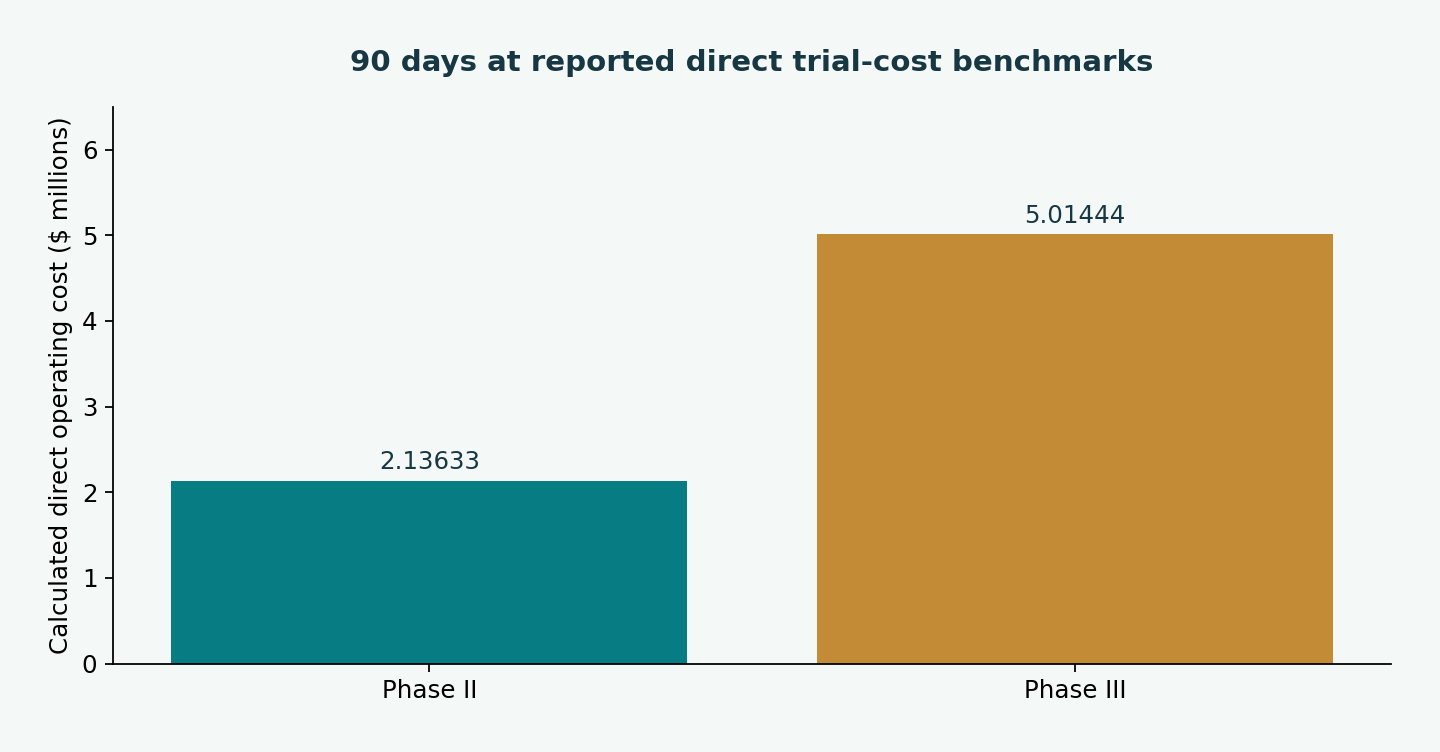
A Tufts CSDD 2024 whitepaper reported estimated direct daily clinical-trial costs of $23,737 for Phase II and $55,716 for Phase III. Multiplying by 90 days gives $2.136 million and $5.014 million. These historical benchmarks describe direct operating cost, not automatically avoidable cash or lost product sales. [1]
A sponsor’s actual contracts may make some costs fixed and others variable. A shorter calendar can release capacity without reducing total payments. A postponed launch may affect discounted future revenue, but that requires a separate model of approval probability, launch timing, demand and exclusivity. Combining all those categories into “daily savings” would overstate what a consulting intervention demonstrated.
Specify the attributable improvement
Consider a hypothetical $120,000 engagement intended to improve a Phase II decision process. Assume the relevant direct-cost benchmark is $23,737 per day and only 30% is economically avoidable. The avoidable component is $7,121.10 per day. At 20 attributable days, modeled avoided cost is $142,422 and net benefit after the fee is $22,422. Break-even requires about 16.85 days. This is an editorial scenario, not a promised result or a BioClarus price quote.
At 10 attributable days, modeled net benefit is negative $48,789; at 30 days it is positive $93,633. If the avoidable share were zero, the same calendar improvement would yield no direct cash-saving claim. These sensitivities force the organization to verify the causal and economic assumptions instead of presenting the favorable case alone.
The word “attributable” is consequential. Changes in site staffing, competitor activity, regulatory requests or supplier capacity may affect time independently of the engagement. A credible evaluation documents the baseline, concurrent interventions and which decision changed. Where causal attribution is weak, report the observed change and its limitations rather than assigning all benefit to the advisor.
Define outputs and outcomes separately
An evidence-gap map, target product profile, access model or diligence index is an output. A resolved development decision, a changed protocol, a qualified partner discussion or a documented budget adjustment is an outcome. The contract can specify acceptance of outputs, while the evaluation can separately assess whether they were used and what changed afterward.
For asset prioritization, record the criteria and assumptions applied to each option. For partnering, track stage progression and reasons for loss. For access, track eligible patients, coverage quality and time to initiation. For an AI audit, track validation gaps, workload changes and retained or avoided spend. The source summary’s broad engagement triggers become more useful when each carries a specific measurement plan.
A six-week diagnostic with a follow-through window
Use the first two weeks to establish the baseline and review the highest-impact evidence. Use the next two weeks to test options and quantify unresolved assumptions. Use the final two weeks to agree the decision, acceptance criteria and implementation owners. This is a proposed schedule from the source framework, not a universal delivery promise.
At 30 and 90 days after delivery, ask whether the decision was implemented and whether the expected measures can be observed. A short diagnostic can end on time while implementation remains unfinished. The follow-through window prevents the evaluation from stopping at the date a presentation was delivered.
The engagement should also state its limits: the client controls the final decision, evidence may remain incomplete and external events may change the plan. That clarity makes the work easier to evaluate. The most useful advisory relationship is one in which the team can explain what changed, what evidence supports that conclusion and how the next decision will be measured.
| Decision area | Measure or question | Why it matters |
|---|---|---|
| Baseline | Decision date, current forecast and documented gaps | Defines what improvement means |
| Deliverables | Accepted outputs / agreed outputs; unresolved assumptions | Makes completion reviewable |
| Implementation | Decisions acted on / decisions accepted at 30 and 90 days | Distinguishes a report from execution |
| Economics | Attributable days, avoidable share and perspective | Prevents capacity gains becoming unsupported cash savings |
| Learning | Forecast versus observed result; concurrent changes | Improves future scoping and attribution |
THE NEXT VALUE INFLECTION
What would change the decision
The engagement should also state its limits: the client controls the final decision, evidence may remain incomplete and external events may change the plan. That clarity makes the work easier to evaluate. The most useful advisory relationship is one in which the team can explain what changed, what evidence supports that conclusion and how the next decision will be measured.
Editorial record
Prepared by Clarus Biotech Review editorial team. Updated 10/1/2026.
Publication relationship: ClarusReview is connected to BioClarus Consulting. No article-specific sponsorship is recorded.
Report a correctionDiscuss this paper
Share evidence, ask a question, or offer a professional perspective. Community guidelines
Loading discussion…