AI biotech financing: measure the evidence purchased by a larger round
Historical financing events and a runway model clarify what a capital headline can—and cannot—tell a reader.
ClarusBIOTECH REVIEWRead, listen & keep
Narrated by Hermione. Save the audio for offline listening.

The AI-biotech financing paper argues that large rounds may fund an integrated evidence engine: models, proprietary data, experiments, translational science and clinical programs. That is a useful hypothesis, but a financing announcement alone cannot establish that the engine works. The reader needs to ask what the capital purchases, which uncertainty it reduces and whether the company can reach a meaningful dataset before needing more money.
This adaptation focuses on disclosed financing events and management economics rather than reconstructing an unverified social-media market map. Company-stage labels and logo collections can obscure differences among software tools, discovery platforms and clinical-asset developers. Those business models need different operating measures even when all use AI.
A financing sequence is more informative than one headline
Iambic announced a closed $100 million Series B on October 3, 2023 and a closed $50 million extension in June 2024. The arithmetic total for those two disclosed events is $150 million. A November 10, 2025 announcement described a separate financing exceeding $100 million. These historical amounts do not establish today’s cash balance, valuation or total lifetime funding. [1][2][3]
The releases describe development and platform ambitions, but investors still need actual spending and performance evidence. Capital raised is a financing input. Clinical progress, reproducible experiments and customer adoption are outputs that require separate measurement. A company can be well funded and still choose the wrong target, collect biased data or underestimate the cost of the next trial.
Runway depends on commitments and burn
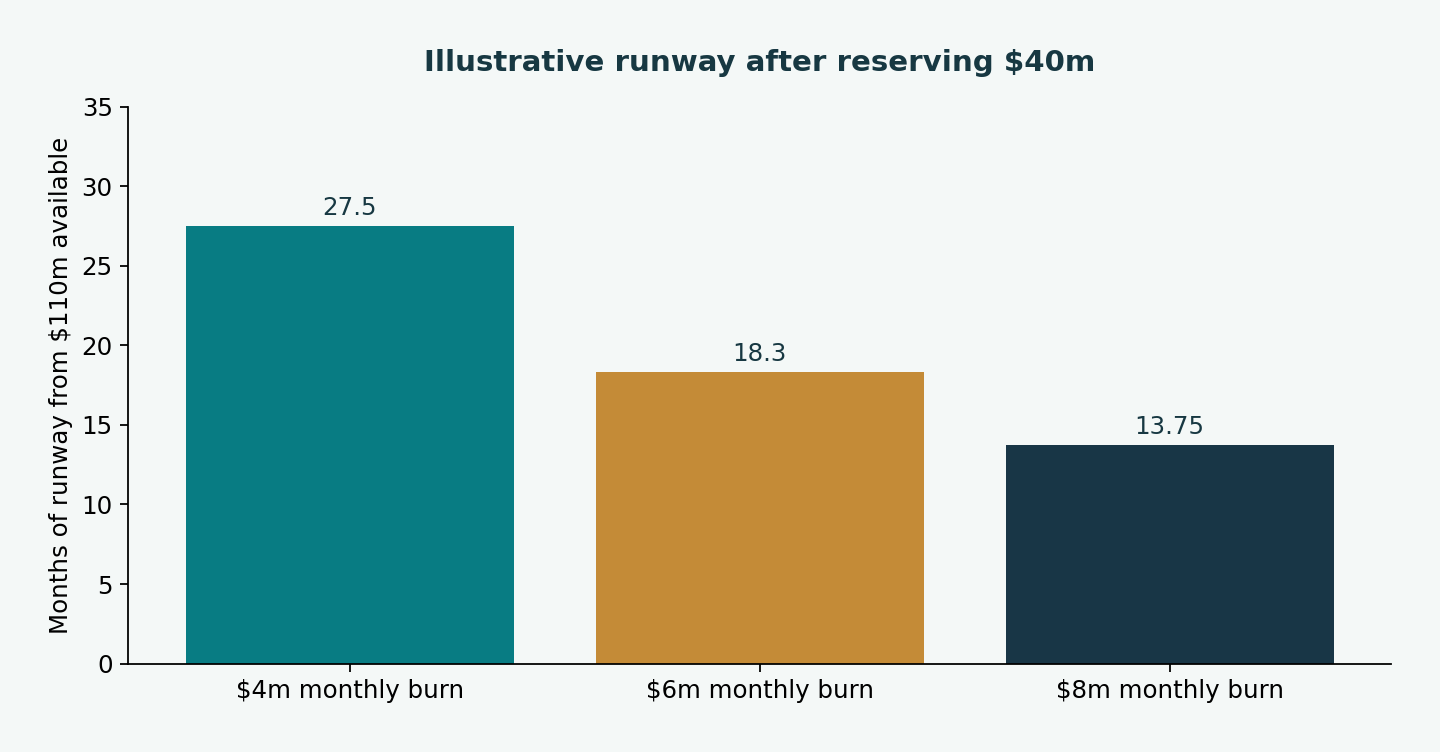
A hypothetical company starts with $150 million and reserves $40 million for obligations excluded from operating burn. The remaining $110 million supports 27.5 months at $4 million monthly burn, 18.3 months at $6 million, or 13.75 months at $8 million. This scenario is independent of the company examples above; none of the inputs is presented as Iambic financial guidance.
Suppose the decision-ready dataset is 20 months away and burn is $6 million per month. The operating requirement alone is $120 million, exceeding the available $110 million by $10 million before any buffer. If the company wants a six-month reserve after that dataset, the model needs another $36 million. The resulting $46 million gap is a scenario calculation, not a recommended financing size.
This is why the size of a round is incomplete without an operating plan. Upfront infrastructure can increase near-term spend while potentially improving future throughput. Whether that trade-off creates value depends on experimentally validated output, the quality of candidates and the cost of maintaining the system. Compute utilization and wet-lab throughput should be measured alongside capitalized capacity.
Distinguish tools, assets and hybrids
An enabling-tool business should track paid adoption, retained users or accounts, validated workflow performance, implementation cost and recurring economics. A therapeutic-asset business should track experimental reproducibility, candidate quality, toxicology, CMC readiness and clinical evidence. A hybrid must make both visible instead of using platform performance to imply medicine efficacy or early clinical activity to imply a scalable software business.
The source paper’s full-stack thesis can be tested through a cost-per-evidence-unit dashboard. Define the unit first: an independently reproduced hit, an accepted candidate package, a qualified workflow or an interpretable clinical dataset. Then include unsuccessful attempts in the denominator. Excluding failed experiments would make the evidence engine look more efficient than it is.
Stage capital around observable decisions
A practical allocation plan identifies what must be built internally and what can be partnered. For each workstream, record cash requirement, delivery date, acceptance criteria and the dependency it resolves. Fund experiments that can change a decision, while avoiding infrastructure that expands fixed cost before the use case is validated.
Large rounds can provide flexibility, but they can also create expectations for scale before the evidence supports it. A board should review downside runway and the option to narrow or stop programs at the same meeting as the upside pipeline. The next value inflection is the evidence that justifies the next commitment, not the announcement that money is available.
Proposed capital-to-evidence dashboard
| Decision area | Measure or question | Why it matters |
|---|---|---|
| Cash | Unrestricted funds; obligations; net operating burn | Defines actual runway |
| Discovery | Reproduced candidates / tested designs; cost per accepted package | Includes failed attempts |
| Infrastructure | Utilized capacity / installed capacity; maintenance burden | Tests fixed-cost efficiency |
| Clinical | Cost and months to decision-ready data | Links funding to a meaningful milestone |
| Platform business | Paid adoption, retention and implementation economics | Separates customer value from laboratory ambition |
THE NEXT VALUE INFLECTION
What would change the decision
Large rounds can provide flexibility, but they can also create expectations for scale before the evidence supports it. A board should review downside runway and the option to narrow or stop programs at the same meeting as the upside pipeline. The next value inflection is the evidence that justifies the next commitment, not the announcement that money is available.
Editorial record
Prepared by Clarus Biotech Review editorial team. Updated 10/1/2026.
Publication relationship: ClarusReview is connected to BioClarus Consulting. No article-specific sponsorship is recorded.
Report a correctionDiscuss this paper
Share evidence, ask a question, or offer a professional perspective. Community guidelines
Loading discussion…