Casgevy’s delivery lesson: patient benefit still needs a treatment slot
Original gene-editing evidence and 2026 launch revenue inform a hypothetical treatment-center capacity model.
ClarusBIOTECH REVIEWRead, listen & keep
Narrated by Hermione. Save the audio for offline listening.
View figure data and context
| Measure | Value |
|---|---|
| Treated | 44 |
| Efficacy evaluable | 31 |
| Met VF12 endpoint | 29 |
The consulting assignment
An effective one-time therapy can remain scarce in practice when collection, conditioning, manufacturing and inpatient care compete for finite resources. A launch forecast needs a capacity model as well as an eligible-patient count. The consultant’s job is to identify the limiting resource and the cost of increasing completed treatment, rather than simply counting activated centers.
The documented comparator
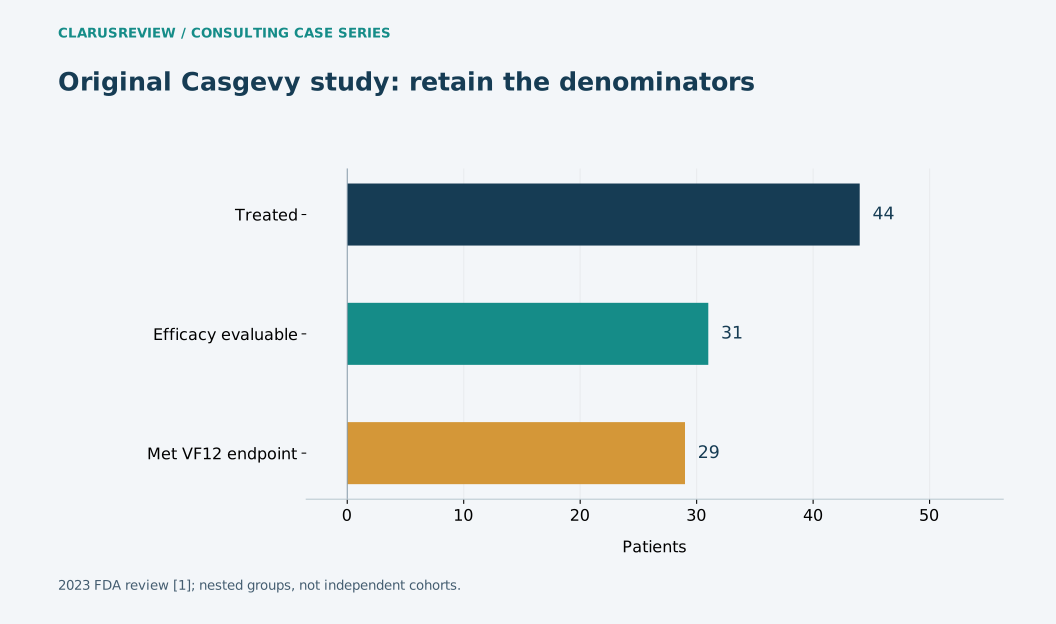
In the original 2023 Casgevy FDA review, 44 patients had been treated and 31 had sufficient follow-up for the specified efficacy analysis. Of those 31, 29—93.5%—achieved freedom from severe vaso-occlusive crises for at least 12 consecutive months. The evaluable denominator is essential; 93.5% is not a completion rate across all referrals. [1]
The current-news bridge
Vertex reported $76 million of Casgevy revenue in Q2 2026, up 78% sequentially. Revenue supplies a commercial checkpoint, but it cannot reveal center capacity, treated-patient counts or net revenue per patient without additional data. [2]
Hypothetical client and numerical assumptions
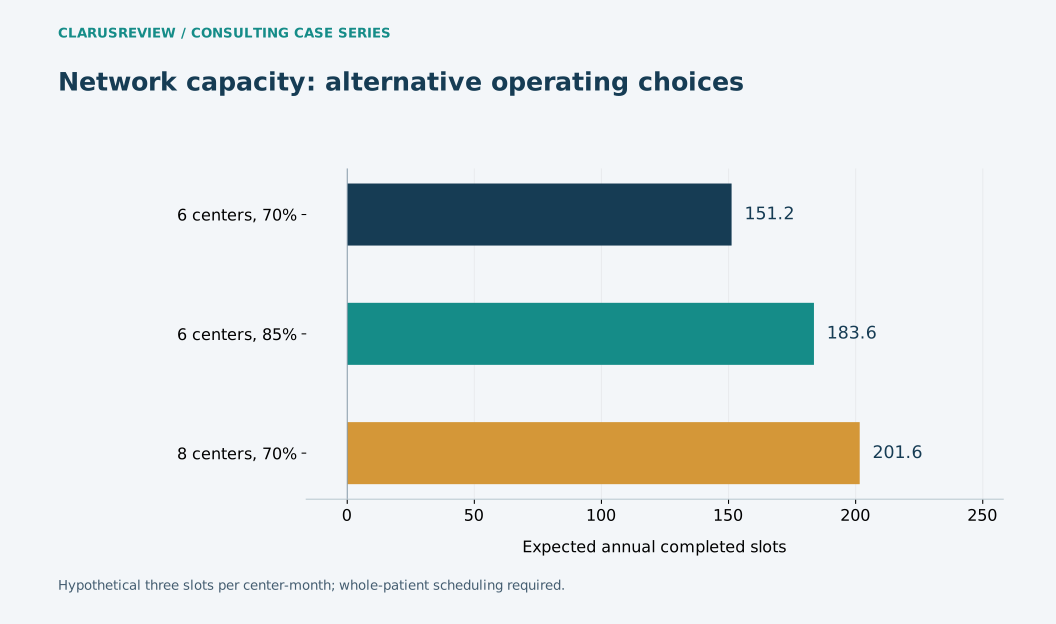
A fictional network has six centers, each with capacity for three relevant treatment slots monthly. At 70% usable-slot utilization, annual capacity is 6 × 3 × 12 × 0.70 = 151.2 expected completed slots. Fractional values are planning averages, not fractional patients. The actual schedule would allocate whole patients and track each prerequisite.
What the numbers change
Improving usable-slot utilization to 85% raises the expected annual total to 183.6, a gain of 32.4. Adding two centers at the original utilization gives 201.6. These scenarios are alternatives rather than additive effects. Before recommending expansion, determine whether the true constraint is a bed, a trained team, collection capacity, manufacturing release or patient readiness.
Assume a $2 million annual operating investment to improve scheduling and coordination. Its cost per additional modeled slot is about $61,728 using 32.4 incremental slots. That figure is a capacity-improvement ratio, not a therapy cost, clinical cost-effectiveness result or return on investment. A value case needs net contribution, care reimbursement and actual utilization.
The operating dashboard should record referral, work-up, authorization, collection, product availability, conditioning and infusion with timestamps. A slot is not productive if a prerequisite fails. Moving an upstream queue faster can simply enlarge the next queue; examine the complete patient journey before describing an intervention as an access improvement.
| Scenario | Expected annual completed slots |
|---|---|
| 6 centers, 70% | 151.2 |
| 6 centers, 85% | 183.6 |
| 8 centers, 70% | 201.6 |
The next decision gate
Pilot a shared readiness checklist at two centers for 90 days. Measure slot cancellation reasons and the interval between manufacturing release and clinical availability. Expand only when the same intervention reliably improves completed treatment rather than moving administrative dates. Preserve safety and suitability decisions independently of throughput targets.
What to watch next
Expected launch question: as eligible populations evolve, capacity may need to change in different ways by age and care setting. Model those requirements separately rather than applying an adult operating pathway unchanged.
| Workstream | Measure to collect | Decision use |
|---|---|---|
| Pathway | Median referral-to-infusion days | Identify the longest handoff |
| Capacity | Completed / schedulable slots | Separate availability from use |
| Quality | Cancellations by clinical and operational reason | Improve coordination without overriding suitability |
Reporting cutoff: October 1, 2026 Pacific. Later outcomes are not assumed. These tools illustrate decisions; they are not validated clinical, legal or investment prediction models.
Treatment-center throughput
Expected annual capacity at a fixed three slots per center-month; this is not a patient-benefit prediction.
Annual capacity = centers × monthly slots × 12 × utilization / 100.
Changing an input explores a scenario; it does not establish an observed result. Inputs stay in this page and are not submitted.
THE NEXT VALUE INFLECTION
What would change the decision
Pilot a shared readiness checklist at two centers for 90 days. Measure slot cancellation reasons and the interval between manufacturing release and clinical availability. Expand only when the same intervention reliably improves completed treatment rather than moving administrative dates. Preserve safety and suitability decisions independently of throughput targets.
Editorial record
Prepared by Clarus Biotech Review editorial team. Updated 10/2/2026.
Publication relationship: ClarusReview is connected to BioClarus Consulting. No article-specific sponsorship is recorded.
Report a correctionDiscuss this paper
Share evidence, ask a question, or offer a professional perspective. Community guidelines
Loading discussion…