The founder translation gap: turn a scientific signal into a decision brief
A practical architecture for communicating clinical meaning, financing exposure and the work required for adoption.
ClarusBIOTECH REVIEWRead, listen & keep
Narrated by Hermione. Save the audio for offline listening.

The founder translation paper describes a recurring problem: a compelling mechanism does not necessarily answer the question an investor, regulator, payer or clinician is asking. Investors need a financeable sequence of uncertainty reduction. Clinicians need interpretable benefit and risk for a defined patient. Payers need an eligible population, comparative context and a workable care pathway. One scientific presentation can support these discussions, but cannot replace their different decision criteria.
The corrective action is to connect each claim to a measured result and each result to a consequence. A decision brief should state the population, comparator, endpoint, observation period, effect estimate and uncertainty before explaining strategic importance. It should then identify the next unresolved question and the money and calendar time required to answer it.
Base rates discipline the narrative
BIO, Informa and QLS’s 2011–2020 analysis estimated overall likelihood of approval from Phase 1 at 7.9% and Phase 2 transition success at 28.9%. These are historical aggregate estimates, not the probability of success for an individual company. They are useful for challenging certainty in a development narrative, while program-specific biology, design and evidence remain essential. [1]
A board should ask which new evidence justifies changing a program’s working probability. An arbitrary increase after a favorable press release is not an evidence model. Define the conditional decision in advance: which dose, population and effect would justify a pivotal study, and what would lead to a narrower indication or termination? Record the same criteria when results disappoint.
Clinical meaning requires both scale and context
In the 2023 TRAILBLAZER-ALZ 2 report, the low/medium-tau population had mean iADRS changes of −6.02 with donanemab and −9.27 with placebo at 76 weeks; the adjusted difference was 3.25 points. Both groups declined. The whole trial randomized 1,736 participants. Amyloid-related edema or effusion occurred in 24.0% versus 2.1%, with three versus one deaths considered treatment related. These findings require benefit and safety to be communicated together. [2]
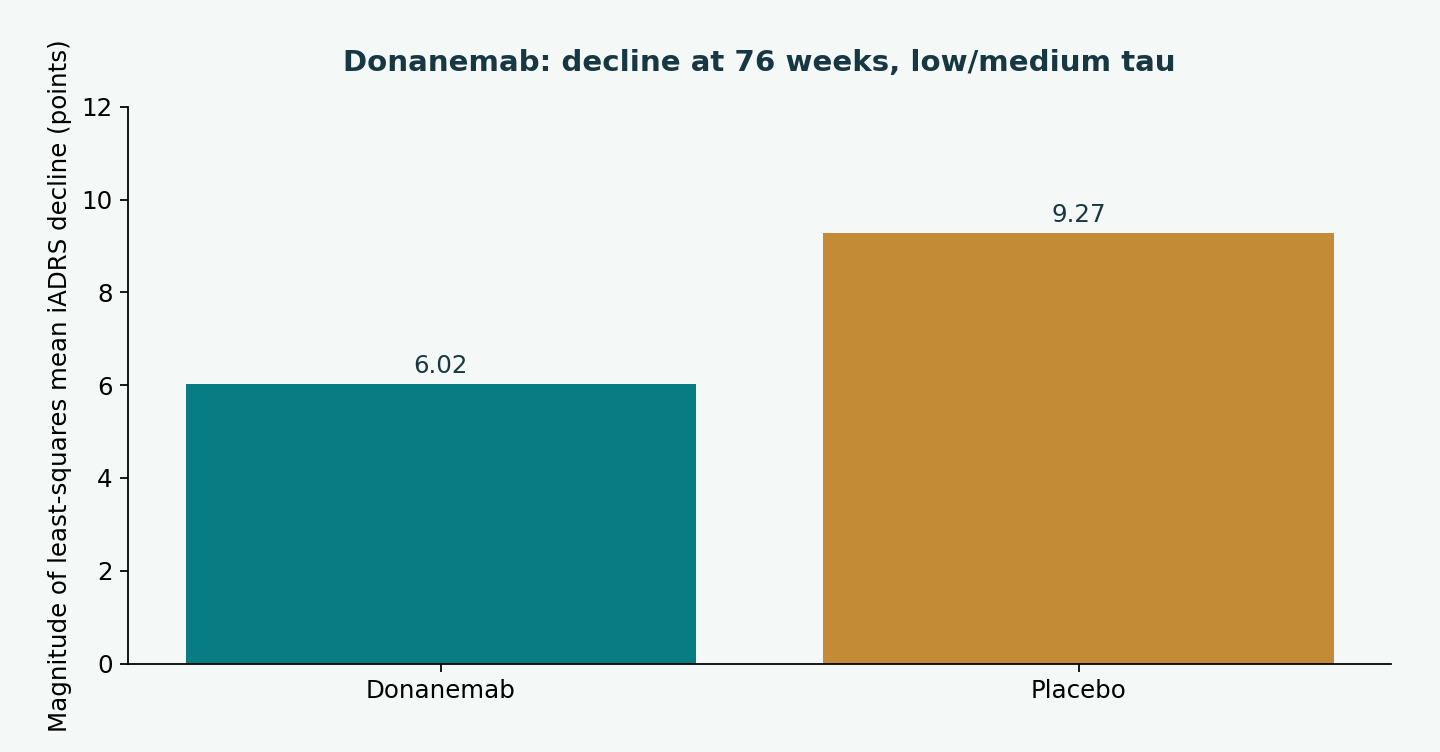
An absolute difference on a clinical scale, a relative slowing percentage and a modeled number of months are different descriptions. A founder should not move among them without explaining the calculation and assumptions. The audience also needs to know which population the result describes. A biomarker-selected trial is not evidence that the same effect applies to every patient carrying the disease label.
CMS’s July 2023 lecanemab coverage statement required an eligible diagnosis, documented amyloid pathology and a physician participating in a qualifying registry with an appropriate clinical team and follow-up. This historical example shows how coverage can include an evidence-collection and delivery pathway after approval. [3]
Put calendar exposure beside the clinical claim
Consider an illustrative program with $30 million in unrestricted cash, $1.2 million monthly operating burn and $8 million of trial payments outside that burn. Reserving those trial payments leaves $22 million, or 18.3 months at the assumed burn. If the next decision dataset is 15 months away, the nominal buffer is only 3.3 months. A four-month delay would consume $4.8 million and exceed that buffer. These are hypothetical inputs, not a company forecast.
A financing discussion should therefore show the cash definition, committed obligations, readout date range and downside scenario. Do not count the same trial expense twice; equally, do not omit it because a headline burn rate excludes large payments. The communication problem is resolved by improving the model, not by replacing a downside chart with more optimistic wording.
Translate oncology and CNS with different questions
For oncology, define biomarker selection, treatment line, endpoint maturity, durability and the comparator likely to matter when the program reads out. For CNS, define disease stage, clinically interpretable change, endpoint reliability, caregiver burden and diagnostic or monitoring capacity. These are questions from the uploaded framework, not a ranking of therapeutic areas.
A useful stakeholder package has a common factual core and audience-specific decisions. The investor version emphasizes capital to the next dataset and financing options. The payer version emphasizes patient eligibility, comparative value and utilization. The clinical version emphasizes effect, uncertainty, safety and practical use. Contradictory claims across versions signal a strategy problem.
Proposed translation checklist
| Decision area | Measure or question | Why it matters |
|---|---|---|
| Scientific claim | Mechanism → human exposure → measured outcome | Prevents mechanistic activity becoming a clinical claim |
| Clinical meaning | Absolute effect, uncertainty and patient population | Makes the result interpretable |
| Finance | Cash to dataset; committed payments; delay sensitivity | Tests whether the next step can be funded |
| Access | Diagnosis, monitoring, registry and care-site capacity | Connects approval to delivery |
| Decision | Predefined continue, narrow or stop criteria | Makes the narrative testable |
THE NEXT VALUE INFLECTION
What would change the decision
A useful stakeholder package has a common factual core and audience-specific decisions. The investor version emphasizes capital to the next dataset and financing options. The payer version emphasizes patient eligibility, comparative value and utilization. The clinical version emphasizes effect, uncertainty, safety and practical use. Contradictory claims across versions signal a strategy problem.
Editorial record
Prepared by Clarus Biotech Review editorial team. Updated 10/1/2026.
Publication relationship: ClarusReview is connected to BioClarus Consulting. No article-specific sponsorship is recorded.
Report a correctionDiscuss this paper
Share evidence, ask a question, or offer a professional perspective. Community guidelines
Loading discussion…