Read the deal structure: upfront value and contingent milestones are different
A large ADC collaboration illustrates why maximum announced consideration should be decomposed before it enters a value narrative.
ClarusBIOTECH REVIEWRead, listen & keep
Narrated by Hermione. Save the audio for offline listening.
View figure data and uncertainty
| Measure | Reported value |
|---|---|
| Upfront | 4 |
| Continuation payments | 1.5 |
| Maximum sales milestones | 16.5 |
Executive perspective
A licensing headline often combines money paid at the start, future continuation payments, contingent milestones, and sometimes a broader sharing arrangement. The resulting maximum is an announcement metric. It is not automatically realized proceeds, an asset valuation, or a comparable price for another company’s program.
Value Inflection Engineering asks which evidence and decisions sit behind those payment categories. This white paper examines the original terms of a historical collaboration to build a practical reading method. It does not assess the present clinical status of the assets or the current financial outcome of the agreement.
Announced terms and source context
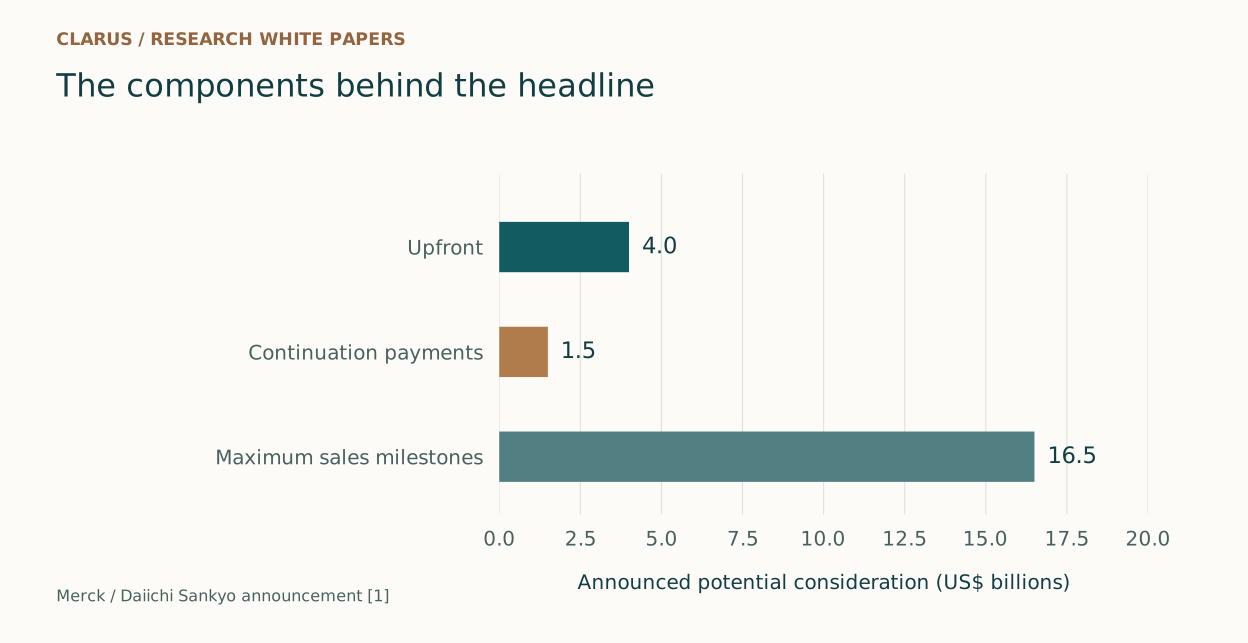
The October 2023 Merck–Daiichi Sankyo announcement described US$4 billion upfront, US$1.5 billion in continuation payments over 24 months, and up to US$16.5 billion contingent on future sales milestones across three ADC programs, for up to US$22 billion. Merck could opt out of specified programs and avoid the associated continuation payments. [1]
Fierce Biotech’s reporting placed the agreement in an oncology portfolio context. That helps explain the strategic interest, but the payment categories in this chart come from the companies’ original announcement. [2]
Clarus analysis: decompose the headline
First, identify the economic categories and the conditions attached to each. Upfront consideration, continuation rights, development milestones, sales milestones, royalties, and profit sharing describe different exposures. A maximum contingent amount should remain labeled as such every time it is reused.
Second, identify what is being exchanged. The number of programs, territorial rights, development responsibilities, manufacturing obligations, and cost sharing can materially affect the economics. A comparison that ignores those terms can make two agreements look similar when they solve very different strategic problems.
Third, connect the structure to decisions. A continuation payment may preserve an option while leaving room to exit. A sales milestone links a potential payment to a future commercial event. Those structures imply different timelines and risks. The planning question is what evidence makes the next decision credible, not whether the announcement looks large.
Fourth, keep the strategic narrative separate from a valuation conclusion. A partner may be purchasing access to capabilities, portfolio breadth, development rights, or a particular candidate. The headline alone does not reveal how much each element contributes. A thoughtful value story acknowledges that uncertainty rather than treating the entire amount as a transferable benchmark.
A practical partnering evidence packet
For an emerging program, define the proposed collaboration’s scientific question, operating responsibilities, rights, and next decision. Link each proposed milestone to evidence that can be independently interpreted. If the milestone concerns development performance, specify the result; if it concerns commercialization, specify the event and its conditions.
Build comparables only after normalizing terms and dates. Retain the source announcement, identify contingent categories, and state whether any later changes have been included. When realized proceeds are not verified, say so. An auditable decomposition is more useful than a league table of headline deal sizes.
Limits and next evidence
The chart reconstructs announced 2023 categories, not realized payments or a current valuation. It excludes other cost-sharing and profit arrangements and does not discount contingent amounts. Current analysis requires the full agreement disclosures, later amendments, and verified program and payment status.
From reading to a reviewable decision
| Dimension | Evidence to inspect | Next decision check |
|---|---|---|
| Economics | Upfront versus conditional consideration | Preserve the payment category |
| Scope | Programs, rights, responsibilities, costs | Normalize before choosing comparables |
| Milestone | Evidence or event that releases a decision | Define conditions and timing explicitly |
Clarus editorial synthesis. This framework is not a validated predictive model.
THE NEXT VALUE INFLECTION
What would change the decision
The chart reconstructs announced 2023 categories, not realized payments or a current valuation. It excludes other cost-sharing and profit arrangements and does not discount contingent amounts. Current analysis requires the full agreement disclosures, later amendments, and verified program and payment status.
Editorial record
Prepared by Clarus Biotech Review editorial team. Updated 9/30/2026.
Publication relationship: ClarusReview is connected to BioClarus Consulting. No article-specific sponsorship is recorded.
Report a correctionDiscuss this paper
Share evidence, ask a question, or offer a professional perspective. Community guidelines
Loading discussion…