Buying an oncology platform does not buy a completed integration
Pfizer–Seagen provides transaction context for a fictional buyer’s integration reserve and portfolio gates.
ClarusBIOTECH REVIEWRead, listen & keep
Narrated by Hermione. Save the audio for offline listening.
View figure data and context
| Measure | Value |
|---|---|
| Systems | 20 |
| Manufacturing transfer | 30 |
| Evidence continuity | 50 |
The consulting assignment
An acquisition can secure capabilities, products and a scientific platform while creating a new operating problem: how to preserve the work that made the target attractive. Integration spending competes with development and launch needs. The consultant should identify which synergies are actionable, which require evidence and which could damage the portfolio if pursued too quickly.
The documented comparator
Pfizer announced completion of its Seagen acquisition in December 2023 at $229 per share and approximately $43 billion enterprise value. Enterprise value is a transaction measure, not a development budget, a product-specific valuation or proof of realized investment returns. [1]
The current-news bridge
The September 2026 withdrawal of a separate partnered ADC filing adds current context for portfolio diligence. The relevant lesson is that platform ownership does not make every asset’s regulatory outcome certain; the withdrawn candidate was not a Seagen program in this comparison. [2]
Hypothetical client and numerical assumptions
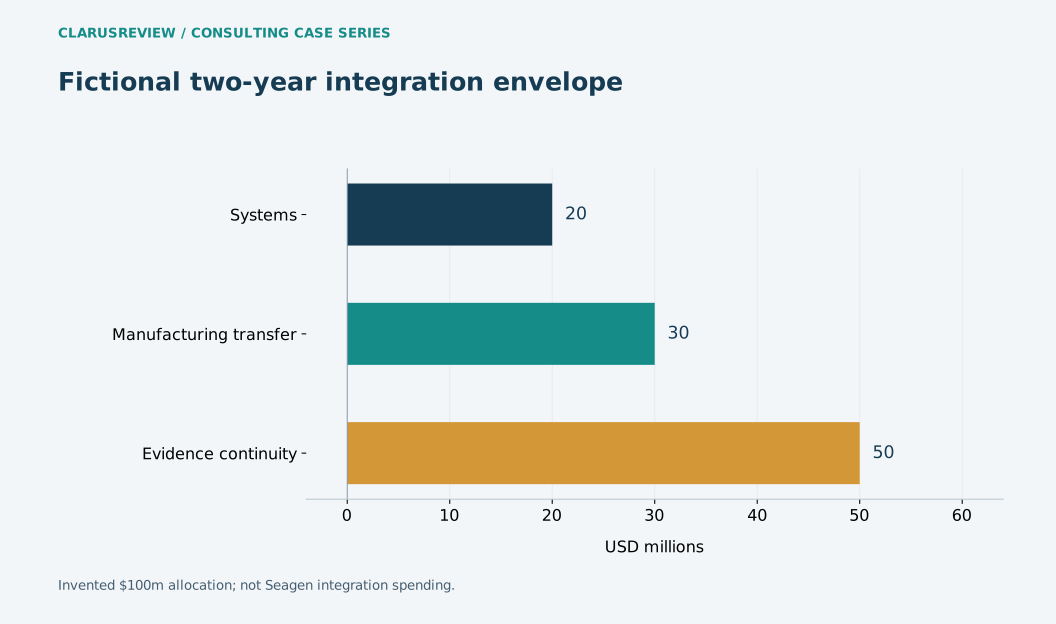
An invented buyer acquires an oncology company with four development programs. It sets a $100 million two-year integration envelope: $20 million for systems, $30 million for manufacturing-transfer work and $50 million for evidence continuity and specialist retention. Those allocations are fictional and are not Pfizer’s costs.
What the numbers change
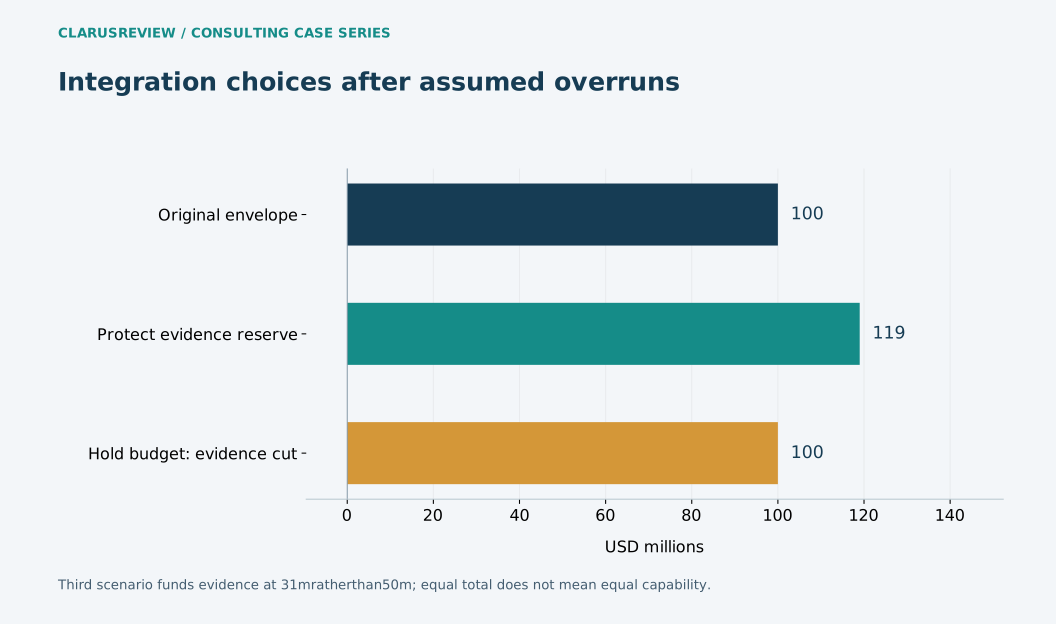
Suppose systems spending overruns 50%, adding $10 million, and manufacturing work overruns 30%, adding $9 million. Keeping evidence continuity intact raises the envelope to $119 million. Cutting that $50 million line by $19 million would preserve the original envelope while reducing evidence funding 38%. The apparent financial discipline could therefore compromise the very milestone supporting the acquisition thesis.
Assume planned recurring savings are $25 million annually, starting after a twelve-month transition. A one-year delay in their start creates a $25 million undiscounted timing gap, before integration overruns. Do not describe delayed savings as a permanent loss unless the later savings disappear. A multi-year discounted model is required for a return calculation.
The portfolio review should examine each program’s population, endpoint, manufacturing needs and cash to the next decision. Shared technology can create capabilities without justifying a common probability of success. Integration metrics should protect critical staff, study continuity and quality systems; headcount reductions alone cannot establish that value has been created.
| Scenario | USD millions |
|---|---|
| Original envelope | 100 |
| Protect evidence reserve | 119 |
| Hold budget: evidence cut | 100 |
The next decision gate
Ring-fence the evidence-continuity reserve until the next asset-specific review. Require integration owners to show how proposed cuts affect enrollment, release testing and milestone dates. Revisit the transaction thesis when new evidence changes expected economics rather than forcing each program to fit the original purchase narrative.
What to watch next
Expected integration risk: early systems or facility consolidation may create late development delays. Track milestone slippage and qualified capacity alongside promised synergies; future savings remain estimates until measured.
| Workstream | Measure to collect | Decision use |
|---|---|---|
| Continuity | Critical trial and release milestones met / due | Protect the acquisition’s evidence thesis |
| Integration | Cost and delay by workstream | Expose where overruns consume reserves |
| Synergies | Realized recurring savings on a consistent baseline | Separate timing changes from permanent value loss |
Reporting cutoff: October 1, 2026 Pacific. Later outcomes are not assumed. These tools illustrate decisions; they are not validated clinical, legal or investment prediction models.
Integration contingency calculator
Hold the fictional evidence-continuity reserve at $50m; adjust overruns on $20m systems and $30m manufacturing bases.
Envelope = $20m × (1 + systems overrun) + $30m × (1 + manufacturing overrun) + evidence reserve.
Changing an input explores a scenario; it does not establish an observed result. Inputs stay in this page and are not submitted.
THE NEXT VALUE INFLECTION
What would change the decision
Ring-fence the evidence-continuity reserve until the next asset-specific review. Require integration owners to show how proposed cuts affect enrollment, release testing and milestone dates. Revisit the transaction thesis when new evidence changes expected economics rather than forcing each program to fit the original purchase narrative.
Editorial record
Prepared by Clarus Biotech Review editorial team. Updated 10/2/2026.
Publication relationship: ClarusReview is connected to BioClarus Consulting. No article-specific sponsorship is recorded.
Report a correctionDiscuss this paper
Share evidence, ask a question, or offer a professional perspective. Community guidelines
Loading discussion…