Microneedle vaccine patches: bridge immunogenicity to real-world usability
A small Phase I study provides a useful early signal and a clear boundary around what remains to be demonstrated.
ClarusBIOTECH REVIEWRead, listen & keep
Narrated by Hermione. Save the audio for offline listening.
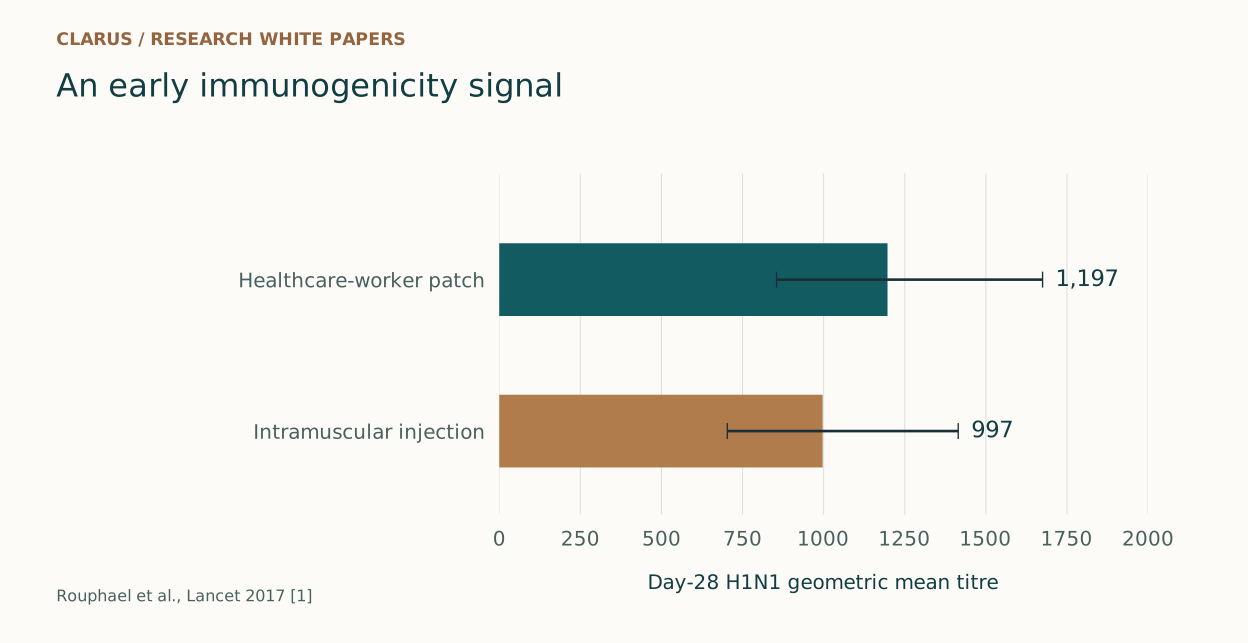
View figure data and uncertainty
| Measure | Reported value | 95% confidence interval |
|---|---|---|
| Healthcare-worker patch | 1,197 | 855–1,675 |
| Intramuscular injection | 997 | 703–1,415 |
Executive perspective
A new administration route has two connected tasks: preserve the product’s biological performance and work reliably in the hands of intended users. Early studies can support a credible direction while leaving both tasks incomplete. Microneedle vaccine patches are a useful case for explaining how a delivery innovation moves from an attractive concept to a testable product proposition.
The Clarus framework separates biological evidence, human interaction, and supply conditions. A patch can be appealing to users without establishing disease protection, and an antibody response can be encouraging without establishing broad usability. Each claim should have a planned measurement and a clear development owner.
Published evidence and scope
Rouphael and colleagues’ 2017 randomized, partly blinded Phase I influenza-vaccine study enrolled 100 healthy adults aged 18–49 across four groups. Day-28 H1N1 geometric mean antibody titres were 1,197 (95% CI 855–1,675) for healthcare-worker patch administration and 997 (703–1,415) for intramuscular injection. The comparison had p = 0.5. [1]
This small study measured safety, immunogenicity, and acceptability; it was not a trial proving protection against influenza disease or statistical equivalence between routes. FDA’s combination-product human-factors guidance provides a separate framework for assessing interactions between users and a product. [2]
Clarus analysis: three parallel evidence tracks
The biological track begins with the antigen and formulation, then follows the evidence into a relevant human response. Its endpoint needs to match the development question. When an early immunogenicity measure is used, preserve its role and avoid converting it into an unsupported clinical-effectiveness claim.
The interaction track asks who will use the product, in which setting, and which errors could compromise its intended performance. Instructions, application feedback, incomplete use, and disposal may all matter. A usability advantage should be measured in the intended context rather than inferred from a favorable demonstration conducted under supervision.
The supply track tests whether the product can remain within its specifications through manufacturing, storage, distribution, and use. A potential advantage in one setting does not establish that advantage across all conditions. Connect any proposed logistical benefit to a defined specification and a verification plan.
These tracks should influence each other. A design change that improves handling may affect product attributes; a formulation change may affect application or packaging. Planning the tracks together can reveal the dependencies before the team commits to a clinical or manufacturing path.
A practical translation plan
Write the intended-user story first: who administers the product, what environment they encounter, and what successful use looks like. Then identify the observations needed to support that story. Map biological, interaction, and supply claims to distinct studies and combine the results at a defined product-profile review.
For early presentations, show the sample size prominently and keep the endpoint wording close to the data. A nonsignificant comparison is not proof that two methods are equivalent. If equivalence or noninferiority is important to the intended product claim, that question needs an appropriately designed and analyzed study.
Limits and next evidence
The trial’s healthy-adult population, small size, partial blinding, and immunogenicity endpoints limit generalization. The chart displays two arms of a four-arm trial and does not summarize its full safety record. Subsequent development needs context-specific performance, human-factors, stability, and clinical evidence.
From reading to a reviewable decision
| Dimension | Evidence to inspect | Next decision check |
|---|---|---|
| Biological performance | Relevant response and safety | Define the clinical question still open |
| User interaction | Successful use in intended conditions | Test critical tasks and foreseeable errors |
| Supply performance | Specifications through distribution | Verify each claimed logistical benefit |
Clarus editorial synthesis. This framework is not a validated predictive model.
THE NEXT VALUE INFLECTION
What would change the decision
The trial’s healthy-adult population, small size, partial blinding, and immunogenicity endpoints limit generalization. The chart displays two arms of a four-arm trial and does not summarize its full safety record. Subsequent development needs context-specific performance, human-factors, stability, and clinical evidence.
Editorial record
Prepared by Clarus Biotech Review editorial team. Updated 9/30/2026.
Publication relationship: ClarusReview is connected to BioClarus Consulting. No article-specific sponsorship is recorded.
Report a correctionDiscuss this paper
Share evidence, ask a question, or offer a professional perspective. Community guidelines
Loading discussion…