Oncology value inflection: matching evidence, capital and the treatment setting
Positive and negative trial examples show why endpoint choice, patient selection and execution costs must be assessed together.
ClarusBIOTECH REVIEWRead, listen & keep
Narrated by Hermione. Save the audio for offline listening.

The uploaded oncology whitepaper considers lung, breast, prostate and colorectal cancers and multiple myeloma. Its central strategic challenge is to connect a differentiated therapeutic proposition to a specific patient population, an interpretable endpoint, manufacturable supply and a financeable development sequence. Broad claims about “oncology demand” cannot resolve those program-level questions.
A value-inflection plan should identify the evidence that could materially change a decision, then work backward to the capital and operating requirements. Two contrasting trials illustrate why the clinical setting matters. They are not competing treatments and should not be ranked against each other; their usefulness here is in the different decisions their results support.
LAURA: a biomarker-defined setting and a substantial PFS result
FDA’s September 25, 2024 approval summary describes LAURA: 216 adults with unresectable stage III EGFR-mutated NSCLC without progression during or after chemoradiation. Median progression-free survival was 39.1 months with osimertinib versus 5.6 with placebo; the hazard ratio was 0.16 (95% CI 0.10–0.24). The calculated difference between medians is 33.5 months, not an overall-survival gain. Overall survival was immature at that approval analysis. [O1]
This is a different treatment setting from first-line metastatic FLAURA, already discussed elsewhere on ClarusReview. The new article focuses on post-chemoradiation evidence, patient selection and the operational implications of a defined indication. An assay result, disease stage and treatment history jointly determine the relevant population; a top-line lung-cancer incidence figure cannot substitute for that eligibility funnel.
PALLAS: an extension of a mechanism did not establish the expected benefit
The 2025 five-year PALLAS report evaluated two years of palbociclib added to endocrine therapy in stage II–III HR-positive/HER2-negative early breast cancer. With median follow-up of 59.8 months, five-year invasive disease-free survival was 84.2% versus 82.4%; HR 0.88 (95% CI 0.77–1.01), P=.0614. The numerical difference of 1.8 percentage points did not establish a statistically significant benefit. [O2]
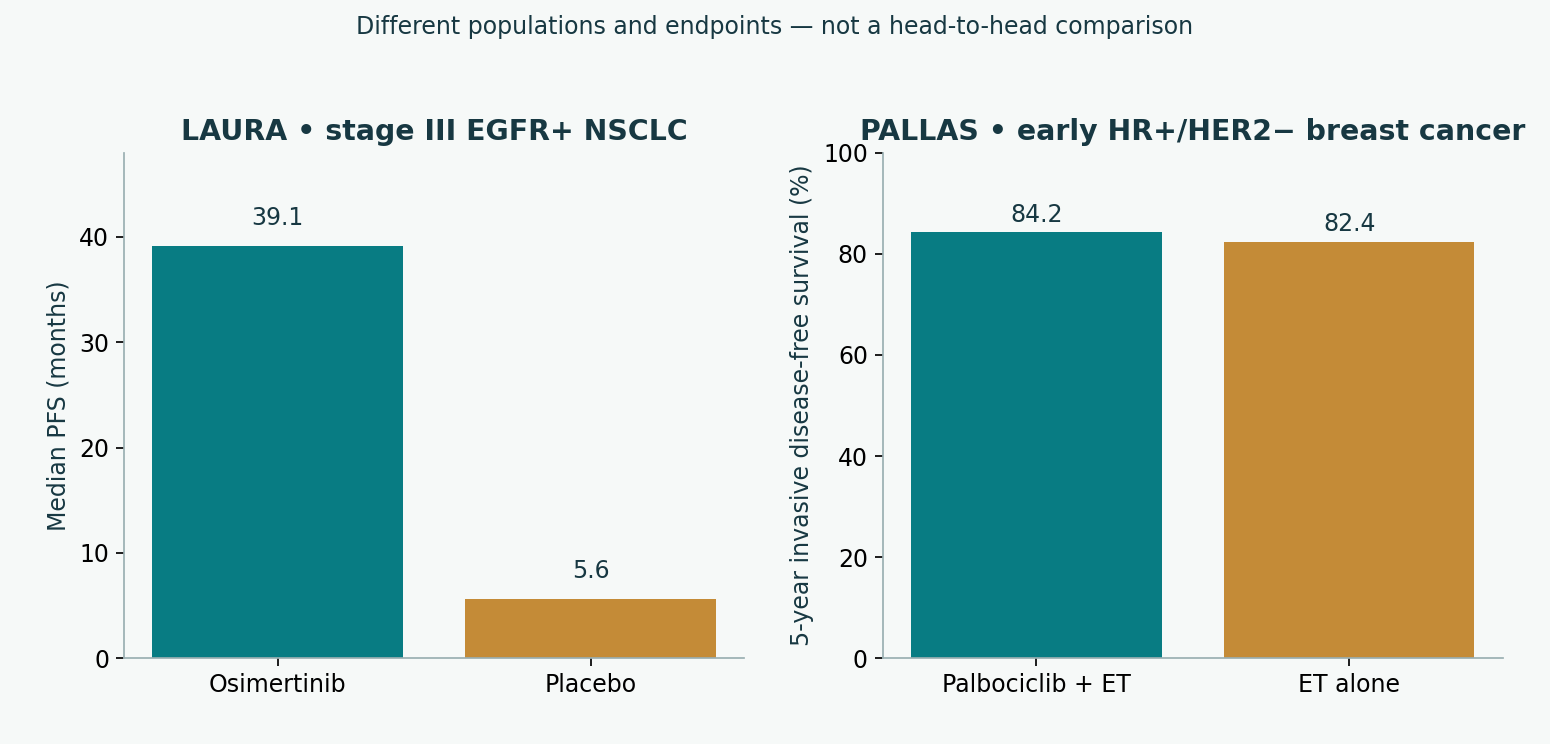
The management lesson is to challenge a proposed extension of a mechanism into a new setting. Biological rationale, treatment duration, adherence and event timing need their own evidence. A negative program can still improve portfolio decisions if the organization records which assumptions failed and stops carrying those assumptions into subsequent forecasts. A numerical difference should not be marketed as a confirmed benefit when the prespecified statistical evidence does not support that claim.
Screening yield is a capital variable
Consider an explicitly hypothetical 120-patient randomized trial. Assume screening costs $1,500 per person, randomized-patient costs are $100,000 each excluding screening, and fixed costs are $3 million. If 20% of screened people randomize, 600 screens cost $0.9 million and total modeled cost is $15.9 million. At a 10% yield, 1,200 screens cost $1.8 million and the modeled total rises to $16.8 million. These are planning assumptions, not reported LAURA or PALLAS budgets.
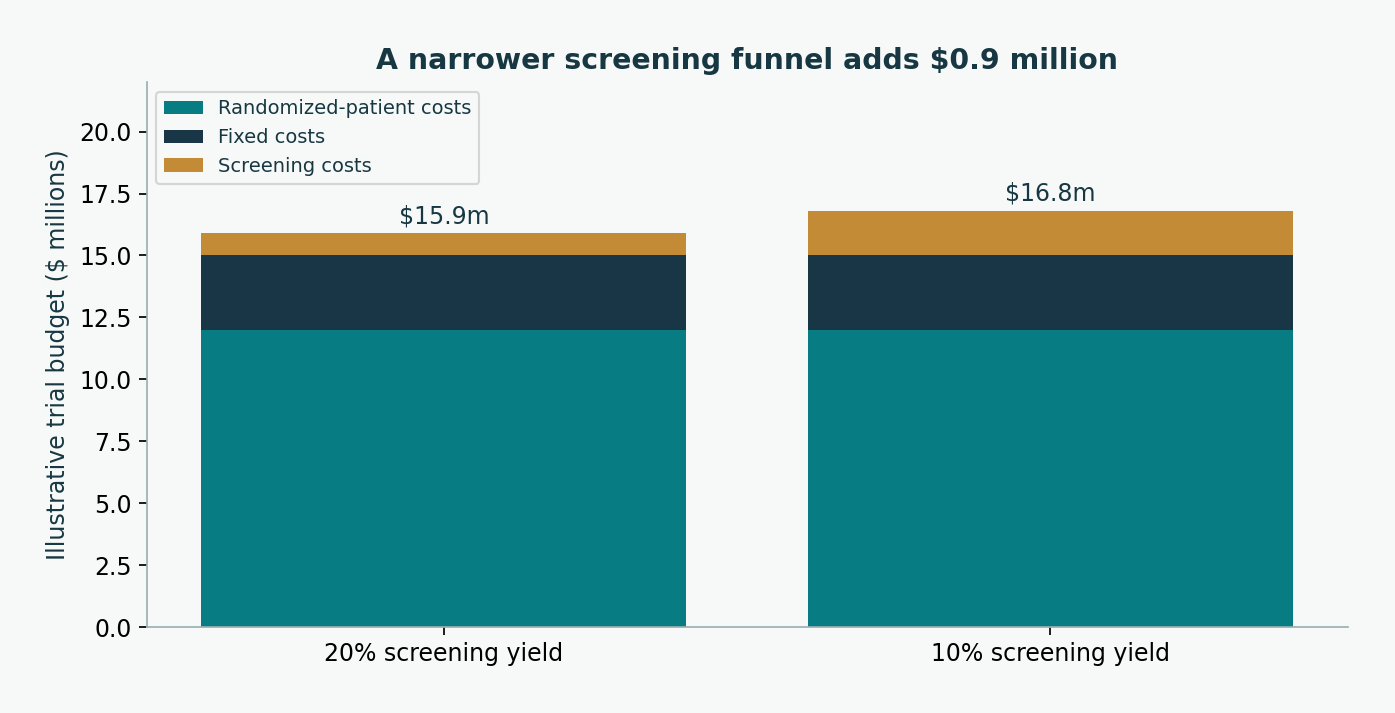
The $0.9 million difference captures screening expense alone. It does not capture the effect of a slower calendar on staffing, sites or financing. For example, an additional $150,000 of genuinely incremental monthly expense over six months would add another $0.9 million. That separate sensitivity should be included only if those costs are not already embedded in the fixed or per-patient assumptions.
Screening yield also needs a precise definition. Biomarker prevalence, consent rate, clinical eligibility and operational randomization are separate transitions. A biomarker prevalence estimate is not automatically the fraction of all screened patients who enroll. Tracking each loss point helps a team choose among more sites, faster testing, revised logistics or a different feasibility assumption.
Transactions provide context, not a universal valuation multiplier
Pfizer completed its Seagen acquisition in December 2023 for $229 per share in cash, approximately $43 billion in enterprise value. This was a company-and-portfolio transaction, not the cost or valuation of one trial. [O3]
For an emerging sponsor, the relevant comparison is the evidence and rights available at the proposed partnering milestone. Development stage, geographic rights, manufacturing capabilities, existing revenue and portfolio breadth must be separated before a transaction becomes a useful comparable. A large acquisition can show strategic interest without establishing what a Phase 2 asset should command.
Operating KPIs by development context
| Context | Clinical evidence question | Execution KPI |
|---|---|---|
| Lung cancer | Is the effect established in the exact stage and biomarker setting? | Assay turnaround; eligible / screened; time from prior therapy |
| Breast cancer | Is the endpoint mature enough for the proposed claim? | Events accrued / planned; adherence and discontinuation by reason |
| Prostate cancer | Does the modality fit patient and care-site constraints? | Dose availability; treatment-ready sites; scheduled doses delivered |
| Colorectal cancer | Does selection enrich for benefit without undermining feasibility? | Biomarker-positive / tested; randomized / screened; screen cost |
| Multiple myeloma | Can durable benefit be delivered with manageable treatment burden? | Manufacturing turnaround where relevant; treatment delays; safety-related utilization |
These proposed measures should be reviewed together rather than in functional silos. Clinical, regulatory, CMC, access and finance leaders should share a single milestone definition and scenario model. The next value inflection is strongest when the team can explain the result, the population, the remaining uncertainty, the money needed and the decision that follows.
THE NEXT VALUE INFLECTION
What would change the decision
These proposed measures should be reviewed together rather than in functional silos. Clinical, regulatory, CMC, access and finance leaders should share a single milestone definition and scenario model. The next value inflection is strongest when the team can explain the result, the population, the remaining uncertainty, the money needed and the decision that follows.
Editorial record
Prepared by Clarus Biotech Review editorial team. Updated 10/1/2026.
Publication relationship: ClarusReview is connected to BioClarus Consulting. No article-specific sponsorship is recorded.
Report a correctionDiscuss this paper
Share evidence, ask a question, or offer a professional perspective. Community guidelines
Loading discussion…