A price cut needs a volume hurdle and an access diagnosis
Repatha’s historical reset and recent growth provide context for a fictional launch team’s break-even calculation.
ClarusBIOTECH REVIEWRead, listen & keep
Narrated by Hermione. Save the audio for offline listening.
View figure data and context
| Measure | Value |
|---|---|
| Baseline | 80 |
| No volume growth | 56 |
| 20% volume growth | 67.2 |
| 50% volume growth | 84 |
The consulting assignment
A lower price can reduce an access barrier, but it can also lower revenue on patients who would already have received treatment. The decision should begin with the barrier being addressed and a credible estimate of incremental use. Without those steps, the launch team can mistake a visible pricing action for an effective adoption strategy.
The documented comparator
In October 2018 Amgen announced a 60% U.S. Repatha list-price reduction to $5,850 annually. The historical list-price change is not a disclosure of net-price change after rebates and contracts. It should therefore not be inserted unchanged into a manufacturer net-revenue forecast. [1]
The current-news bridge
Amgen reported Q2 2026 Repatha sales of $953 million, up 37% year over year. The long interval and intervening changes prevent attributing that quarter’s growth solely to the 2018 price reset. [2]
Hypothetical client and numerical assumptions
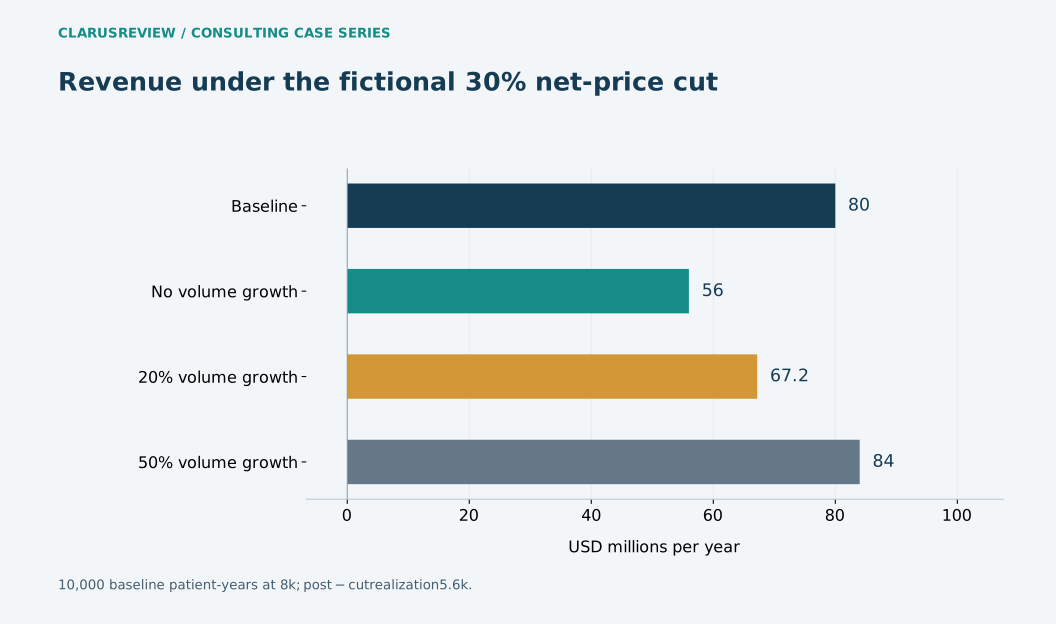
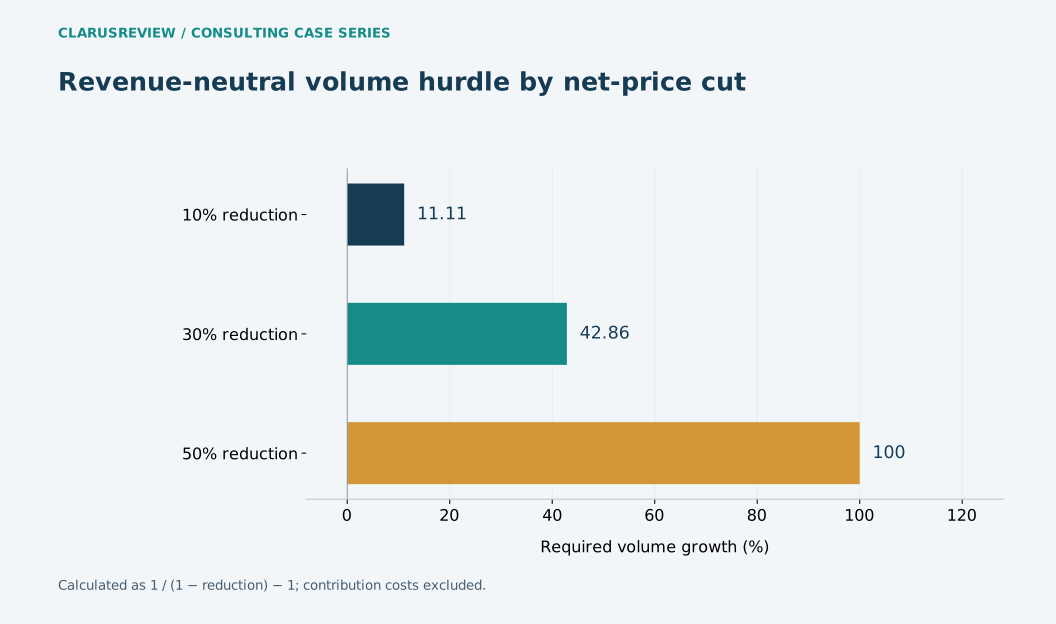
Assume a fictional therapy has 10,000 treated patient-years at $8,000 net revenue each: $80 million annually. A proposed 30% net-price reduction lowers realization to $5,600. Revenue neutrality requires 80m ÷ 5,600 = about 14,286 patient-years, or 42.9% more volume. The assumed net-price cut is not Repatha’s disclosed list-price cut.
What the numbers change
At unchanged volume, revenue is $56 million. With 20% volume growth, it is $67.2 million; with 50% growth, $84 million. These outcomes describe revenue, not profit. If distribution, patient support or manufacturing costs rise with volume, contribution neutrality may require a different hurdle.
Access diligence should distinguish prior authorization, out-of-pocket burden, clinical eligibility, prescriber workflow and dispensing abandonment. A price change helps only where it changes the relevant constraint. If the main barrier is an incomplete authorization process, lowering realization across the whole cohort could be an expensive substitute for a targeted service improvement.
Commercial evidence should compare completed appropriate treatment before and after intervention with a defensible counterfactual. Track the contract-level net price, not simply the public list price. The economics of new patients must be considered alongside revenue lost on existing patients and any changes to payer mix.
| Scenario | Required volume growth (%) |
|---|---|
| 10% reduction | 11.11 |
| 30% reduction | 42.86 |
| 50% reduction | 100 |
The next decision gate
Test the proposal in a bounded segment with finance, access and field leadership sharing one measurement plan. Set the required incremental patient-years before the test and evaluate contribution as well as revenue. Do not scale on prescription interest if paid dispensing and persistence have not changed.
What to watch next
Future growth could come from evidence, indications, access, supply or pricing together. Keep those mechanisms separate in the forecast instead of making a single historical price event explain every later result.
| Workstream | Measure to collect | Decision use |
|---|---|---|
| Access | Paid starts / approved prescriptions | Determine where treatment is lost |
| Realization | Net revenue / patient-year by contract | Avoid list-price assumptions |
| Decision | Incremental contribution after price and service changes | Choose a financially coherent intervention |
Reporting cutoff: October 1, 2026 Pacific. Later outcomes are not assumed. These tools illustrate decisions; they are not validated clinical, legal or investment prediction models.
Price-cut volume hurdle
Revenue neutrality only; manufacturing and service costs are excluded.
Neutral volume = baseline volume / (1 − net-price reduction / 100).
Changing an input explores a scenario; it does not establish an observed result. Inputs stay in this page and are not submitted.
THE NEXT VALUE INFLECTION
What would change the decision
Test the proposal in a bounded segment with finance, access and field leadership sharing one measurement plan. Set the required incremental patient-years before the test and evaluate contribution as well as revenue. Do not scale on prescription interest if paid dispensing and persistence have not changed.
Editorial record
Prepared by Clarus Biotech Review editorial team. Updated 10/2/2026.
Publication relationship: ClarusReview is connected to BioClarus Consulting. No article-specific sponsorship is recorded.
Report a correctionDiscuss this paper
Share evidence, ask a question, or offer a professional perspective. Community guidelines
Loading discussion…