A valuable cure can still create a treatment queue
Sovaldi and current Medicare pricing implementation frame an indication-specific budget-impact assignment.
ClarusBIOTECH REVIEWRead, listen & keep
Narrated by Hermione. Save the audio for offline listening.
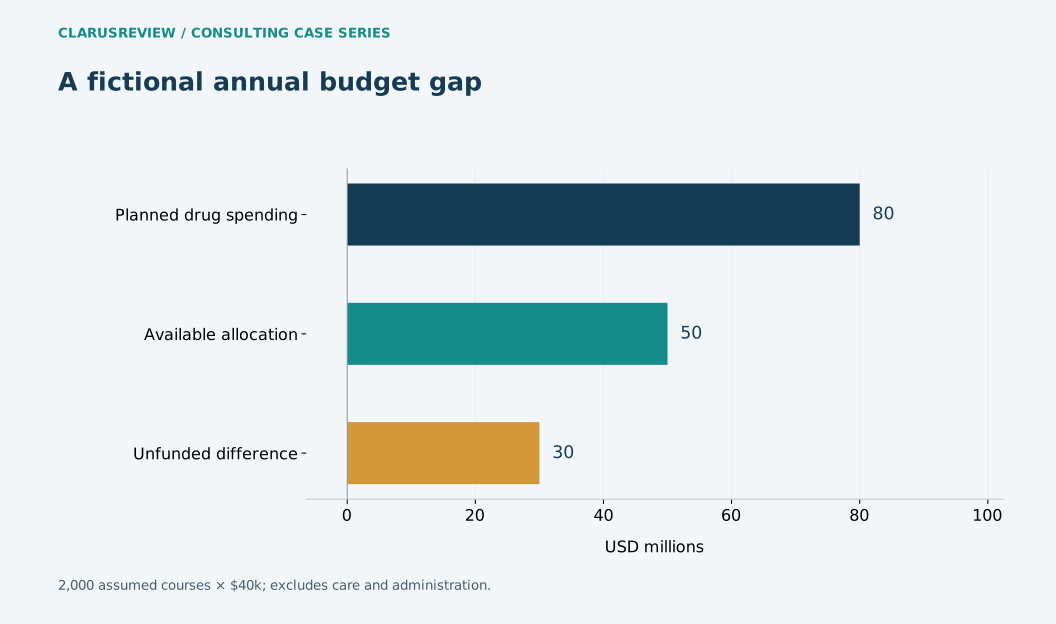
View figure data and context
| Measure | Value |
|---|---|
| Planned drug spending | 80 |
| Available allocation | 50 |
| Unfunded difference | 30 |
The consulting assignment
Clinical value and annual affordability answer different questions. A treatment that changes a patient’s long-term outlook may require spending now while offsets occur later or benefit a different payer. A consulting case should make that timing visible, estimate who can be treated under a defined budget and show the consequences of a queue without pretending the budget establishes clinical priority.
The documented comparator
The Senate Finance Committee’s 2015 Sovaldi investigation described an $84,000 standard treatment course and examined access consequences. That historical course price is not a current confidential net price, a full episode cost or a universal benchmark for curative therapies. [1]
The current-news bridge
CMS’s June 2026 proposed-rule announcement noted that negotiated prices for the first ten selected drugs took effect January 1, 2026. Actual implementation and future proposed policies should be separated in a manufacturer’s planning model. [2]
Hypothetical client and numerical assumptions
Assume a fictional payer has 10,000 eligible patients, plans 20% treatment uptake during one year and pays an invented $40,000 net drug cost per course. Drug-only spending is $80 million for 2,000 courses. A $50 million allocation covers 1,250 courses at that price, leaving 750 of the modeled planned starts unfunded before care costs.
What the numbers change
At net course costs of $30,000, $40,000 and $50,000, the $50 million allocation supports approximately 1,667, 1,250 and 1,000 courses. These are arithmetic capacity estimates; they do not authorize rationing or describe an actual payer policy. Clinical urgency, eligibility and care costs need separate assessment.
If a hypothetical budget model assumes $6,000 in annual avoided downstream expense per treated patient for five years, undiscounted offsets are $30,000 per patient. That is not equivalent to cash saved in the treatment year, and it depends on continuity, timing and whether the payer actually bears the avoided costs. Use discounted, time-specific cash flows for economic evaluation and preserve uncertainty rather than reporting a fictional net saving as established evidence.
An outcomes agreement can alter who carries performance risk without eliminating the initial capacity constraint. Payment timing, rebate triggers and follow-up administration all matter. A payer brief should show the disease-specific eligible cohort, uptake, gross payments, expected adjustments and the care episode separately.
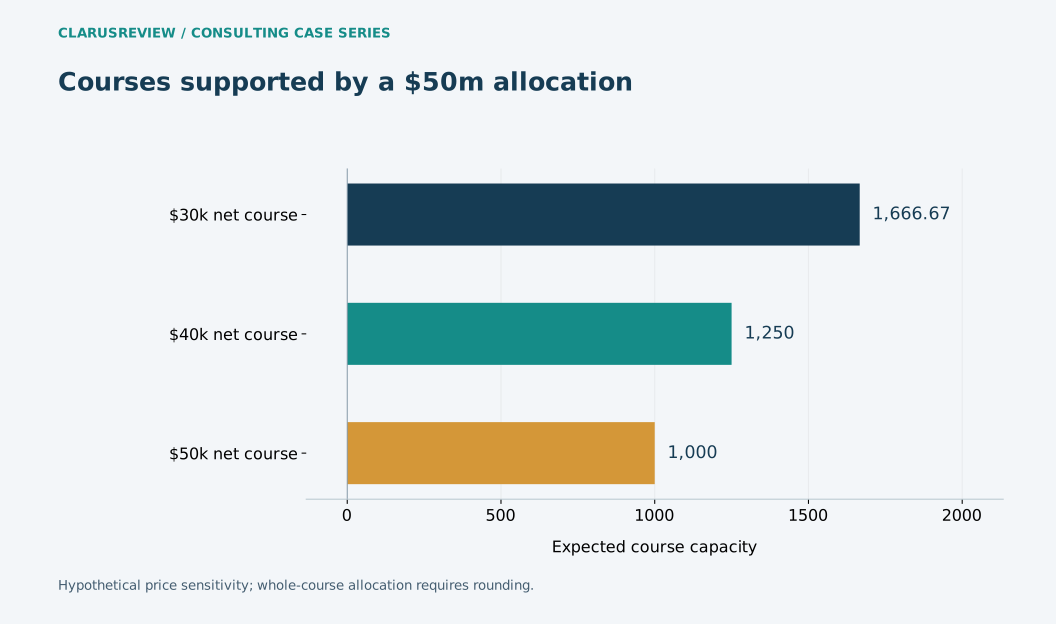
| Scenario | Expected course capacity |
|---|---|
| $30k net course | 1666.67 |
| $40k net course | 1250 |
| $50k net course | 1000 |
The next decision gate
Present a one-year budget case beside a longer-horizon value case. Reconcile their populations and perspectives; do not use future societal benefit to erase current payer cash requirements. A useful negotiation deliverable offers transparent price/volume sensitivities and a clinically governed implementation plan with an explicit follow-up budget.
What to watch next
Watch realized net cost, completed treatment and payment reconciliation as policy implementation evolves. A proposed rule is not a final rule, and no future negotiated price is assumed for the fictional medicine.
| Workstream | Measure to collect | Decision use |
|---|---|---|
| Affordability | Year-specific drug and care expenditure | Separate immediate cash need from future offsets |
| Implementation | Eligible, planned and completed treatment | Describe the queue without making clinical prioritization claims |
| Contracting | Net payments after reconciled adjustments | Distinguish promised rebates from received amounts |
Reporting cutoff: October 1, 2026 Pacific. Later outcomes are not assumed. These tools illustrate decisions; they are not validated clinical, legal or investment prediction models.
Treatment-budget capacity
Drug-only arithmetic using fictional prices; not a cost-effectiveness or clinical-priority model.
Capacity = budget / net course cost. Budget gap = planned starts × cost − budget.
Changing an input explores a scenario; it does not establish an observed result. Inputs stay in this page and are not submitted.
THE NEXT VALUE INFLECTION
What would change the decision
Present a one-year budget case beside a longer-horizon value case. Reconcile their populations and perspectives; do not use future societal benefit to erase current payer cash requirements. A useful negotiation deliverable offers transparent price/volume sensitivities and a clinically governed implementation plan with an explicit follow-up budget.
Editorial record
Prepared by Clarus Biotech Review editorial team. Updated 10/2/2026.
Publication relationship: ClarusReview is connected to BioClarus Consulting. No article-specific sponsorship is recorded.
Report a correctionDiscuss this paper
Share evidence, ask a question, or offer a professional perspective. Community guidelines
Loading discussion…