Antibody–drug conjugates: delivery performance includes the safety burden
A randomized breast-cancer trial shows why efficacy and adverse-event context belong in the same product discussion.
ClarusBIOTECH REVIEWRead, listen & keep
Narrated by Hermione. Save the audio for offline listening.
View figure data and uncertainty
| Measure | Reported value | 95% confidence interval |
|---|---|---|
| Trastuzumab deruxtecan | 75.8 | 69.8–80.7 |
| Trastuzumab emtansine | 34.1 | 27.7–40.5 |
Executive perspective
A targeted delivery concept becomes a medicine only when its whole product profile is understood. For antibody–drug conjugates, a strong efficacy result can be highly consequential while still requiring close attention to safety, clinical monitoring, and the conditions of use. Those dimensions should be developed and communicated together.
This white paper uses the first published DESTINY-Breast03 analysis as a bounded case study. Its purpose is to build a development framework around a benefit–risk evidence package, not to recommend a therapy or rank current oncology products. A historical result can support a durable lesson without being presented as the latest clinical guidance.
Published evidence and scope
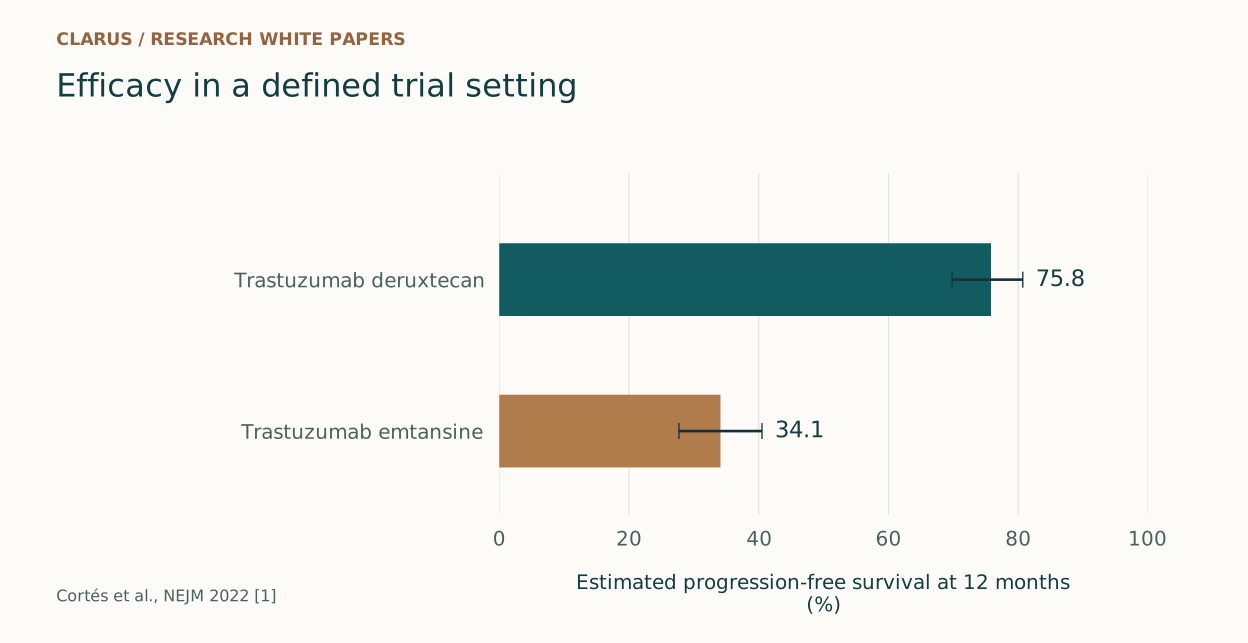
In the 2022 report, 524 patients with HER2-positive metastatic breast cancer previously treated with trastuzumab and a taxane were randomized. Estimated 12-month progression-free survival was 75.8% (95% CI 69.8–80.7) with trastuzumab deruxtecan and 34.1% (27.7–40.5) with trastuzumab emtansine. Adjudicated drug-related interstitial lung disease or pneumonitis occurred in 10.5% versus 1.9%. [1]
The progression-free-survival comparison is not an overall-survival percentage or a cure rate. Later trial reporting provides additional follow-up, reinforcing that a clinical evidence package changes over time. The figure here deliberately retains the initial publication’s endpoint and time point. [2]
Clarus analysis: define the complete delivery proposition
A development team should describe the intended distribution and action of a delivery system alongside the exposures it seeks to avoid. The relevant question is whether the final product produces a usable therapeutic window in the chosen disease setting. Selectivity in a laboratory model is one contribution to that argument, rather than a complete demonstration of it.
The evidence plan should therefore contain parallel tracks. One track tests whether the product achieves the intended effect against an appropriate comparator. The other characterizes the adverse effects that could change the practical benefit–risk balance. The tracks meet in decisions about the intended population, treatment setting, monitoring requirements, and the next study—not merely in a combined score.
Communication should preserve that structure. An efficacy chart is easier to interpret when the reader can also find the material safety context and the analysis cutoff. If a deck presents only a favorable efficacy endpoint, it can understate the evidence needed for clinical use and the resources needed to support that use. Confidence in the program should come from a complete explanation, not selective visual emphasis.
A practical product-profile review
Use a structured review in which clinical, safety, analytical, and manufacturing teams each state the most important unresolved product question. Ask how a change in linker, payload, process, or formulation would affect the evidence supporting the profile. Record which conclusions are direct observations and which depend on a comparability argument.
The next milestone should be specific enough to change a decision. Examples include resolving a clinically important safety uncertainty, confirming an outcome in the intended population, or demonstrating that a process change preserves relevant product attributes. A milestone described only as advancing the platform leaves the essential decision undefined.
Limits and next evidence
These findings apply to the trial’s disease setting and comparator. They cannot be transferred to every ADC or target. The paper does not summarize all subsequent analyses or current labels. Development and clinical decisions need the complete, current efficacy and safety record for the specific product and indication.
From reading to a reviewable decision
| Dimension | Evidence to inspect | Next decision check |
|---|---|---|
| Efficacy | Outcome in the intended population | Preserve comparator and cutoff |
| Safety | Material adverse effects and uncertainty | Integrate monitoring implications |
| Product changes | Attributes affected by development changes | Reassess the supporting evidence chain |
Clarus editorial synthesis. This framework is not a validated predictive model.
THE NEXT VALUE INFLECTION
What would change the decision
These findings apply to the trial’s disease setting and comparator. They cannot be transferred to every ADC or target. The paper does not summarize all subsequent analyses or current labels. Development and clinical decisions need the complete, current efficacy and safety record for the specific product and indication.
Editorial record
Prepared by Clarus Biotech Review editorial team. Updated 9/30/2026.
Publication relationship: ClarusReview is connected to BioClarus Consulting. No article-specific sponsorship is recorded.
Report a correctionDiscuss this paper
Share evidence, ask a question, or offer a professional perspective. Community guidelines
Loading discussion…