Biotech partnering: qualify the decision before building the contact list
Turn a leadership directory into a dated, evidence-based partnering process with measurable progression.
ClarusBIOTECH REVIEWRead, listen & keep
Narrated by Hermione. Save the audio for offline listening.

The source business-development whitepaper assembles public professional contact routes for AI-enabled and emerging biopharma companies. A useful directory is only the beginning of a partnering process. The more consequential work is to identify the organizational decision, verify the asset or technology fit and prepare evidence that permits the right team to evaluate the opportunity.
This public adaptation avoids republishing a long list of leadership names as if a May 2026 snapshot were permanently current. It instead develops a qualification framework. Contact information, roles, company priorities and pipeline status should be rechecked at the point of use through official company routes. A directory entry is a research lead, not a claim that the person will consider a proposal.
A current agreement shows what the partner is buying
Iambic’s February 9, 2026 Takeda announcement described a multi-year technology and discovery collaboration in oncology and gastrointestinal/inflammation programs. It combined access to AI technology with discovery work. The release disclosed upfront, research-cost and technology-access payments, plus eligibility for success-based payments that could exceed $1.7 billion and royalties. It did not disclose an upfront dollar amount. [1]
The distinction matters: a headline contingent amount is not an immediate payment. For a potential partner, the interesting question is which rights, work and evidence are being purchased. For an emerging company, it is how retained rights, obligations, governance and future payments affect the operating plan. A broad AI label is insufficient to describe those economics.
Match the evidence package to the business model
For an asset developer, qualification should cover indication, mechanism, stage, target product profile, clinical design, manufacturing status and rights availability. For a tool company, it should cover the workflow, validation population, integration requirements, security, adoption and measurable economics. For a hybrid, both packages may be needed, but they should remain explicit.
The first external brief should let the recipient decide whether the opportunity fits the organization’s remit. A short factual summary is more useful than an undifferentiated capabilities deck: what is offered, what evidence exists, what remains uncertain, which rights or services are available and what decision is sought. Claims about speed or success should carry a comparator and an observation period.
Track progress with stage definitions
An illustrative 12-month funnel begins with 30 qualified organizations. Twelve undertake technical review, five enter diligence and one signs. That represents 40% progression into technical review, 41.7% from technical review into diligence and 20% from diligence to signing; overall signing conversion is 3.3%. These are hypothetical counts, not observed BioClarus or industry performance.
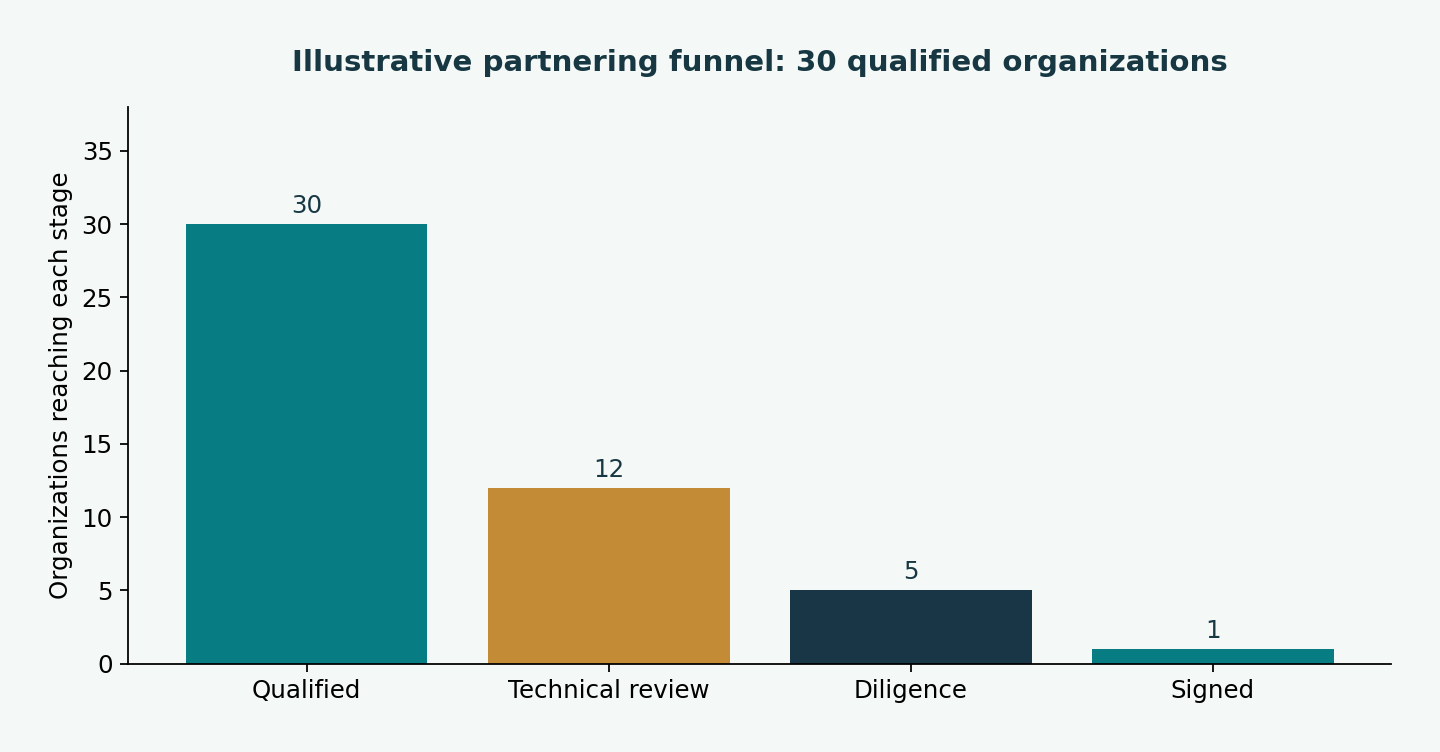
A dashboard should record the stage-entry date, next action, responsible owner and reason for loss. A non-response, lack of fit, insufficient data and unacceptable economics are different outcomes. Combining them as “no deal” loses information that could improve the evidence package or targeting strategy.
If this illustrative process costs $120,000 in external diligence preparation and $180,000 in internal allocated effort, total modeled cost is $300,000. With one signing, that is $300,000 per signed transaction in the scenario. It is not a fee quote or an expected acquisition cost; internal allocated effort may not be incremental cash. A signed transaction also has to be assessed for retained economics and execution obligations before being counted as value created.
Verify public routes without guessing personal information
Use official company partnering pages, published professional contact routes and current leadership pages. Record the date checked and the reason a role is relevant. Do not infer a personal email from a naming convention or use a media address as if it were necessarily the correct scientific partnering route. The source paper’s public-route approach is preserved, with verification treated as a live task rather than a one-time spreadsheet property.
A CRM record should separate organization qualification from individual identity. If a leader changes roles, the organizational hypothesis may remain valid while the contact needs updating. Similarly, a new asset license or collaboration may change fit even when the same person remains in position.
Review the learning, not just the activity
Monthly review should compare progression and elapsed time by opportunity type. Are tool proposals stalling at integration review? Are asset proposals losing credibility because the clinical claim is broader than the dataset? Are discussions progressing but economics consistently failing? These patterns point to specific corrections.
A strong partnering process converts research into a decision sequence: qualify, prepare, route, evaluate, negotiate and implement. The directory supports that sequence, while evidence quality and strategic fit determine whether it can advance.
| Decision area | Measure or question | Why it matters |
|---|---|---|
| Qualification | Verified fit and available rights; last-checked date | Prevents stale targeting |
| Technical review | Entered review / qualified organizations; median elapsed days | Distinguishes activity from progress |
| Diligence | Open evidence requests; complete / required documents | Makes readiness measurable |
| Economics | Upfront cash, contingent payments and retained rights separately | Avoids misleading transaction totals |
| Learning | Loss reasons by stage and opportunity type | Improves the next decision package |
THE NEXT VALUE INFLECTION
What would change the decision
A strong partnering process converts research into a decision sequence: qualify, prepare, route, evaluate, negotiate and implement. The directory supports that sequence, while evidence quality and strategic fit determine whether it can advance.
Editorial record
Prepared by Clarus Biotech Review editorial team. Updated 10/1/2026.
Publication relationship: ClarusReview is connected to BioClarus Consulting. No article-specific sponsorship is recorded.
Report a correctionDiscuss this paper
Share evidence, ask a question, or offer a professional perspective. Community guidelines
Loading discussion…